
Pakistan have reached the final of the home ODI tri-series against England and Sri Lanka, winning three of their four matches. England, beaten in all three of theirs, are out.
Yet the route to the final has raised as many questions as it has answered, with a one-wicket escape against England followed by an eight-wicket defeat to Sri Lanka in Lahore.
With the 2027 World Cup in South Africa, Zimbabwe and Namibia now a year away, two problems stand out: a top three that is not setting up innings, and a wicketkeeper-batter at No. 4 who has yet to make the role his own since Mohammad Rizwan dropped from the ODI side.
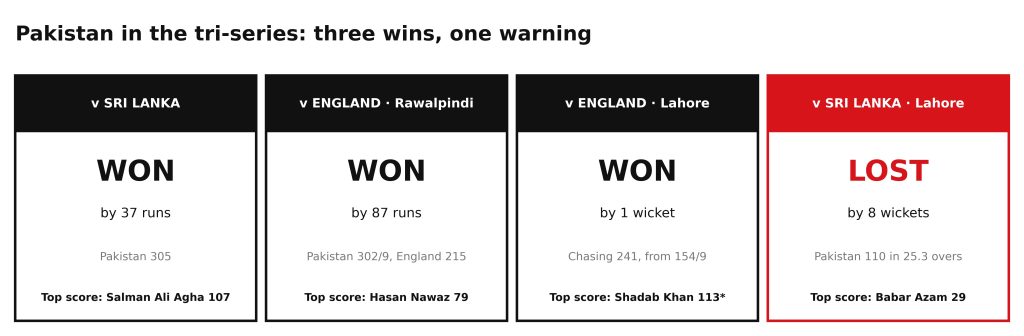
Pakistan’s four league matches in the tri-series.
Rescued, Then Exposed
The first two wins came in spite of the top order rather than because of it. Against Sri Lanka, Fakhar Zaman made 16, Saim Ayub 7 and Babar Azam 45 before Salman Ali Agha’s 107 off 90 balls lifted Pakistan to 305 and a 37-run win. Against England in Rawalpindi, the top three managed 42 between them, with Fakhar out on the first ball. Hasan Nawaz (79 off 74), Arafat Minhas (59 off 58) and Faheem Ashraf (39 off 26) took the total to 302 for 9, and Minhas then took 6 for 40 to bowl England out for 215.
The third win was the most dramatic. Chasing 241 against England in Lahore, Pakistan were 154 for 9 when Haris Rauf joined Shadab Khan. Shadab finished unbeaten on 113 from 96 balls, and the pair added an unbroken 89 to win by one wicket. It was a remarkable escape, but hardly evidence of a sound batting structure.
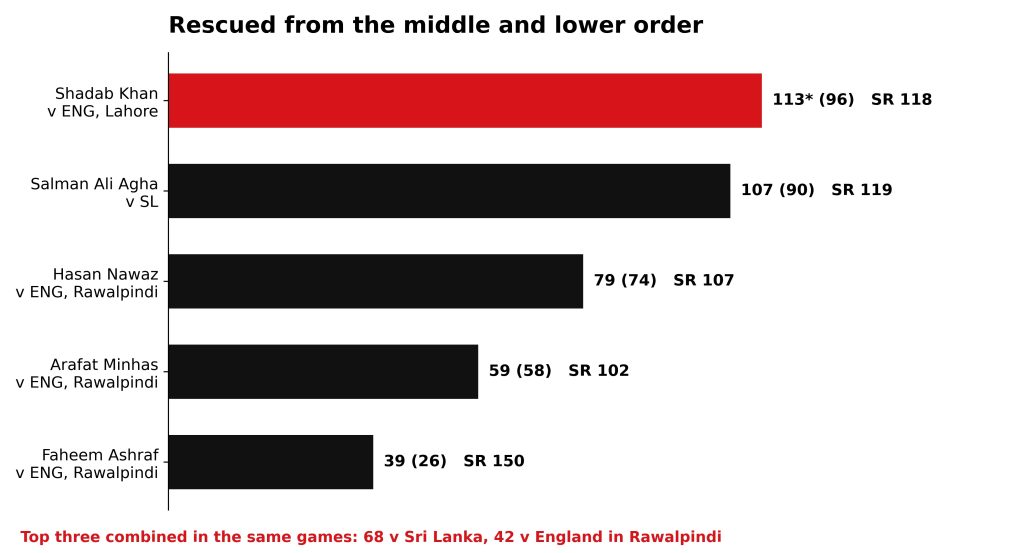
Pakistan’s biggest innings came from No. 4 and below.
Pakistan somehow managed to win in the first three matches, but the fourth match gave the warning. Pakistan were bowled out for 110 in 25.3 overs, with Babar’s 29 the top score, as Dilshan Madushanka took 5 for 34. Sri Lanka needed only 18.1 overs to win by eight wickets, days after chasing down 430 against England through Pavan Rathnayake’s 130 and Dasun Shanaka’s 97 off 50. Individual brilliance has carried Pakistan into the final. It cannot be relied on to do so every time.
A Top Three Without a Template
Before the 2023 World Cup, Pakistan’s top order had a clear shape: Fakhar’s aggression and Imam-ul-Haq’s accumulation at the top, with Babar steadying the innings at No. 3. That structure has since dissolved. Imam was dropped in 2023, Abdullah Shafique had his chances, and Saim emerged as an attacking alternative, scoring three ODI centuries in 2024.
An injury interrupted Saim’s rise, and since returning in August 2025, he has made 257 runs in 11 innings at 23.36. His three tri-series innings brought 21 runs, and he has now been released at his own request to work on his batting in domestic cricket, with Sahibzada Farhan called up in his place.
Fakhar’s numbers are similar: 265 runs in his last 11 ODIs at 24.09. Scores of 78 and 55 against Sri Lanka in late 2025, after recovering from the injury he suffered at the Champions Trophy, suggested a revival that has not held.
Babar’s figures look healthier, with 638 runs in 19 innings at 35.44 since the Champions Trophy, but his conversion rate has collapsed: one century since 2023, compared with 19 between 2015 and 2023.
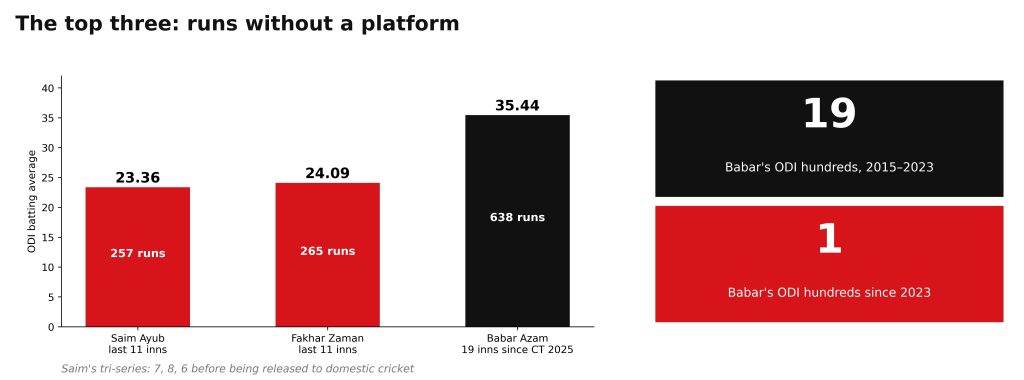
Two openers averaging in the low 20s, and a No. 3 who has stopped converting.
The problem is not only the volume of runs but the role they play. When early wickets fall, the No. 4 must rebuild; when the top order survives, that batter must accelerate without wasting the platform. Pakistan cannot go into a World Cup expecting the middle order to do both jobs.
Who Keeps Wicket & Bats at No. 4?
Rizwan’s place was built on consistency and adaptability. He became central across formats after Sarfaraz Ahmed lost his place, and replacing him in ODIs, where the keeper has also batted at No. 4, has proved harder than removing him.
Muhammad Ghazi Ghori and Saad Baig have both been tried. Ghori’s three innings have brought 110 runs at 36.66, an encouraging start that merits a fair run. Saad has 111 runs in four tri-series innings at 27.75, with a strike rate of 89.51.
His 39 off 40 against Sri Lanka, and 35 off 54 and 32 off 22 against England, showed he can shift tempo; his 5 in Lahore showed the inconsistency that remains. Four innings are not enough to judge either player.
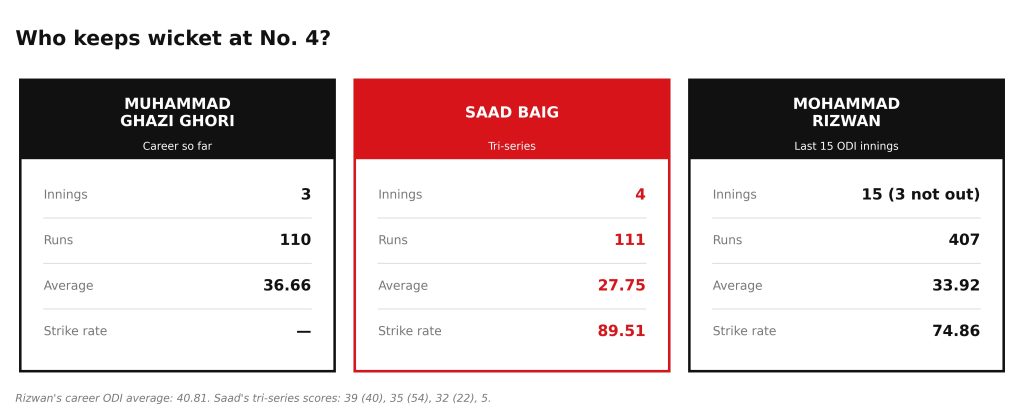
Three candidates, and no one has yet made the role his own.
Rizwan’s own recent record offers a point of comparison: 407 runs in his last 15 innings at 33.92, with a strike rate of 74.86, below his career average of 40.81. Those numbers raise fair questions about tempo, but not about experience. Should he return, batting him at No. 5, with Shadab at six or seven, would add depth, provided the combination scores quickly enough at the end.
His situation with the National Cyber Crime Investigation Agency, where no charges or findings have been announced, is a separate matter from selection.
Whatever the choice, what matters is defining the role and backing the player in it. Rotating the incumbent without doing so is unlikely to produce an answer.
Balance in the Bowling
The bowling attack has offered more encouragement. Shaheen Shah Afridi lacks some of his former pace but has adapted, keeping the runs down and taking four wickets against England in Lahore. Haris Rauf has been effective through the middle and later overs, while Naseem Shah is still searching for consistency at his best level. Pakistan need that consistency if he is to become a dependable part of the attack.
The allrounders have given the side flexibility. Minhas’s six-wicket haul and half-century in the same match made a strong case for a regular place, and Faheem has contributed with bat and ball. Shadab’s century masked a quieter tournament with the ball, and if he is picked mainly as an allrounder, his bowling role needs to be clear.
That raises a wider question: is the reliance on allrounders coming at the expense of specialist spinners such as Abrar Ahmed and Sufiyan Muqeem? A frontline spinner offers control in the middle overs and a different route to wickets on surfaces where pace alone is not enough, something several part-time or all-round options cannot guarantee.
None of this requires the selectors to settle every position now. It does require them to define clear roles and give players enough matches to show they can fill them. A year out from the World Cup, the task is to turn individual match-winning performances into a structure that holds up match after match.