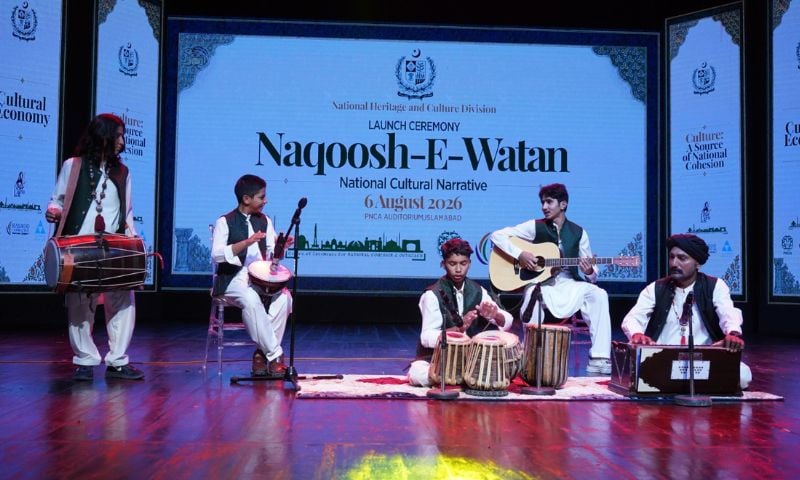
ISLAMABAD: Pakistan has launched “Naqoosh-e-Watan”, the nation’s first-ever National Cultural Narrative, in a move to preserve the country’s rich cultural heritage and foster national unity.
The initiative was launched by Federal Minister for National Heritage and Culture, Aurangzeb Khan Khichi, at a ceremony hosted by Lok Virsa and the Centre for National Cohesion and Outreach at the Pakistan National Council of the Arts (PNCA) in Islamabad. The event marked a historic moment in the country’s cultural history.
Naqoosh-e-Watan (The Imprints of the Homeland) is designed as a comprehensive framework to present Pakistan’s genuine cultural identity to the world with confidence and authenticity, while also reinforcing national unity and cohesion at home.
The inauguration ceremony drew a distinguished gathering, including Governor Sindh Syed Nehal Hashmi, Minister of State for Federal Education and Professional Training Ms. Wajiha Qamar, Chairman Higher Education Commission Dr. Niaz Ahmed, Secretary National Heritage and Culture Division Asad Rehman Gilani, along with ambassadors, federal secretaries, senior government officials, academicians, cultural experts, artists, and representatives from various institutions.
A civilisation spanning millennia
Addressing the gathering, it was emphasised that Pakistan is the custodian of a civilisation that stretches back thousands of years, encompassing the ancient Mehrgarh, the Indus Valley Civilisation, Gandhara, the Islamic era, Sufi traditions, folk heritage, and the diverse cultural traditions of all regions of the country. Pakistan’s cultural diversity is its greatest strength, with every language, tradition, art form, song, and community forming an integral part of the nation’s collective identity.
The Centre of Excellence for National Cohesion, its leadership, and the National Heritage and Culture Division were praised for developing Naqsh-e-Watan in close consultation with provincial governments and other key stakeholders. The initiative provides a national framework that will enable Pakistan to present its cultural narrative to the world with authenticity and pride.
Achievements and institutional reforms
Highlighting recent accomplishments, it was revealed that since March 2025, the National Heritage and Culture Division and its affiliated organisations have completed an impressive 655 activities. Notable achievements include:
- Nearly 300,000 people participated in Lok Mela 2025
- Over 270,000 readers benefited from the National Library of Pakistan
- The Pakistan Academy of Letters organised 434 literary activities
- A remarkable 1,252 cultural artefacts were successfully repatriated to Pakistan
Significant institutional reforms have been introduced over the past year, including strengthened artists’ welfare initiatives, new cultural and literary projects, enhanced cultural diplomacy, and the signing of twelve international cultural agreements and exchange programmes.
Culture as a driver of development
It was emphasised that Naqsh-e-Watan is not merely a cultural initiative but a comprehensive national development vision, with culture playing a vital role in generating employment, promoting tourism, increasing exports, strengthening rural economies, empowering women economically, and preserving traditional crafts.
A call was extended to universities, government institutions, media, the private sector, development partners, overseas Pakistanis, youth, and citizens to collectively promote the National Cultural Narrative across educational institutions, museums, cultural festivals, public spaces, and digital platforms.
Provincial unity and shared identity
Governor Sindh Syed Nehal Hashmi underscored that Sindh is home to one of the world’s oldest civilisations and a rich legacy of culture and Sufi traditions.
He described the province as a symbol of tolerance, hospitality, and interfaith harmony, adding that the message of Shah Abdul Latif Bhittai continues to inspire peace, justice, and humanity. He noted that Ajrak, the Sindhi cap, and traditional handicrafts represent Sindh’s cultural identity and contribute significantly to livelihoods.
He further emphasised that Karachi reflects Pakistan’s diversity, while all provincial cultures collectively form the country’s shared national identity and strength.
Read Also: Pakistan Launches Conservation Plan to Protect 3,000-Year-Old Taxila Heritage
Education and research at the core
Minister of State for Federal Education and Professional Training Wajiha Qamar stressed the need to encourage serious research on Pakistan’s cultural traditions and indigenous knowledge in universities.
She emphasised that national cultural heritage should become an integral part of the education curriculum. Describing Naqoosh-e-Watan as a living national asset, she called for its continuous evolution through research, participation, and improvement, adding that the true measure of success lies not in the number of events organised but in raising a generation that understands and values its own civilisation, culture, and identity.
Chairman Higher Education Commission Dr. Niaz Ahmed remarked that Pakistan’s culture and national identity are the foundations of the country’s progress and dignity. Drawing from his recent visit to China, he observed that China’s remarkable development is deeply rooted in its commitment to its culture, people, and national identity.
He described Naqoosh-e-Watan as a timely and significant national initiative and emphasised that promoting Pakistan’s diverse cultural heritage is a shared national responsibility.
The ceremony concluded with patriotic songs, musical performances, and vibrant cultural presentations showcasing the country’s rich artistic traditions, which were warmly appreciated by the audience.