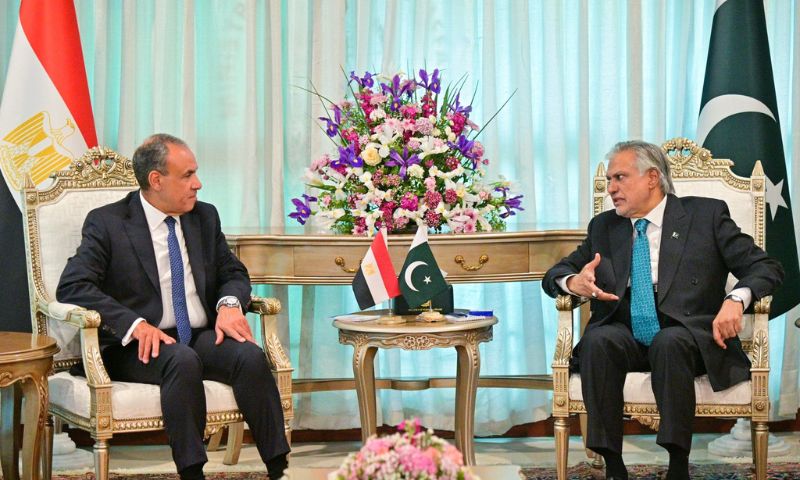
ISLAMABAD: Pakistan’s Deputy Prime Minister and Foreign Minister Ishaq Dar on Saturday held a telephone conversation with Egypt’s Foreign Minister Badr Abdelatty and discussed regional developments and ongoing diplomatic efforts to de-escalate the ongoing conflict involving the United States, Israel and Iran.
During the telephonic conversation, both leaders emphasised the importance of dialogue and de-escalation, noting that continued diplomatic engagement was essential for regional stability.
Both sides also agreed to remain in close contact, Pakistan’s Ministry of Foreign Affairs stated.
Deputy Prime Minister / Foreign Minister Senator Mohammad Ishaq Dar @MIshaqDar50 held a telephone conversation today with the Foreign Minister of Egypt, Badr Abdelatty.
They discussed the latest regional developments and ongoing diplomatic efforts, underscoring the importance of… pic.twitter.com/mPE8KxE6XW
— Ministry of Foreign Affairs – Pakistan (@ForeignOfficePk) April 4, 2026
The war between the United States, Israel, and Iran that began on February 28 has plunged the Middle East into deep turmoil.
Iran has been carrying out attacks on Israeli and Gulf countries.
Pakistan’s diplomatic outreach
Pakistan has intensified its diplomatic efforts to bring an end to the US-Israel war involving Iran.
Last week, Islamabad hosted key regional ministers from Saudi Arabia, Turkiye, and Egypt, while also facilitating the exchange of messages between Washington and Tehran.
On Tuesday, Pakistan and China jointly called on the United States, Israel, and Iran to halt ongoing strikes and begin “peace talks as soon as possible.”
The appeal followed a high-level meeting in Beijing between Deputy Prime Minister and Foreign Minister Ishaq Dar and Chinese Foreign Minister Wang Yi.
Bahrain lauds Pakistan’s diplomatic efforts
On Saturday, Bahrain appreciated Pakistan’s diplomatic efforts for dialogue and diplomacy towards peace and stability in the region.
The appreciation was expressed by Bahrain’s Foreign Minister Dr. Abdullatif bin Rashid Al Zayani, during a telephone conversation with Minister Ishaq Dar.
During their telephone conversation, the two leaders discussed the latest regional situation.
Ishaq Dar underscored the urgent need for de-escalation and emphasised the importance of dialogue and diplomacy.
He highlighted the Pakistan–China five-point initiative aimed at promoting peace and stability in the Middle East and the Gulf region.
Al Zayani appreciated the efforts being pursued by Pakistan for dialogue and diplomacy towards peace and stability in the region.
Both sides also exchanged views on multilateral efforts, including at the UN Security Council, and agreed to remain in close contact.
Deputy Prime Minister / Foreign Minister Senator Mohammad Ishaq Dar @MIshaqDar50 held a telephone conversation today with the Foreign Minister of Bahrain, Dr. Abdullatif bin Rashid Al Zayani.
The two leaders discussed the latest regional situation.
DPM/FM underscored the… pic.twitter.com/8JfSOPFRkN
— Ministry of Foreign Affairs – Pakistan (@ForeignOfficePk) April 4, 2026
Pakistan, Saudi Arabia emphasise need for de-escalation
On Friday, Dar also held a telephonic conversation with Saudi Foreign Minister Prince Faisal bin Farhan.
During their conversation, both sides underscored the urgent need for de‑escalation and dialogue to end the ongoing conflict in the Middle East.
“The two leaders exchanged views on the latest developments in the regional situation, emphasising the urgent need for de-escalation and dialogue,” it said.
They also discussed the Pak-China Five-Point Initiative for peace in the Gulf and the Middle East.
Deputy Prime Minister/Foreign Minister, Senator Mohammad Ishaq Dar @MIshaqDar50 spoke with Saudi Foreign Minister HH Prince Faisal bin Farhan @FaisalbinFarhan.
The two leaders exchanged views on the latest developments in the regional situation, emphasizing the urgent need for… pic.twitter.com/EN01zURZfN
— Ministry of Foreign Affairs – Pakistan (@ForeignOfficePk) April 3, 2026
Pakistan-China peace initiative to end the Iran war
It may be recalled that Pakistan and China have agreed on a comprehensive five-point framework aimed at restoring peace and stability in the Gulf and Middle East, following high-level talks between Pakistan’s Deputy Prime Minister Ishaq Dar and China’s Foreign Minister Wang Yi in Beijing on Tuesday.
The two sides called for an immediate cessation of hostilities, the initiation of dialogue among all parties, protection of civilians and critical infrastructure, ensuring the security of key maritime routes, including the Strait of Hormuz, and upholding the principles of the United Nations Charter to achieve lasting peace in the region, according to a statement issued by Pakistan’s Foreign Ministry.
Earlier, the Pakistan Foreign Office said the joint five-point peace initiative by Pakistan and China has received broad appreciation from across the region and beyond, with even US leadership acknowledging ongoing diplomatic efforts.
The plan is being seen as part of a wider, coordinated push for de-escalation, with officials noting strong alignment between proposals discussed in Beijing and outcomes of recent consultations held in Islamabad involving Pakistan, Saudi Arabia, Turkey, and Egypt.