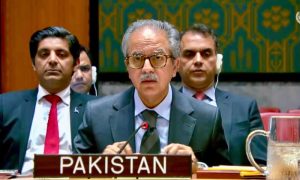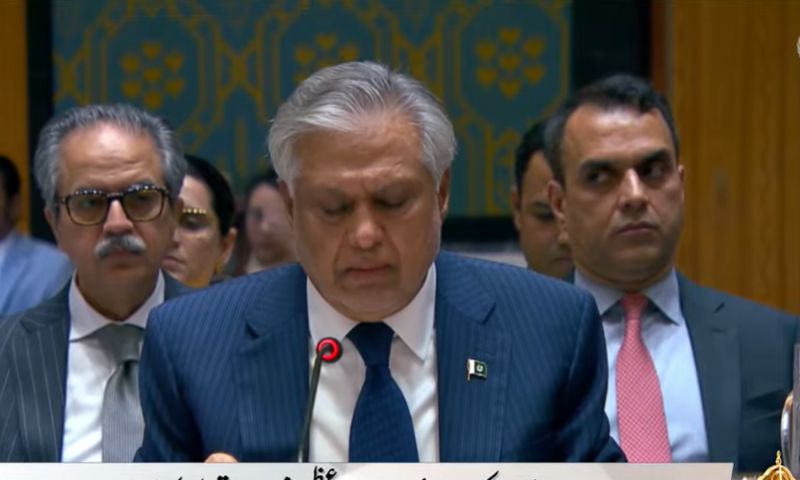
NEW YORK: Pakistan’s Deputy Prime Minister and Foreign Minister Ishaq Dar at a high-level debate in the United Nations Security Council highlighted the country’s efforts to help facilitate a lasting resolution to the Middle East conflict, one that ensures the security of maritime routes and delivers durable peace in the region.
He made the remarks at a UNSC Open Debate titled “Maintenance of International Peace and Security: Upholding the Purposes and Principles of the UN Charter and Strengthening the UN-Centred International System.”
The debate was held under China’s Security Council presidency, focused on upholding the purposes and principles of the UN Charter.
Ishaq Dar in his remarks said that during his visit to China at the end of March, Beijing and Islamabad announced a five-point initiative for regional peace and stability in the Middle East.
Remarks by H.E. Senator Mohammad Ishaq Dar, Deputy Prime Minister and Foreign Minister of Pakistan, at the UN Security Council Open Debate on “Maintenance of International Peace and Security: Upholding the Purposes and Principles of the UN Charter and Strengthening the… pic.twitter.com/Y41dGwTieg
— Ministry of Foreign Affairs – Pakistan (@ForeignOfficePk) May 26, 2026
“Another prolonged conflict would serve no one. It would endanger regional peace, disrupt global energy flows, deepen humanitarian suffering and strain an already fragile international order,” he told the UN Security Council. “The path forward lies in diplomacy.”
“As a friendly neighbour of Iran and brotherly countries of the Gulf, Pakistan consistently stood for restraint, de-escalation and a return to diplomacy,” he said.
Ishaq Dar added that Pakistan has been actively working to help facilitate a lasting resolution to the Middle East conflict, one that ensures the security of maritime routes and delivers durable peace in the region.
Remarks delivered by Deputy Prime Minister / Foreign Minister of Pakistan, Senator Mohammad Ishaq Dar @MIshaqDar50 at the UN Security Council Open Debate on “Maintenance of International Peace and Security: Upholding the Purposes and Principles of the UN Charter and Strengthening… pic.twitter.com/LvN36QqIUj
— Ministry of Foreign Affairs – Pakistan (@ForeignOfficePk) May 26, 2026
On April 8, Pakistan brokered a ceasefire between the US and Iran and intensified mediation efforts to permanently the conflict through negotiations.
Last month, Pakistan hosted direct talks between the US and Iranian negotiators in Islamabad.
The Islamabad Talks between the US and Iran concluded without reaching a final agreement; however, they paved the way for diplomacy to permanently end the conflict.
Selective application
Ishaq Dar said that the ongoing crisis in the international system stems not from a lack of guiding principles, but from their selective and inconsistent application.
“The principles are there, and have been clearly spelt out and globally agreed,” he tells the UN Security Council. “The crisis lies in their selective application.
“When sovereignty is defended in one case, but disregarded in another, the [UN] Charter is weakened,” he adds.
He stated that if UN Security Council resolutions are selectively invoked, it erodes the credibility of the institution.
“This selectivity is very dangerous. It breeds mistrust, fuels grievances, encourages unilateralism and weakens the very multilateral system we claim to uphold,” he stresses.
Weaponisation of water
He strongly criticised the use of water as a “weapon” by India, describing it as “completely unacceptable”.
He further stated that the United Nations Charter guarantees equal rights to all peoples, including the right to self-determination, and reaffirmed Pakistan’s commitment to its principles. According to him, the responsibility of maintaining peace and resolving disputes rests with states in line with international agreements and legal frameworks.
Kashmir dispute
Ishaq Dar also underscored that the Kashmir dispute has remained unresolved for eight decades. He urged the international community to ensure adherence to international laws and agreements, and called for renewed diplomatic efforts to resolve long-standing conflicts.
Diplomatic marathon
On the sidelines of the debate, the Deputy Prime Minister and Foreign Minister will hold a series of intense bilateral engagements to discuss bilateral relations, regional developments, and multilateral cooperation.