
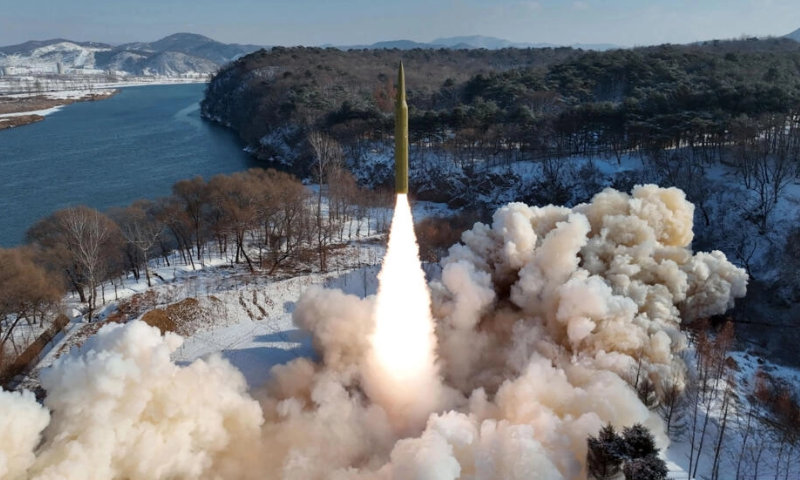
SEOUL: North Korea announced on Monday that it had conducted a successful test of a new ballistic missile equipped with a hypersonic maneuverable warhead.
This marks the country’s first known weapons test in the current year and its inaugural trial of a solid-fuel hypersonic intermediate-range ballistic missile (IRBM). The test, detected by Seoul’s military, signifies a significant advancement in North Korea’s pursuit of sophisticated weaponry capable of posing threats to South Korean and U.S. targets.
The official Korean Central News Agency (KCNA) reported that the solid-fuel IRBM was “loaded with a hypersonic maneuverable controlled warhead.” The primary objective of the launch was to validate the warhead’s “gliding and maneuvering characteristics” and assess the “reliability of newly developed multi-stage high-thrust solid-fuel engines,” as stated by KCNA. Despite North Korea’s assertion that the launch had no impact on neighboring countries’ security and was unrelated to the regional situation, it occurred shortly after live-fire exercises and heightened tensions near the maritime border with South Korea.
Kim Jong-un, North Korea’s leader, has been vocal about the country’s commitment to advancing its military capabilities. Earlier in the week, Kim designated Seoul as his “principal enemy” and issued a warning of potential annihilation for South Korea during his tour of major weapons factories.
The use of solid-fuel missiles, known for being easier to conceal and quicker to deploy, coupled with the incorporation of hypersonic technology, allows for greater maneuverability during flight, enhancing precision and evading missile defence systems. Analysts suggest that North Korea’s pursuit of mid- to long-range hypersonic missiles could serve strategic purposes, especially in targeting locations like Guam while avoiding interception by U.S. missile defence systems.
The latest missile launch comes on the heels of North Korea’s previous test of a Hwasong-18 solid-fuel intercontinental ballistic missile (ICBM) on December 18. While the KCNA report did not mention Kim Jong-un’s presence during the recent test, a single photograph accompanying the report has drawn attention. Analysts, including Ankit Panda, have noted features in the image that suggest the potential use of a “maneuverable reentry vehicle (MaRV),” indicative of North Korea’s efforts to enhance its weapons’ precision and penetration capabilities.
Relations between North and South Korea have deteriorated, with Kim Jong-un solidifying the country’s nuclear status in the constitution and testing advanced ICBMs. Simultaneously, North Korea has been cultivating closer ties with traditional ally Russia, prompting concerns about potential arms deals. A North Korean government delegation, led by Foreign Minister Choe Son Hui, recently embarked on an official visit to Russia.
Despite facing economic challenges, North Korea conducted a series of record-breaking weapons tests in 2023, showcasing its technological prowess. Last year’s accomplishments included the successful launch of a reconnaissance satellite, raising questions about potential collaboration with Russia. The geopolitical landscape remains tense as North Korea continues its pursuit of advanced weaponry, posing challenges for regional stability.