
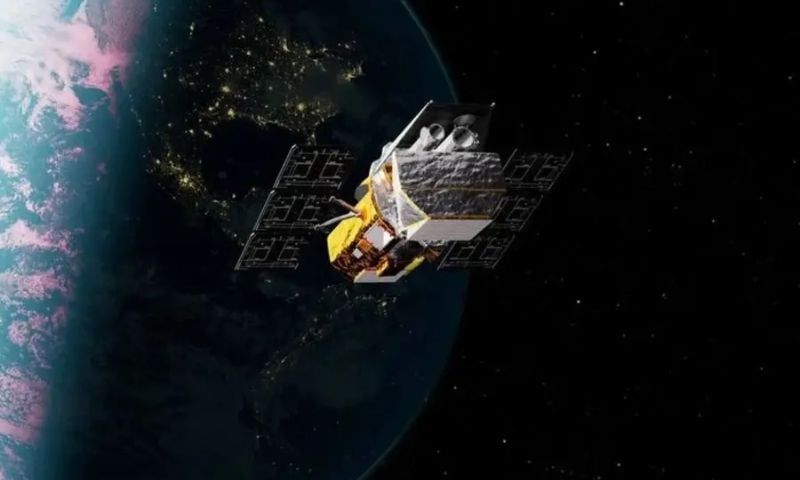
WASHINGTON: NASA’s $30 million mission to rescue its ageing Swift space telescope has failed after the robotic spacecraft sent to move the satellite into a higher orbit developed serious control problems.
The US space agency confirmed on Wednesday that the rescue operation had been called off, leaving Swift likely to fall back towards Earth and disintegrate in the atmosphere later this year.
The ambitious mission was designed to demonstrate whether robotic spacecraft could capture ageing satellites and extend their operational lives by repositioning them in orbit.
“This is not the outcome we were working toward, but it does not change why this mission was worth attempting,” NASA Administrator Jared Isaacman said.
Rescue spacecraft loses control
American startup Katalyst developed the unmanned spacecraft, which was launched on July 3 aboard a Pegasus rocket deployed from an aircraft.
However, Katalyst reported on July 28 that the spacecraft had been spinning uncontrollably for 72 hours and was experiencing multiple technical problems, including loss of communications.
The company and NASA ultimately abandoned the rescue attempt because of continuing “attitude control issues”, which prevented operators from properly controlling the spacecraft’s orientation.
NASA said the vehicle would still attempt to approach Swift, allowing engineers and scientists to collect information that could help improve future satellite-servicing missions.
Isaacman said the project had allowed teams to advance capabilities that could eventually be used to service other satellites in orbit.
ALSO READ: Why OpenAI Is Slowing Down Its AI Model Race
NASA launched Swift in 2004 to observe gamma-ray bursts — extremely powerful explosions occurring across the universe.
The telescope has remained an important tool for studying these high-energy astronomical events for more than two decades.
The failed rescue represented an unprecedented attempt to extend Swift’s operational life, while also serving as a test of technologies that could eventually make repairing or repositioning satellites in space more routine.