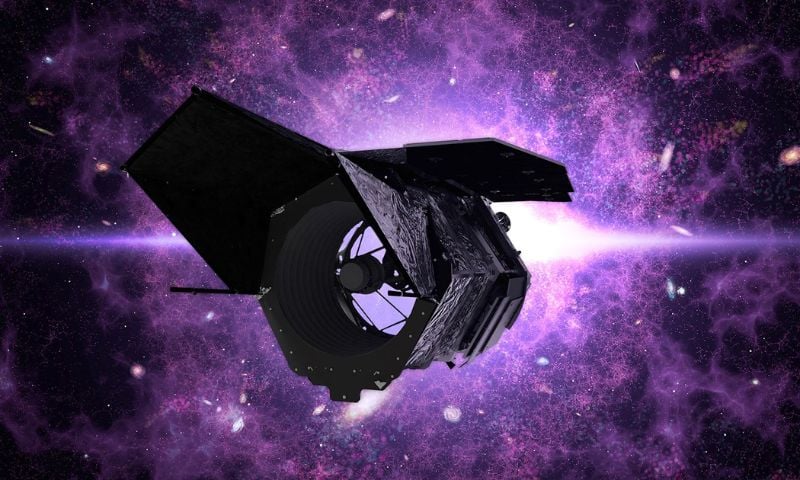
WASHINGTON: NASA has introduced a powerful new space telescope designed to explore vast regions of the cosmos, identify planets beyond our solar system, and deepen scientific understanding of dark matter and dark energy.
The Roman Space Telescope, revealed on Tuesday, is expected to detect tens of thousands of exoplanets and provide fresh insights into how common such worlds may be across the universe.
“Roman will give the Earth a new atlas of the universe,” NASA administrator Jared Isaacman said at a press briefing held at the Goddard Space Flight Center.
The 12-metre-wide telescope, equipped with expansive solar panels, is scheduled to be transported to Florida ahead of a planned launch aboard a SpaceX rocket as early as September.
The project, which cost more than $4 billion and took over a decade to complete, is named after astronomer Nancy Grace Roman, widely known as the “Mother of Hubble.”
Field of view
With a field of view at least 100 times greater than the Hubble Space Telescope, Roman will scan large swathes of space from a vantage point about 1.5 million kilometres from Earth. It is expected to transmit around 11 terabytes of data daily.
“In the first year, we’ll have sent down more data than Hubble will have for its entire life,” said Mark Melton, a systems engineer involved in the project.
Scientists say the telescope will catalogue billions of galaxies, thousands of supernovae and tens of billions of stars.
It will also complement missions such as the James Webb Space Telescope in identifying targets for deeper study.
Crucially, Roman will investigate invisible cosmic forces. Using infrared technology, it will observe ancient light to better understand dark matter and dark energy, which together make up most of the universe.
“If Roman wins a Nobel Prize at some point, it’s probably for something we haven’t even thought about or questioned yet,” Melton added.