
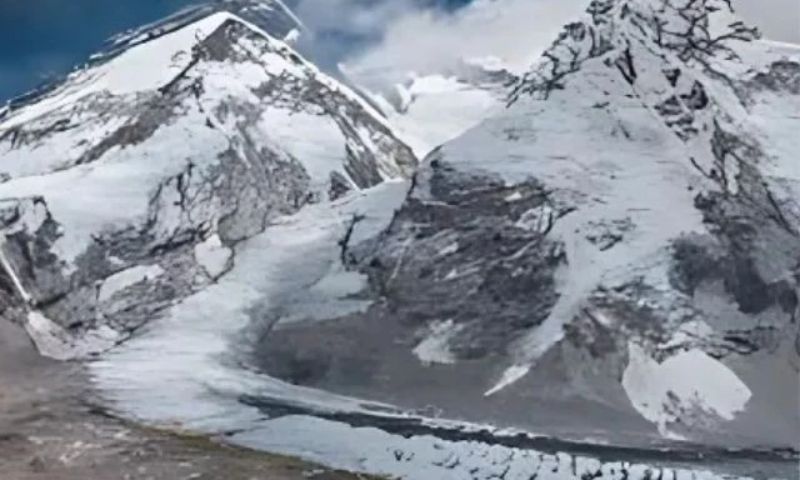
KATHMANDU, Nepal: A Nepali climbing guide who was feared dead after disappearing on Mount Everest for nearly a week has been found alive, astonishing rescuers, fellow climbers and his family after surviving alone in some of the harshest conditions on Earth.
Dawa Sherpa, a veteran mountain guide in his 50s popularly known as “Hillary” after the legendary Everest pioneer Sir Edmund Hillary, went missing on the upper slopes of the world’s highest mountain on May 30 during the final days of the spring climbing season. Search efforts failed to locate him for six days, leading many to believe he had perished in the extreme cold and thin air near the summit.
However, in an extraordinary turn of events, Dawa Sherpa was discovered alive on Thursday morning near Everest Base Camp after apparently making a gruelling descent on his own.
According to officials involved in the rescue operation, he was found by members of the Sagarmatha Pollution Control Committee (SPCC), a Nepali organisation responsible for maintaining climbing routes and removing waste from the mountain.
“He was found close to Base Camp and was crawling down when the team spotted him,” said Pemba Sherpa of 8K Expeditions, the company coordinating search and rescue efforts.
A rescue helicopter was immediately dispatched to evacuate him from the mountain. He was flown to Kathmandu, where medical teams admitted him to the intensive care unit of HAMS Hospital for treatment. Doctors said the climber was conscious and responding well despite suffering from frostbite and other cold-related injuries.
“He is awake and undergoing treatment,” said Dr Nishant Dhakal, who is overseeing his care. “We are treating frostbite, cold exposure, dehydration and trauma. Further medical evaluations are ongoing, and he will remain under close observation in the ICU.” The news sparked scenes of joy among his family, who had already begun preparing for life without him after losing hope of his survival.
According to AFP, his wife, Damu Sherpa, revealed that relatives had started performing traditional prayers for his soul just a day before receiving word that he had been found alive.
“We had completely lost hope,” she said. “When we heard the news, we were overwhelmed with happiness. We had even begun the prayers yesterday.” His daughter, Mendo Lhamu Sherpa, said the family initially struggled to believe the reports.
“When we first received the call, we were unsure whether it was really him,” she said. “Then photographs were sent to us for confirmation, and only then did we realise he had survived. It was an incredible moment.”
Dawa Sherpa had reached the summit of the 8,849-metre mountain on May 29 alongside British climber and former Royal Marine Chris Thrall. Thrall later recounted the final moments he saw the Nepali guide before he disappeared.
According to the British mountaineer, the pair had successfully reached the summit late on May 29 and began descending the following day from Camp Four, located at approximately 7,950 metres, just below Everest’s notorious “death zone” where oxygen levels are dangerously low.
During the descent, Dawa Sherpa stopped to rest while carrying a heavy load. “I asked him if he was okay and he told me to continue,” Thrall recalled. “It was not unusual. Sherpas often move at different speeds, and I expected he would catch up as he had done many times before.”
As he continued downward, Thrall encountered a Polish climber in distress who had run out of supplemental oxygen and was suffering from frostbite. Faced with a difficult decision, he chose to assist the stranded climber rather than return uphill.
“It had been an exceptionally demanding expedition,” Thrall explained. “What should have taken five days to summit and return ended up taking eleven days because of the challenging conditions.”
He described sharing his own oxygen supply with the Polish climber during a perilous descent that took around 11 hours instead of the usual two. “At that point, I knew we were dealing with a serious emergency,” he said. Search teams subsequently launched efforts to locate Dawa Sherpa, but no trace of him was found despite extensive efforts on the mountain.
Remarkably, the experienced guide appears to have survived alone and gradually descended the mountain under his own power before eventually being spotted near Base Camp. His survival is being regarded as one of the most extraordinary Everest rescue stories in recent years.
The incident occurred near the end of the spring climbing season, a period when the number of climbers remaining on the mountain had already begun to decline, reducing the chances of anyone encountering him during his descent.
This year’s Everest season has been the busiest on record, according to preliminary figures released by Nepali authorities. More than 1,000 climbers successfully reached the summit during the season.
Despite the high number of successful ascents, the mountain also claimed several lives. At least five people died during the season, including two Indian climbers and three Nepali workers involved in expedition preparations.
For now, attention remains focused on Dawa Sherpa’s recovery, with many in Nepal’s mountaineering community celebrating what is being described as a near-miraculous survival against overwhelming odds on the world’s highest peak.