Key Points
- Trump threatens to halt trade with U.S. deficit countries.
- Trump says stronger US credit justifies lower borrowing costs.
- Fed Chair Kevin Warsh recently warned rate hikes remain possible.
- Vice President JD Vance also urged the Fed to cut rates.
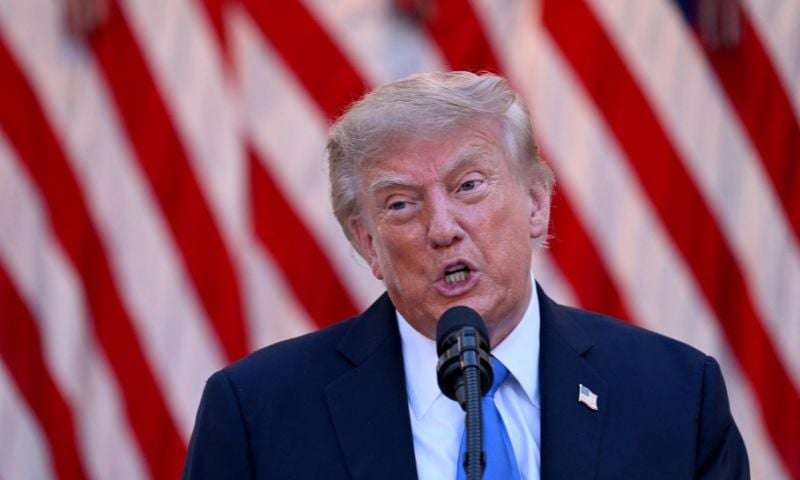
WASHINGTON: US President Donald Trump on Friday intensified his pressure on the Federal Reserve, demanding lower interest rates and threatening to halt trade with countries that run trade surpluses with the United States.
He made the sweeping demand in a post on Truth Social shortly after the release of a stronger-than-expected US jobs report, claiming the figures demonstrated that the American economy was strong enough to support significantly lower borrowing costs.
“Lower the interest rates,” Trump said, arguing that a stronger United States should have cheaper credit and calling for the country to have the lowest interest rate in the world.
He went further by threatening to cut off trade with countries with which the United States runs trade deficits.
“Lower the rate or I’ll stop trading with countries with which we have a deficit.” – President Trump
“Lower the rate or I’ll stop trading with countries with which we have a deficit,” Trump wrote, describing such a move as preferable to imposing tariffs.
The statement marked a renewed escalation in Trump’s longstanding campaign for lower interest rates and his criticism of US trade deficits.
Trade threat
Taken literally, Trump’s threat would have sweeping implications for the US economy and global trade because Washington runs trade deficits with dozens of countries, including many of its largest trading partners.
— Rapid Response 47 (@RapidResponse47) September 4, 2026
Such a policy could, therefore, affect a broad range of major US trading relationships if implemented as stated.
The White House did not immediately provide additional details on how such a policy would be implemented or which countries could potentially be affected.
The Federal Reserve also declined to comment on Trump’s post.
Trump additionally invoked a recent Supreme Court decision concerning presidential tariff authority, arguing that the ruling supported his ability to take action against countries running trade surpluses with the United States.
His comments came as the administration continues to debate the appropriate balance between economic growth, inflation and monetary policy.
Pressure on fed
Trump has repeatedly pushed for lower interest rates, arguing that high borrowing costs place the United States at an economic disadvantage.
His latest remarks revive that pressure campaign after it had appeared to ease following the appointment of Kevin Warsh as his handpicked successor to former Fed Chair Jerome Powell.
Warsh, however, has recently signaled a willingness to consider tighter monetary policy if necessary to bring inflation under control.
In a speech a week earlier, the Fed chair emphasised his commitment to returning inflation to the central bank’s 2 per cent target and described short-term interest rates as the main instrument for achieving the Fed’s economic objectives.
That position puts Warsh at odds with Trump’s latest demand for substantially lower rates.
Vice President JD Vance also called for rate cuts on Thursday, describing lower interest rates as the “proper and responsible” response to recent inflation data.
National Economic Council Director Kevin Hassett took a more cautious position Friday, saying the Fed would make its own decision while acknowledging that there was a strong argument for keeping rates unchanged.
Jobs fuel debate
Trump’s latest intervention followed a monthly employment report showing employers added 162,000 jobs in August, a figure he highlighted as evidence of economic strength.
He said the result had exceeded expectations and argued that a stronger economy and improved US creditworthiness should translate into lower interest rates.
The president has long linked monetary policy with his broader economic agenda, particularly his efforts to boost growth, reduce borrowing costs and address the country’s trade imbalances.
The latest remarks also underscore the continuing tension between the White House’s economic priorities and the Federal Reserve’s independent approach to setting monetary policy.
With US midterm elections two months away, persistent inflation remains a major political issue, increasing the stakes surrounding monetary policy and the administration’s economic messaging.
Trump’s demand now adds another layer to that debate, linking interest-rate policy directly to the United States’ international trade relationships.