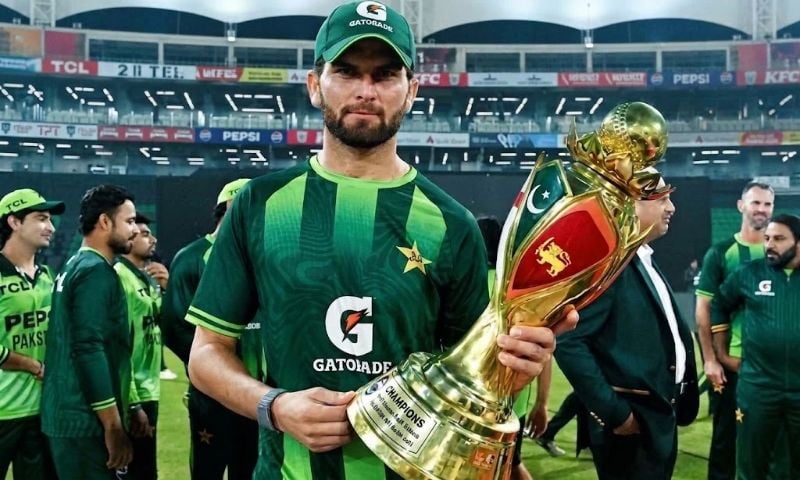
LAHORE: Pakistan’s thrilling three-wicket victory over Sri Lanka in the ODI tri-series final on Saturday delivered more than a trophy, showcasing Fakhar Zaman’s big-match temperament, Arafat Minhas’s explosive batting and captain Shaheen Shah Afridi’s growing leadership ambitions.
Chasing a formidable target of 326 at Gaddafi Stadium, Pakistan recovered from an early collapse to reach 331-7 in 48.3 overs, winning with nine balls remaining.
Lahore witnessed a little history as Pakistan finally turned home advantage into an ODI final triumph.
After losing their previous three finals on home soil, they defeated Sri Lanka to break the sequence and lift their first tri-series title since the 2008 Kitply Cup, when India were beaten in the final in Dhaka.
Seventeen years separate those triumphs, a reminder of how rare these moments have become.
For #Pakistan, this was more than another trophy: it was the satisfaction of finishing the job before their own supporters. A familiar setting finally delivered an unfamiliar ending: Pakistan celebrating a home ODI final victory.
— Revolt (@revolt_71) October 31, 2026
Fakhar’s magnificent 127 off 99 balls laid the foundation, while Saad Baig contributed a composed 74 and Arafat Minhas turned the contest around with a blistering 61 off just 31 deliveries.
The final highlighted Pakistan’s batting depth, resilience under pressure and the emergence of young players capable of influencing major matches.
1. Fakhar Zaman matches Saeed Anwar’s record
Fakhar produced one of the outstanding innings of the final, smashing 127 runs with 11 fours and six sixes to anchor Pakistan’s chase.
The left-hander rescued Pakistan after the early dismissals of Maaz Sadaqat and Babar Azam left the hosts struggling at 14-2. His 149-run partnership with Saad Baig restored stability and put Pakistan back in contention.
Pakistan win the ODI Tri-Series final, chasing down Sri Lanka’s 325/8 to finish on 331/7 and win by 3 wickets in Lahore.
🔥 Fakhar Zaman – 127
Congratulations Pakistan 🇵🇰🙏 https://t.co/wtEfIx18tY
— Sri Lanka Tweet 🇱🇰 (@SriLankaTweet) October 31, 2026
Fakhar’s century also brought him level with legendary Pakistan batter Saeed Anwar for two centuries in ODI tournament finals.
His performance reinforced his reputation as a batter capable of delivering when Pakistan needs him most.
2. Arafat Minhas emerges as Pakistan’s match-winner
While Fakhar provided the foundation, Arafat Minhas supplied the decisive acceleration.
With Pakistan still needing 106 runs after Fakhar’s dismissal, Arafat launched an aggressive counterattack, scoring 61 off only 31 balls at a strike rate of 196.77. His innings featured three fours and four sixes.
Arafat Minhas 61(31) vs Sri Lanka | ODI Tri-Series Final 2026 – Lahore | Ball By Ball Highlights https://t.co/EvuZtuF91o
— Danish (@PctDanish) October 31, 2026
Arafat’s partnership with Hasan Nawaz helped Pakistan regain control during the closing overs. Hasan remained unbeaten on 37 off 45 balls, providing the stability needed alongside Arafat’s attacking approach.
Arafat Minhas was also named Player of the Series for his impressive all-round performances in the ODI tri-series.
Although Arafat and Faheem Ashraf fell in successive deliveries with Pakistan on 324, Shaheen Afridi struck the winning six to seal the contest.
Arafat’s performance demonstrated the importance of all-round batting depth and the ability to accelerate under pressure.
3. Saad Baig demonstrates the value of young talent
The 19-year-old Saad Baig played a pivotal role in Pakistan’s recovery, scoring 74 off 75 deliveries.
Saad Baig 74(75) vs Sri Lanka | ODI Tri-Series Final 2026 – Lahore | Ball By Ball Highlights https://t.co/RqAf76k2iu
— PctMedia (@PctMediaa) October 31, 2026
After Pakistan lost two early wickets, Saad complemented Fakhar’s attacking style with a composed innings that helped rebuild the chase. Their 149-run partnership for the third wicket transformed Pakistan’s position and prevented Sri Lanka from dictating the contest.
His performance underlined the value of giving young players opportunities to contribute in high-pressure international matches.
4. Shaheen Afridi strengthens his captaincy credentials
Shaheen Shah Afridi added another trophy to Pakistan’s ODI campaign under his leadership by guiding the team to victory in the tri-series featuring Sri Lanka and England.
His recent captaincy record has been credited with series victories against South Africa, Sri Lanka and Australia, alongside the tri-series triumph.
6 to win it by the Pakistani captain!! 🇵🇰
Pakistan win the tri-series final by beating Sri Lanka 🇱🇰
This is Pakistan’s first ODI tri-series win at home!
This has been the most entertaining tri-series ever! 🇵🇰🇱🇰🏴
#PAKvSL https://t.co/3tN92DCwQa— A B (@6ixAB23) October 31, 2026
The Lahore final also demonstrated his contribution as a player. Shaheen remained unbeaten on six off three balls and finished the match with the winning six when Pakistan needed two runs.
These results are helping Shaheen establish his own identity as Pakistan’s ODI captain. Sustaining that success across future bilateral series and major tournaments will be crucial to defining his long-term legacy.
5. Kamindu Mendis gives Sri Lanka a strong platform
Sri Lanka’s total of 325-8 was built around an outstanding century from Kamindu Mendis, who scored 131 off 128 balls, including 12 fours and two sixes.
Kamindu Mendis: maiden ODI hundred. 💯
106* off 110 balls in a tri-series final against Pakistan. 🇱🇰🔥
Sri Lanka 194/2 and in control. 🏏
#PAKvSL https://t.co/IYitjQfLxd— Md Haqbaaz (@mdhaqbaaz) October 31, 2026
The innings was Mendis’s maiden ODI century and provided the backbone of Sri Lanka’s batting effort.
Pavan Rathnayake also impressed with 77 off 65 balls, while Avishka Fernando contributed 38. Their partnerships helped Sri Lanka establish a challenging total and put Pakistan under considerable pressure.
6. Pakistan’s batting depth proves decisive
Pakistan’s chase was not the work of a single batter. Fakhar supplied the platform, Saad steadied the innings and Arafat accelerated when the required rate threatened to become difficult.
Hasan Nawaz’s unbeaten contribution and Shaheen’s finishing blow completed the recovery.
The ability of different players to step up at different stages was the defining feature of Pakistan’s successful chase. It also demonstrated why batting depth is essential when pursuing totals above 300 in modern ODI cricket.
Read Also: Pakistan Eye First ODI Tri-Series Title Since 2008 in Saturday’s Final Against Sri Lanka
TRI-SERIES CHAMPIONS! 🏆🇵🇰
Pakistan seal the title in front of a packed Lahore crowd 💚
#PAKvSL | #CricketKaJashan | #BackTheBoysInGreen https://t.co/zR90gu0tMx
— Pakistan Cricket (@TheRealPCB) October 31, 2026
7. Sri Lanka pay the price for missed opportunities
Sri Lanka had opportunities to put Pakistan under greater pressure, particularly through missed chances against Fakhar.
The opener capitalised on those reprieves to score a match-winning century, while Arafat’s late assault proved difficult for the Sri Lankan bowlers to contain.
Although Mendis and Rathnayake delivered outstanding performances with the bat, Sri Lanka could not defend their total. The final underlined how missed fielding opportunities and an inability to control the closing overs can influence high-scoring contests.
8. Pakistan show resilience in a high-pressure chase
Pakistan’s early collapse to 14-2 could have derailed the chase, but the team recovered through partnerships and calculated aggression.
🚨 PAKISTAN LIFT THE TROPHY OF THE TRI-NATION SERIES! 🇵🇰🏆 https://t.co/0TkTeM2nZ3
— Rayham. (@RayhamUnplugged) October 31, 2026
Fakhar and Saad rebuilt the innings, Arafat changed its momentum and Shaheen delivered the decisive finish.
Read Also: Fakhar Zaman Leads Pakistan to Win Triangular ODI Cricket Series
Pakistan reached 331-7 in 48.3 overs to secure a three-wicket victory with nine balls remaining.
The result highlighted the importance of composure, partnerships and timely acceleration in high-pressure ODI cricket.