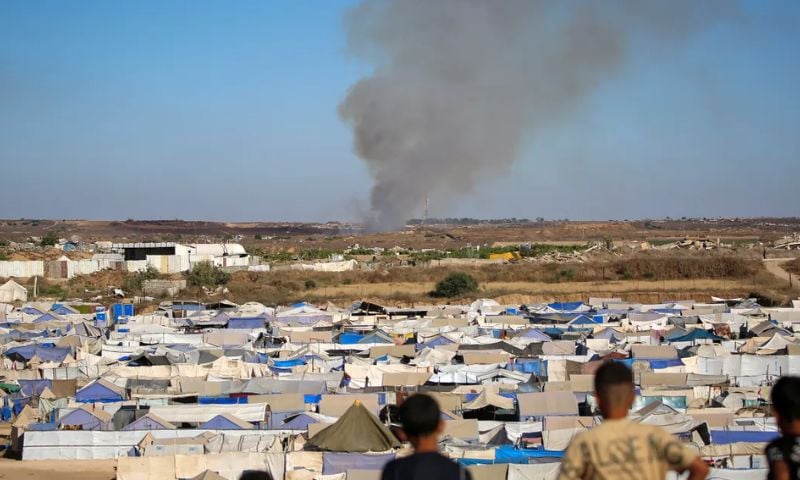
GENEVA: A UN Commission of Inquiry has found that attacks on Palestinian children and the harm inflicted upon them formed a key component of Israel’s genocidal campaign in Gaza, amid a wider pattern of alleged war crimes and crimes against humanity targeting young people in Gaza and the West Bank since October 2023.
The findings were presented in a report by the Independent International Commission of Inquiry on the Occupied Palestinian Territory, including East Jerusalem, and Israel. Titled The Essence of Childhood, the report argues that nearly every legal protection guaranteed to children under international law has been systematically dismantled during the conflict.
According to the commission, evidence gathered over the course of its investigation demonstrates that Palestinian children have been subjected to killings, severe physical and psychological harm, starvation, displacement, and the destruction of essential services on a scale that points to an intention to destroy Palestinians as a national group, either wholly or partially.
Justice Srinivasan Muralidhar, who chairs the commission, said investigators identified a recurring pattern in which children appeared to have been deliberately targeted by Israeli forces.
Speaking about the inquiry’s findings, Muralidhar said testimony from medical personnel, eyewitnesses and other sources suggested that the deaths and injuries suffered by children could not simply be explained as collateral damage arising from military operations.
The commission heard evidence from healthcare workers who described treating infants and young children with gunshot wounds to the head, neck and upper body. Among the incidents highlighted was the reported shooting of a baby by a quadcopter drone while the child was being breastfed by her mother.
Investigators concluded that such incidents formed part of a broader trend in which children were repeatedly exposed to lethal force.
Findings of genocidal intent
The report states that the killing of Palestinian children, the infliction of serious bodily and mental harm, and the deliberate creation of conditions that threaten survival collectively support a finding of genocidal intent under the 1948 UN Genocide Convention.
The commission argued that attacks on children carry particular significance because they directly affect the future continuity of a people. It concluded that children had become a central target in actions aimed at weakening the biological and social fabric of Palestinian society.
According to figures cited in the report, at least 20,179 children were killed and 44,143 injured in Gaza between October 7, 2023, and October 7, 2025. Children accounted for roughly 30 per cent of all fatalities during that period, a proportion considerably higher than in previous major rounds of Israeli-Palestinian violence.
Among those killed were more than 5,000 children under the age of five, including approximately 420 newborn babies. The report also cited estimates indicating that more than 5,000 children remain buried beneath collapsed buildings and debris.
Killings continued after ceasefire
The commission found that child fatalities continued even after the ceasefire agreement reached in October 2025. Particular concern was expressed about areas near the so-called “yellow line” inside Gaza, where Israeli military operations reportedly continued despite the truce.
Investigators documented the deaths of more than 100 children between October 2025 and mid-January 2026. Among the cases examined was the killing of two brothers, aged nine and ten, near Khan Younis while collecting firewood. The commission concluded that available evidence did not support claims that the children posed any threat to Israeli soldiers.
The report also revisited the widely publicised killing of five-year-old Hind Rajab and six members of her family in January 2024. Investigators attributed responsibility for the attack on the family vehicle and a Palestine Red Crescent Society ambulance dispatched to assist them to the Israeli military’s 401st Brigade.
In addition, the commission documented numerous cases in which children were shot by snipers or struck by fire from quadcopter drones. It noted that the location and consistency of injuries suggested deliberate targeting rather than accidental harm.
Collapse of healthcare system
A substantial portion of the report focuses on the destruction of Gaza’s healthcare infrastructure and its consequences for children.
Investigators found that repeated attacks on medical facilities severely reduced the capacity of hospitals to provide treatment, particularly for newborns and critically ill children.
The commission reported that neonatal intensive care services were devastated, contributing to the deaths of premature babies who were deprived of incubators, electricity and specialised care. It also highlighted a dramatic decline in births during the conflict, with live births during the first half of 2025 reportedly falling by around 41 per cent compared with the same period in 2022.
According to testimony received by the commission, medical staff were frequently forced to carry out emergency amputations on infants and children without anaesthesia because of shortages of medicine and equipment.
Doctors described developing distressing terms to classify child casualties. These reportedly included references to wounded children who had lost every family member, children suffering catastrophic head injuries, and youngsters who were the sole survivors of their families.
Muralidhar said healthcare workers repeatedly described situations in which they were unable to save children because essential supplies had been exhausted or medical facilities had been destroyed.
Education system devastated
The report also details the extensive destruction of Gaza’s education sector. According to the commission, more than 97 per cent of schools across the territory have either been damaged or completely destroyed.
Investigators concluded that numerous educational institutions, including schools and universities, were intentionally demolished in circumstances where military necessity had not been established.
The destruction of educational facilities, the commission argued, has deprived an entire generation of Palestinian children of learning opportunities and normal social development.
Treatment of child detainees
The inquiry further examined the treatment of Palestinian children held in Israeli detention facilities. It documented cases involving children as young as five and reported allegations that minors were detained alongside adults and subjected to physical abuse, prolonged stress positions and, in some instances, sexual violence.
Among the incidents highlighted was the death of a 17-year-old detainee at Megiddo Prison in March 2025. The commission concluded that the teenager died after being deliberately deprived of food, water and medical treatment.
Violence in the West Bank
Beyond Gaza, the commission reported a significant increase in violence affecting children in the occupied West Bank, including East Jerusalem. Investigators found that 213 Palestinian children were killed by Israeli security forces between October 2023 and October 2025.
The report argued that Palestinian boys were frequently viewed through what it described as a “security lens”, resulting in disproportionate use of force against them.
The commission also documented rising levels of settler violence, including assaults, abductions and cases of sexual abuse involving Palestinian children.
Dehumanisation and psychological trauma
Another aspect of the report focused on what investigators described as the dehumanisation of Palestinian children. Evidence reviewed by the commission included videos and photographs showing Israeli soldiers mocking children’s toys, destroying play items and attaching toys to military vehicles.
The commission said such conduct reflected a broader culture in which Palestinian children were stripped of their humanity. Muralidhar described the behaviour as deeply disturbing and said it demonstrated a deliberate disregard for the emotional and psychological wellbeing of children.
The report further documented the severe psychological effects of prolonged bombardment, displacement and loss. According to testimony from medical experts and aid workers, many children have been left traumatised, while others have become withdrawn or unable to speak after experiencing repeated violence.
Investigators also reported cases of children being injured while playing with unexploded ordnance and others living in environments lacking even the most basic recreational opportunities.
Calls for international action
The commission called on Israel to immediately halt military activities near the yellow line, comply with legally binding orders issued by the International Court of Justice, provide information on detained children and cease withholding the bodies of Palestinian minors.
It also urged UN member states to suspend arms transfers to Israel where there are grounds to believe such weapons could be used to commit violations of international law.
The report further recommended sanctions against Israeli political and military officials found responsible for serious abuses and called on the International Criminal Court to prioritise crimes committed against children in its ongoing investigation into the situation in Palestine.
Among the Israeli military formations specifically named in connection with incidents examined by the commission were the 401st Brigade, the 162nd Division, the 98th Division, the 99th Division and the Duvdevan Unit.
Warning for the future
The commission warned that current developments in Gaza and the West Bank risk creating a fragmented future in which Palestinians are confined to isolated and disconnected enclaves.
Muralidhar said the evidence gathered by investigators points to long-term consequences that could affect generations of Palestinian children.
He stressed that the commission’s work was based on evidence subjected to rigorous examination and internationally recognised investigative standards.
The commission maintained that its sole objective was accountability for all victims, regardless of nationality, and emphasised that justice must apply equally to Israeli and Palestinian civilians.
The report concludes that the destruction experienced by Palestinian children extends beyond immediate physical harm, arguing that the conflict has undermined the foundations of childhood itself and left lasting scars that may shape generations to come.