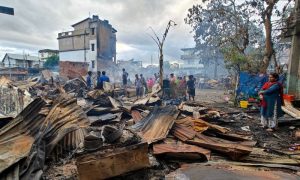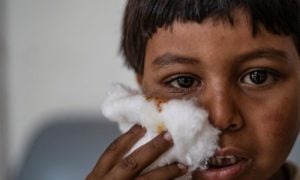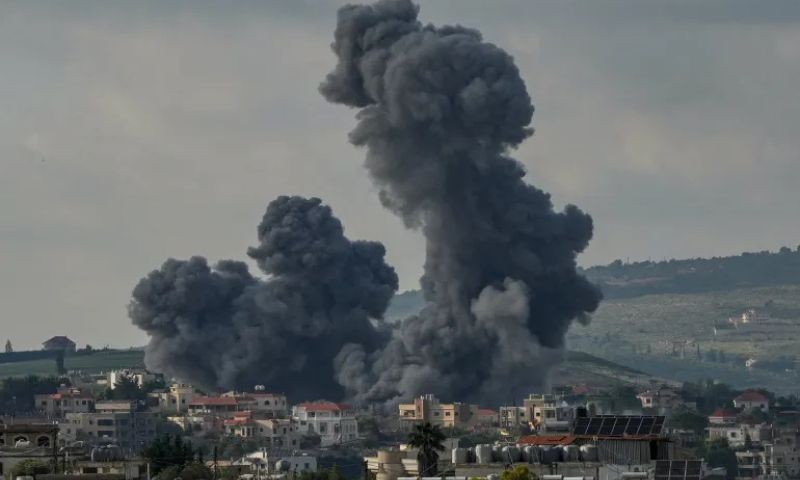



BEIRUT, Lebanon: Israeli airstrikes and drone attacks across southern Lebanon killed at least 15 people on Saturday, Lebanon’s Health Ministry said.
The ministry said several others were wounded. The casualties included paramedics and a Syrian national, according to the ministry.
Lebanon’s Public Health Emergency Operations Centre later said the death toll in the country from the conflict since March 2 had risen to 3,371, with 10,129 people injured.
The Lebanese Army said on social media platform X that two soldiers were seriously wounded when an Israeli drone struck their vehicle on a main road in the village of Ebba in the Nabatieh district.
The army said the soldiers were taken to hospital for treatment.
In a separate statement, the military said later on Saturday that “two soldiers were seriously wounded as a result of being targeted inside a vehicle by a hostile Israeli drone” near Nabatieh.
Meanwhile, Hezbollah said it fired rockets towards the northern Israeli cities of Safed, Nahariya and Kiryat Shmona. The Israel Defense Forces said no casualties were reported.
The Israeli military said the launches came shortly after it warned of expected rocket fire from Lebanon.
Hezbollah also said it ambushed Israeli soldiers near Ghandouriyeh in southern Lebanon and fired rockets at a military base in northern Israel.
Lebanese PM calls for de-escalation
Lebanese Prime Minister Nawaf Salam said on Saturday that the country was facing a critical phase amid what he described as a sharp escalation in Israeli strikes.
He urged stronger political and diplomatic efforts to secure a ceasefire.
Salam accused Israel of carrying out widespread destruction and collective punishment.
He said strikes had expanded beyond military targets to hit towns, villages and civilian infrastructure.
However, he reiterated Lebanon’s commitment to a negotiated ceasefire deal that would include an Israeli withdrawal, the release of prisoners, the return of displaced people and reconstruction efforts.
Salam also said decisions on war and peace must remain under state authority, calling for national unity under “one state, one decision and one army.”
In a televised address, he said direct negotiations with Israel were “the least costly path” for Lebanon, though he acknowledged the outcome was not guaranteed.
Israeli Prime Minister Benjamin Netanyahu said on Friday that Israeli forces had expanded operations north of the Litani River, beyond a designated security zone in southern Lebanon.
Israeli media assessments said the increase in Hezbollah attacks was linked to expanded Israeli military activity in Lebanon.
Senior Lebanese military sources, quoted by Anadolu news agency, said Israeli forces had crossed the Litani River and were on the outskirts of Nabatieh, a key city in southern Lebanon.
A truce to halt fighting formally took effect on April 17 but has not been fully observed.
Lebanese authorities say violence has continued despite the agreement, with repeated air and ground operations reported in the south.