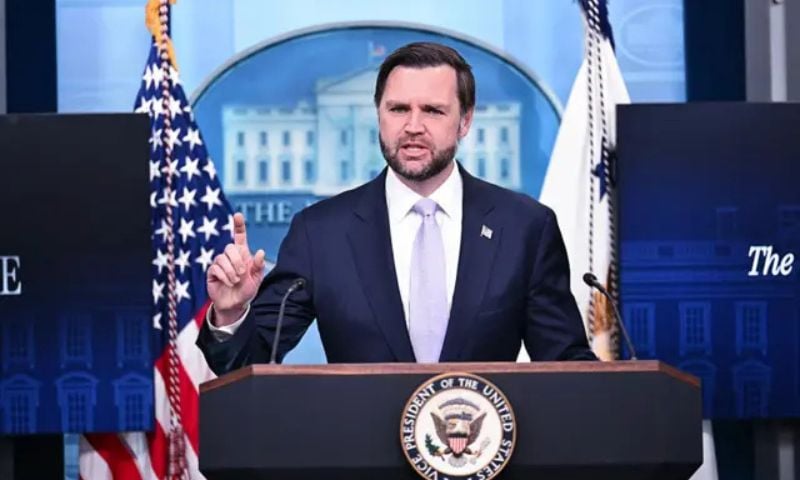
WASHINGTON: US Vice President JD Vance said some members of the Israeli government had tried to influence US public opinion to oppose a deal between the US and Iran to end the Middle East war.
Speaking on a podcast with host Joe Rogan, posted on Wednesday, Vance said he believed certain Israeli officials wanted to prolong the military campaign against Iran rather than support diplomatic efforts to end the conflict.
“I know beyond a shadow of a doubt that there have been people within the Israeli government who are trying to actually shift us away from that policy because they want to continue the military campaign,” Vance said.
JD Vance exposes Israel:
I know beyond a shadow of a doubt that there have been people within the Israeli government who are trying to actually shift us away from that policy because they want to continue the military campaign.
There are some people within their system, we know… pic.twitter.com/KG163nrgfP
— Clash Report (@clashreport) July 15, 2026
His remarks mark one of the strongest public criticisms by a senior US official of elements within the Israeli government and add to signs of widening differences between the two allies over the Iran war.
Vance defends US-Iran Islamabad MoU
Vance defended the Islamabad memorandum of understanding between the US and Iran reached last month to end the war, despite opposition in Israel.
Last month, Pakistan mediated a memorandum of understanding between the United States and Iran aimed at ending their military conflict and advancing negotiations towards a lasting peace agreement.
The Islamabad MoU was signed on June 18 by US President Donald Trump, Iranian President Masoud Pezeshkian and Prime Minister Shehbaz Sharif after Pakistan brokered a ceasefire between Washington and Tehran.
Under the Islamabad MoU, the US and Iran committed to halt military operations, reopen the Strait of Hormuz to commercial shipping and negotiate a comprehensive agreement covering Iran’s nuclear programme, US sanctions and a permanent ceasefire within 60 days.
Vance said that he maintains “good relationships” with some members of the Israeli government but alleged that others were attempting to shape US public opinion to influence Washington’s policy.
“There are some people within their system that we know beyond a shadow of a doubt are manipulating and trying to change American public opinion to keep the war going on indefinitely,” he said.
Foreign influence and US policy
The vice president said attempts by foreign governments to influence US policy were common and not unique to Israel.
“It doesn’t bother me that Israel tries to do this; it frankly doesn’t even bother me that Russia or some of these other countries do it,” Vance said. “It’s just the nature of being a political leader in 2026.”
He said his concern arose when such influence campaigns affected US decision-making.
“What does bother me is when those operations, those influence campaigns, actually affect American political judgment,” he said.
Question on Israeli influence
When asked whether the United States would have become involved in the latest war with Iran without Israeli influence, Vance replied, “Yes, yes I do.”
He added, however, that President Donald Trump believed Iran should not possess nuclear weapons.
“I think the president, separate from any influence from Israel, believes very strongly, and again I agree with this, that Iran should not have a nuclear weapon,” Vance said.
The comments echoed criticism Vance made in June, when he rebuked Israeli opponents of the Iran agreement. At the time, he said Trump remained Israel’s strongest ally despite criticism from some Israeli figures and noted the billions of dollars in US defence assistance provided to Israel.
Islamabad MoU framework
Under the Islamabad MoU, the US and Iran committed to halt military operations, reopen the Strait of Hormuz to commercial shipping and negotiate a comprehensive agreement covering Iran’s nuclear programme, US sanctions and a permanent ceasefire within 60 days.
Pakistan and Qatar subsequently co-mediated the first round of high-level negotiations in Lucerne, Switzerland, on June 21.
The talks were attended by US Vice President JD Vance and Iranian Parliament Speaker Mohammad Bagher Ghalibaf.
The next round of negotiations is intended to advance the Islamabad MoU framework. The technical talks were delayed because of the state funeral ceremonies for Iran’s late Supreme Leader, Ayatollah Ali Khamenei.
The planned meeting follows indirect technical discussions held in Doha earlier this week.
Pakistan’s diplomatic efforts
Pakistan is the principal mediator between the US and Iran after it secured a ceasefire on April 08 and hosted the highest level of talks between the two nations on April 12 and 13 in Islamabad.
Pakistan, which brokered the ceasefire and has continued to mediate between Washington and Tehran, has urged all parties to honour the agreement.
Pakistan’s Deputy Prime Minister and Foreign Minister Ishaq Dar last week stressed the need for all parties to the Middle East conflict to uphold the ceasefire agreement.
On June 18, Prime Minister Shehbaz Sharif, President Donald Trump and Iranian President Masoud Pezeshkian signed the Islamabad Memorandum of Understanding to end hostilities and launch further negotiations.
On June 21, Pakistan and Qatar mediated the high-level US-Iran talks in Switzerland.
The first round of Pakistan and Qatar mediated US-Iran talks, led by US Vice President JD Vance and Iran’s Parliament Speaker Mohammad Baqer Ghalibaf, was held in Switzerland a week ago, and Washington waived sanctions on Tehran.
After the talks, Pakistan and Qatar announced significant progress in diplomatic efforts between the US and Iran following the conclusion of the first round of high-level talks in Switzerland.