WASHINGTON: US President Donald Trump said on Tuesday that Iran “desperately” wants to meet with the United States but insisted Washington would only engage if Tehran was prepared for meaningful negotiations, as Pakistan-led diplomatic efforts continued to de-escalate the conflict and revive peace talks.
Trump’s remarks came as Pakistan intensified its diplomatic efforts to de-escalate the renewed confrontation between Washington and Tehran and resume peace talks under the Islamabad Memorandum of Understanding (MoU) framework.
On Tuesday, Prime Minister Shehbaz Sharif reaffirmed Pakistan’s commitment to continue acting as an “honest and sincere mediator and facilitator” during a meeting with Iranian Interior Minister Eskandar Momeni in Islamabad.
The Islamabad MoU, brokered by Pakistan, was signed in June to end hostilities between the two countries and pave the way for a lasting peace agreement to permanently end the conflict.
The Islamabad MoU was signed on June 18 by President Trump, Iranian President Masoud Pezeshkian, and Pakistan’s Prime Minister Sharif, following Islamabad brokered a ceasefire between Washington and Tehran.
Under the Islamabad MoU, the US and Iran committed to halt military operations, reopen the Strait of Hormuz to commercial shipping, and negotiate a comprehensive agreement covering Iran’s nuclear programme, US sanctions, and a permanent ceasefire within 60 days.
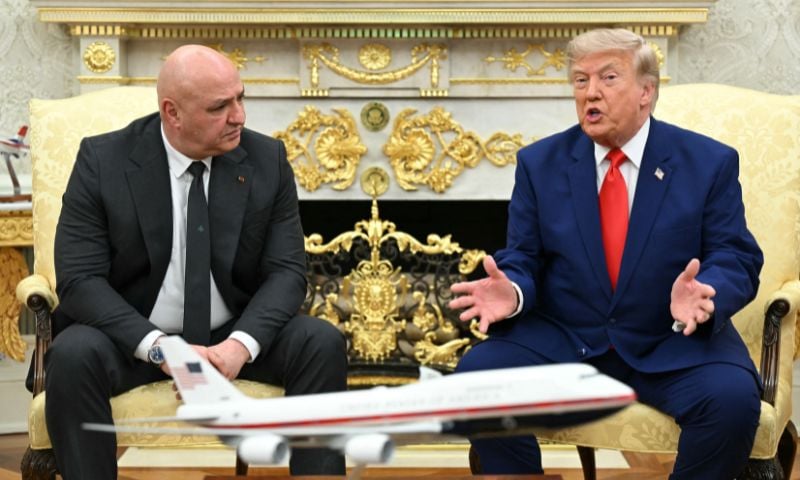
President Trump participates in a Bilateral Meeting with the President of the Republic of Lebanon https://t.co/NHyvU2BrGU
— The White House (@WhiteHouse) July 21, 2026
Trump warns Iran over nuclear programme
Speaking to reporters at the White House, Trump warned that the United States would strike any new Iranian site linked to its nuclear programme.
“We will absolutely attack the new site that they’re talking about,” Trump said, referring to what he claimed was a location where Iran intended to resume nuclear activities.
“Any site where they’re even thinking about nuclear, we’ll be hitting it very powerfully,” he added, while asserting that US military operations had significantly degraded Iran’s military capabilities.
Trump also acknowledged that Iran had managed to “slip something through” during a recent attack in Jordan.
Trump says US ‘not finished’ with Iran
The US President projected that it would take Iran more than 20 years to rebuild from damage sustained in the war, two weeks after fighting between the two sides resumed.
“If we left right now, it would take Iran 20, 25 years to rebuild,” he said. “We’re not finished at all… we’re not leaving right now.”
His comments came after Jordan, Kuwait and Bahrain came under attack Tuesday.
Bahrain said it intercepted Iranian attacks as sirens sounded multiple times in the kingdom, with Kuwait and Jordan also announcing they had intercepted drone and missile strikes.
Kuwait has said that Tehran hit multiple power and water desalination plants across the country over the past days, including on Monday, forcing residents to ration energy consumption.
US, Iran signal openness to diplomacy
Despite the continued exchange of military strikes, both Washington and Tehran have signalled they remain open to diplomacy.
A senior Iranian official, cited by Reuters, said on Monday that mediators had conveyed a proposal for a 10-day ceasefire aimed at de-escalating the conflict and reviving an interim agreement reached last month between Tehran and Washington.
Meanwhile, Iranian Foreign Ministry spokesman Esmaeil Baghaei said intermediaries had delivered fresh proposals to Iran in recent days and that negotiations with the United States could continue if they served Iran’s national interests.
Asked whether the door to talks with Washington had closed, Baghaei rejected the notion that diplomacy and military action were mutually exclusive.
“I reject the duality of either war or diplomacy. Diplomacy is a tool through which we pursue our national interests, just like war,” he said.
Meanwhile, US Secretary of State Marco Rubio said Washington would continue pursuing a diplomatic solution while insisting that any agreement with Tehran must be meaningful and fully implemented.
Speaking to reporters on Monday, Rubio accused elements within Iran of attempting to use the Strait of Hormuz as leverage against the international community.
“It is evident that some within Iran want to use the Strait of Hormuz as leverage against the rest of the world,” Rubio said.
Pakistan urges de-escalation and return to talks
On Tuesday, Prime Minister Sharif reaffirmed Pakistan’s commitment to promoting peace and stability in the Middle East.
He assured Iranian Interior Minister Eskandar Momeni that Islamabad would continue to play the role of an “honest and sincere mediator and facilitator” to de-escalate regional tensions and encourage dialogue.
Also Read: Pakistan Will Continue as Mediator and Facilitator for Middle East Peace: PM Sharif
Expressing deep concern over the recent escalation in the Gulf region, the prime minister urged all sides to exercise restraint and avoid actions that could further destabilise the region.
He reiterated Pakistan’s unwavering commitment to regional peace and stability, stressing that Islamabad would continue supporting dialogue and diplomatic engagement.
Pakistan-backed Islamabad MoU framework
Washington and Tehran have been testing the limits of escalation since Trump announced last week that the ceasefire agreement with Iran is over.
The US military’s Central Command said it concluded its latest round of attacks by hitting surveillance sites, military logistics infrastructure, underground weapons storage and maritime capabilities.
Under the Islamabad MoU, the US and Iran committed to halt military operations, reopen the Strait of Hormuz to commercial shipping and negotiate a comprehensive agreement covering Iran’s nuclear programme, US sanctions and a permanent ceasefire within 60 days.
Pakistan and Qatar subsequently co-mediated the first round of high-level negotiations in Lucerne, Switzerland, on June 21.
The talks were attended by US Vice President JD Vance and Iranian Parliament Speaker Mohammad Bagher Ghalibaf.
Pakistan’s diplomatic efforts
Pakistan is the principal mediator between the US and Iran after it secured a ceasefire on April 08 and hosted the highest level of talks between the two nations on April 12 and 13 in Islamabad.
Pakistan, which brokered the ceasefire and has continued to mediate between Washington and Tehran, has urged all parties to honour the agreement.
The first round of Pakistan and Qatar mediated US-Iran talks, led by US Vice President JD Vance and Iran’s Parliament Speaker Mohammad Baqer Ghalibaf, was held in Switzerland a week ago, and Washington waived sanctions on Tehran.
After the talks, Pakistan and Qatar announced significant progress in diplomatic efforts between the US and Iran following the conclusion of the first round of high-level talks in Switzerland.