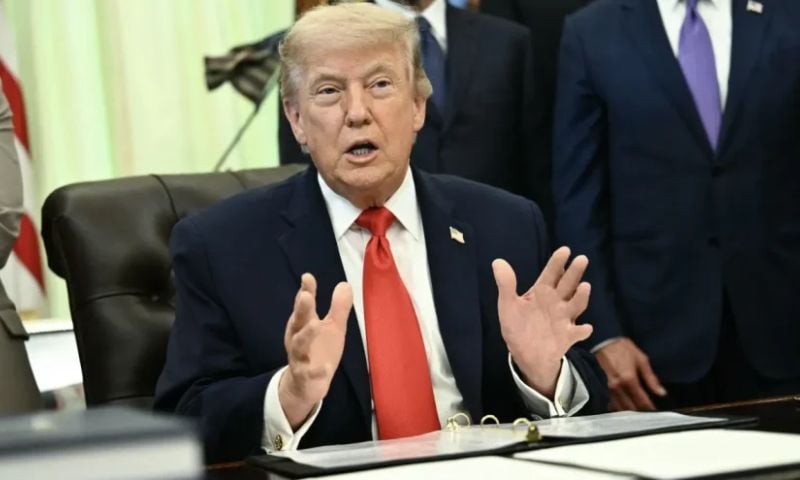
WASHINGTON: US President Donald Trump on Saturday said Iran “cannot be allowed to obtain a nuclear weapon,” reaffirming Washington’s main objective after Tehran announced it was suspending its commitments under the Islamabad memorandum of understanding (MoU) signed last month between the US and Iran.
Speaking in a brief phone interview with US cable network NewsNation, Trump said he “couldn’t care less” about Iran’s decision to suspend commitments under the Islamabad MoU. He said the United States would remain focused on preventing Tehran from acquiring nuclear weapons.
Trump also commented on the deaths of two US service members killed in an Iranian missile attack in Jordan, saying they died “in service to our country”.
NewsNation exclusive: President Donald Trump responded to the deaths of two U.S. service members who were killed in an Iranian missile attack in Jordan. Trump said the service members died “in service to our country” and reiterated that Iran cannot be allowed to obtain a nuclear… pic.twitter.com/JykOv5Upla
— NewsNation (@NewsNation) July 18, 2026
His remarks came after Iran’s Deputy Foreign Minister for Legal Affairs, Kazem Gharibabadi, announced that Tehran had suspended its commitments under the June MoU, accusing Washington of violating the agreement reached following weeks of US-Iran diplomacy aimed at ending the conflict that erupted earlier this year.
The Islamabad MoU was signed on June 18 by US President Donald Trump, Iranian President Masoud Pezeshkian, and Pakistan’s Prime Minister Shehbaz Sharif, following Islamabad brokered a ceasefire between Washington and Tehran.
Under the Islamabad MoU, the US and Iran committed to halt military operations, reopen the Strait of Hormuz to commercial shipping, and negotiate a comprehensive agreement covering Iran’s nuclear programme, US sanctions, and a permanent ceasefire within 60 days.
Renewed US-Iran escalation
Trump’s remark came as the conflict between the US and Iran entered another dangerous phase marked by an expanding military campaign across the region. The US military has widened its campaign against Iranian targets.
The US Central Command (CENTCOM) said it conducted an eighth consecutive night of strikes and specifically targeted units of Iran’s Islamic Revolutionary Guard Corps that it identified as being responsible for the attack in Jordan that killed the two American troops.
Meanwhile, Kuwait and Bahrain’s militaries said they were responding to Iranian aerial attacks, and air raid sirens sounded in the two Gulf countries as Tehran presses its strikes across the region.
“Kuwaiti air defences are currently confronting hostile missile and drone attacks, following the sinful Iranian aggression,” the army has said in a statement.
In Bahrain, the military said its air defences “confronted, intercepted, and destroyed a number of treacherous Iranian aerial attacks”.
Pakistan urges adherence to Islamabad MoU commitments
Pakistan on Saturday urged the United States and Iran to fully uphold their ceasefire commitments under the Islamabad MoU and avoid any actions that could further escalate regional tensions.
Pakistan’s Deputy Prime Minister and Foreign Minister Ishaq Dar received a telephone call today from his Kuwaiti counterpart Sheikh Jarrah Jaber Al-Ahmad Al-Sabah. During the telephone conversation, the two Foreign Ministers discussed the latest developments in the region, Pakistan’s Foreign Office said in a statement.
Ishaq Dar underscored the urgent need for de-escalation and stressed the importance of respecting the sovereignty and territorial integrity of all states. He emphasised that maintaining regional peace and security must remain the foremost priority.
Deputy PM Dar also underlined the importance of upholding ceasefire commitments under the Islamabad MoU and avoiding any actions that could further escalate tensions.
Foreign Minister Sheikh Jarrah shared Kuwait’s serious concerns regarding the continued attacks on its territory and expressed hope that restraint would be exercised by all sides and that the Islamabad MoU would be fully implemented.
Arab League chief warns of escalating regional violence
Meanwhile, Nabil Fahmy, the secretary-general of the Arab League, on Sunday warned that escalating tensions between the US and Iran risk plunging the region into further violence, destruction and economic decline.
In a statement, Fahmy has condemned Iranian attacks on Arab countries and said these states should not bear the cost of the conflict.
He has also called on the US and Iran to de-escalate, uphold the memorandum of understanding, respect freedom of navigation in the Strait of Hormuz and return to negotiations.
Islamabad MoU framework
Washington and Tehran have been testing the limits of escalation since Trump announced last week that the ceasefire agreement with Iran is over.
The US military’s Central Command said it concluded its latest round of attacks by hitting surveillance sites, military logistics infrastructure, underground weapons storage and maritime capabilities.
The Islamabad MoU was signed on June 18 by US President Donald Trump, Iranian President Masoud Pezeshkian and Prime Minister Shehbaz Sharif after Pakistan brokered a ceasefire between Washington and Tehran.
Under the Islamabad MoU, the US and Iran committed to halt military operations, reopen the Strait of Hormuz to commercial shipping and negotiate a comprehensive agreement covering Iran’s nuclear programme, US sanctions and a permanent ceasefire within 60 days.
Pakistan and Qatar subsequently co-mediated the first round of high-level negotiations in Lucerne, Switzerland, on June 21.
The talks were attended by US Vice President JD Vance and Iranian Parliament Speaker Mohammad Bagher Ghalibaf.
Pakistan’s diplomatic efforts
Pakistan is the principal mediator between the US and Iran after it secured a ceasefire on April 08 and hosted the highest level of talks between the two nations on April 12 and 13 in Islamabad.
Pakistan, which brokered the ceasefire and has continued to mediate between Washington and Tehran, has urged all parties to honour the agreement.
The first round of Pakistan and Qatar mediated US-Iran talks, led by US Vice President JD Vance and Iran’s Parliament Speaker Mohammad Baqer Ghalibaf, was held in Switzerland a week ago, and Washington waived sanctions on Tehran.
After the talks, Pakistan and Qatar announced significant progress in diplomatic efforts between the US and Iran following the conclusion of the first round of high-level talks in Switzerland.