UNITED NATIONS: The Permanent Mission of Pakistan to the United Nations has underlined that dialogue and diplomacy remain the most effective instruments for overcoming divisions and promoting mutual understanding in an increasingly fragmented world.
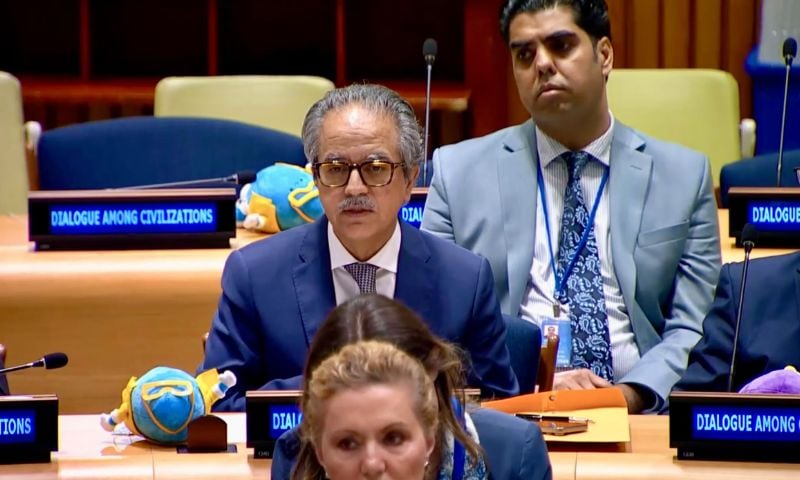
Speaking at a high-level event marking the International Day of Dialogue among Civilisations, organised by the Permanent Mission of China to the UN, Pakistan’s Permanent Representative Ambassador Asim Iftikhar Ahmad stressed that inter-civilisational dialogue has become indispensable at a time when global peace and harmony face multiple and complex challenges.
At UN, Pakistan Terms Inter-Civilizational Dialogue as Key to Addressing Contemporary Challenges
– Our Press Release today pic.twitter.com/7rAhNpb3K9
— Permanent Mission of Pakistan to the UN (@PakistanUN_NY) June 11, 2026
He said the current period of history demands renewed commitment to dialogue as a means of bridging differences, adding that it is through such engagement that human civilisation has historically built trust, respect and pathways towards shared progress.
Ambassador Ahmad observed that the United Nations system, established in the aftermath of the Second World War, continues to recognise the strong link between international peace and dialogue among civilisations, cultures and faiths.
He reiterated that Pakistan views dialogue and diplomacy as “the most effective tools to transcend differences and foster mutual understanding and cooperation,” noting that such principles are central to its foreign policy orientation.
Highlighting Pakistan’s geographical and civilisational context, he described the country as being situated at the crossroads of the Middle East and West, South and Central Asia, and said it has historically served as a melting pot of diverse civilisations, religions and cultures.
He added that values such as interfaith harmony, peaceful coexistence, diversity, pluralism and dialogue are not only defining features of Pakistani civilisation but also serve as guiding principles in its foreign policy approach.
Ambassador Ahmad further recalled Pakistan’s joint sponsorship with the Philippines of a United Nations General Assembly resolution titled “Promotion of Interreligious and Intercultural Dialogue, Understanding and Cooperation for Peace,” which was adopted by consensus on 20 May.
He noted that Pakistan remains committed to working closely with all Member States to advance shared objectives relating to dialogue among civilisations, cultures and faiths in pursuit of global peace and prosperity.
The envoy also acknowledged remarks delivered by senior international figures, including Wang Yi, UN Secretary-General António Guterres, President of the General Assembly, and High Representative of the UN Alliance of Civilisations Miguel Ángel Moratinos, as well as President of Colombia Gustavo Petro.
He said these interventions reflected a shared global understanding of the urgency of fostering dialogue in an era marked by geopolitical tensions and social fragmentation.
Concluding his statement, Ambassador Ahmad reaffirmed that Pakistan will continue its constructive engagement with the United Nations and all Member States to advance the cause of inter-civilisational understanding, cooperation and global peace.