NEW DELHI: A youth-led protest movement fuelled by anger over unemployment and examination paper leaks is emerging as a fresh challenge for Prime Minister Narendra Modi’s government.
The protesters are demanding the resignation of Education Minister Dharmendra Pradhan and sweeping reforms to India’s examination system.
The Cockroach Janta Party (CJP) led protest movement gained momentum, with growing concern over the deteriorating health of educationist and climate activist Sonam Wangchuk who is observing an indefinite hunger strike demanding government accountability.
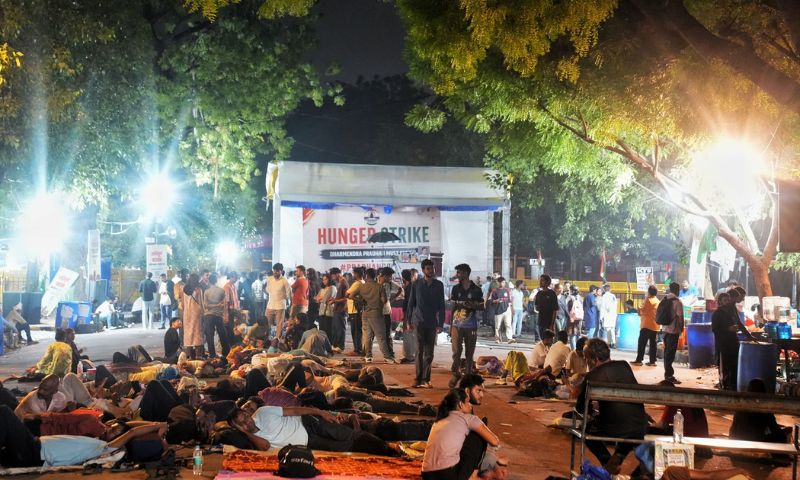
Wangchuk, 59, has been on a hunger strike for nearly three weeks at New Delhi’s Jantar Mantar protest site in support of the youth movement, which emerged in May following examination paper leaks and widespread frustrations over unemployment and governance.
“If not fasting, what? Riots in the streets? That’s what we don’t want to do. So this is a peaceful way to take your voice to the government,” Wangchuk said at the protest camp, where supporters have continued to monitor his condition.
I would like to express my deepest gratitude to Samajwadi Party Leader and MP @dimpleyadav ma’am for joining our protest at Jantar Mantar and extending support to our movement.@CJP_for_India pic.twitter.com/anSZiA0UME
— Cockroach Janta Party (@CJP_for_India) July 16, 2026
The protest has become one of the most prominent youth-led movements challenging Prime Minister Narendra Modi’s government. Organisers are accusing authorities of ignoring demands for the resignation of Education Minister Dharmendra Pradhan and reforms to India’s examination system.
Movement born from controversy
The Cockroach Janta Party was launched in May by Abhijeet Dipke, a graduate of Boston University, after comments by India’s Supreme Court Justice Surya Kant comparing unemployed young Indians to “cockroaches” triggered widespread outrage.
Dipke called on India’s “cockroaches” to unite, prompting demonstrations in New Delhi, Pune, Jaipur, Bengaluru and other cities.
The movement initially focused on examination paper leaks, particularly those involving the National Eligibility-cum-Entrance Test (NEET), India’s highly competitive medical entrance examination, before expanding into a broader campaign addressing unemployment, institutional accountability and governance.
Wangchuk’s health condition deteriorates
Organisers say Wangchuk’s condition has deteriorated significantly.
“Sonam sir is not doing so well, and his rib cage has started showing,” Vijeta Dahiya, spokesperson for the Cockroach Janta Party, told reporters in New Delhi.
सोनम वांगचुक सर का तबियत दिन प्रतिदिन बिगड़ता जा रहा है,
पर इस सोई हुई सरकार को कुछ भी सुनाई नहीं दे रहा है,अब तो हद हो गई है।🥺 pic.twitter.com/Z3IT3OyfIz
— Cockroach Janta Party (@CJP_for_India) July 16, 2026
“He has lost muscle mass. The heat and humidity are not helping either and I can see him having dizzy spells,” Dahiya said, adding that Wangchuk had survived on salt water for 19 days and lost more than nine kilograms.
The Delhi High Court on Thursday directed the government to monitor Wangchuk’s health regularly and provide medical treatment if necessary after hearing an urgent petition concerning his condition.
Despite growing concern, Wangchuk has refused calls to end the fast.
According to filmmaker and author Natasha Badhwar, who recently met the activist, Wangchuk urged supporters not to focus on ending his protest.
“He told us not to save him or ask him to stop his hunger strike and instead put the same energy into the cause and press the government to listen to the demands of the youth,” she said.
Exam leaks and youth anger
The protesters are demanding Education Minister Dharmendra Pradhan’s resignation after the cancellation of this year’s NEET examination following question paper leaks.
They are also seeking sweeping reforms to India’s examination system and compensation for families of students who died by suicide following examination controversies.
“Paper leaks have been recurring for years,” Dahiya said.
“In fact, according to our records, 22 disillusioned students committed suicide following this year’s NEET paper leak.”
Organisers say the protest has grown into a broader campaign to restore trust in institutions, including the judiciary, political system and media.
“The system needs a complete overhaul because the current system is no longer accountable or even taking basic responsibility,” Dipke said.
Unemployment fuelling discontent
The movement has also tapped into growing frustration over unemployment among India’s educated youth.
According to the university’s latest State of Working India report, India had 63 million graduates aged between 20 and 29 in 2023, of whom around 11 million were unemployed.
The report also found that nearly 40% of graduates aged 15 to 25 and around 20% of those aged 25 to 29 were unemployed, significantly higher than among less educated groups.
It said India has the world’s largest youth population, with 367 million people aged between 15 and 29, including 263 million outside formal education and constituting the country’s potential workforce.
The report concluded that the country’s labour market has failed to generate sufficient salaried employment for graduates in recent years.
Growing support but limited govt response
The movement has attracted support from opposition politicians, Bollywood personalities and civil society figures, while Wangchuk’s participation has broadened its appeal beyond students.
Known internationally for developing the “ice stupa” water conservation system and recipient of the Ramon Magsaysay Award, Wangchuk has become the movement’s most recognisable face.
“His coming aboard has given our cause a huge boost,” Dahiya said.
The protests at Jantar Mantar have generally attracted several hundred demonstrators during the day, with organisers saying attendance rises to around 1,000 in the evenings despite heavy monsoon rains.
Supporters have travelled independently to New Delhi, where they have camped for weeks inside the designated protest area without a formal organisational structure.