
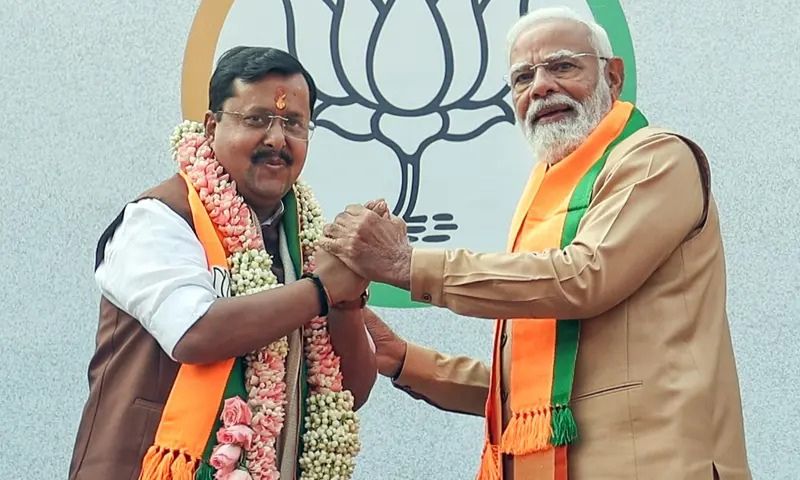



NEW DELHI: India’s ruling Bharatiya Janata Party (BJP) has appointed Nitin Nabin, a close ally of Prime Minister Narendra Modi who faces multiple criminal cases, as its new national president, a move critics say underscores the party’s growing emphasis on personal loyalty over democratic accountability under Modi’s leadership.
Nabin will be succeeding J.P. Nadda after the completion of his full term. He is from Patna, Bihar, and is a five-term Member of the Legislative Assembly (MLA) representing the Bankipur constituency.
This appointment occurred unopposed, with full support from the party’s top leadership, including Prime Minister Narendra Modi, Amit Shah, and others. At the age of 45, Nitin Nabin has become the youngest National President in the history of the BJP.
“Blue-Eyed” loyalist
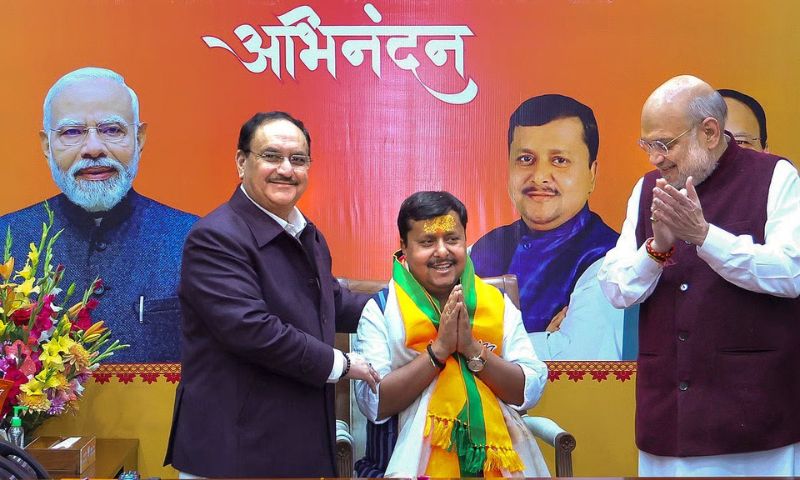
Blue eyed chary picked of the so-called “Modi–Amit-Doval (MAD) troika”, Babin has a long association with the BJP, and Modi personally proposed his name for the presidency.
The elevation of Nitin Nabin as BJP National President exemplifies how Narendra Modi’s India prioritises loyalty, lineage, and coercive politics over accountability and democratic norms.
Political experts say Modi personally proposing Nabin’s name for the presidency was not incidental—it was symbolic.
In today’s BJP, proximity to the leader matters more than performance in office or credibility among the public, according to political experts.
Ceremony without introspection
Modi’s at Nitin Nabin’s presidential ceremony “Shunya to Shikhar” celebrated the BJP’s rise while sidestepping uncomfortable realities.
There was no mention of democratic backsliding, no reflection on the rushed abrogation of Article 370 that deepened unrest in Indian Illegally Occupied Jammu and Kashmir, and no acknowledgment of widening inequality and the marginalisation of minorities.
Welfare slogans replaced substantive reform; triumphalism stood in for introspection.
This selective storytelling has become a hallmark of Modi’s political style—one that glorifies power while insulating it from critique.
Nabin is the nepo kid of RSS (Rashtriya Swayamsevak Sangh). Nabin is a product of the Sangh–BJP ecosystem, born into a Janta Sangh/BJP political family.
After the death of his father, a long-time BJP MLA from Patna West, he entered politics and rose as an “organisation man”, reflecting the BJP’s preference for internal obedience over public leadership under Modi’s centralised command structure.
Nabin’s criminal record
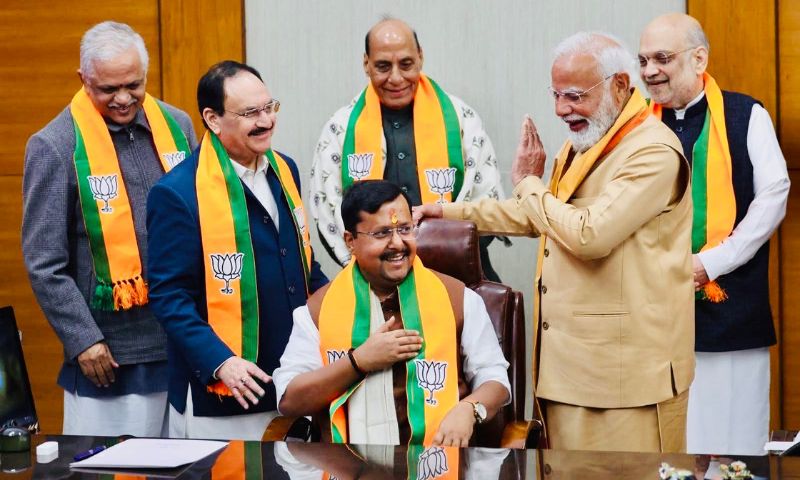
Nabin’s record also highlights the normalisation of criminalisation in Indian politics.
He has five pending criminal cases, all linked to political protests involving unlawful assembly, rioting, and public disobedience.
While there are no convictions, their routine acceptance underscores how BJP leaders are insulated from scrutiny while dissenters face repression.
Perhaps most revealing was Nabin’s 2017 decision to file a sedition complaint against Congress leader Abdul Jalil Mastan for allegedly insulting Prime Minister Modi.
Rather than defending free speech, Nabin attempted to weaponise a colonial-era law to silence political opposition—an approach that closely mirrors the Modi government’s broader use of sedition and policing to protect authority rather than constitutional values.
Governance failures, rewarded
As Bihar’s Road Construction Minister, Nabin presided over a period marked by alarming infrastructural failures.
In 2024 alone, around 15 bridges collapsed across the state, causing widespread disruption and an estimated loss of nearly US $ 43.5 million.
Opposition parties raised serious allegations of corruption, negligence, and poor oversight. Yet there were no resignations, no inquiries with teeth, and certainly no political consequences. Instead, Nabin’s career advanced.
Symbol, not an exception
Nitin Nabin’s ascent is not an aberration; it is emblematic of a system that rewards fidelity to power over service to democracy.
His journey—from a Sangh-bred political heir with a contentious record to the unchallenged head of the world’s largest political party—captures the essence of contemporary BJP politics.
Nitin Nabin’s rise signals a deeper reality: in Modi’s India, governance failures are forgiven, dissent is criminalised, and loyalty is rewarded. He is not an anomaly; he is a symbol of the system itself.