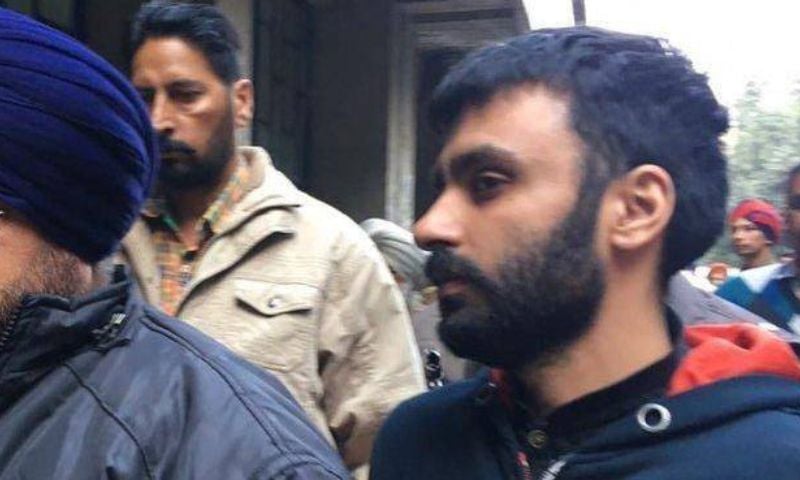
GENEVA: United Nations experts on Wednesday said India’s prolonged detention of Scottish Sikh blogger and activist Jagtar Singh Johal amounts to “psychological torture”, calling for his immediate release and an independent investigation into alleged abuses.
A group of 10 independent experts, including special rapporteurs on torture and on human rights while countering terrorism, said Johal has spent more than eight years in detention without a foreseeable conclusion to his case.
“Over eight years — 3,089 days — in prison without a foreseeable end to his case,” the experts said in a statement, warning that “the prolonged uncertainty alone is a form of psychological torture”.
“International law is unequivocal: torture includes severe mental suffering caused by prolonged uncertainty while awaiting trial,” they added.
The experts are mandated by the United Nations Human Rights Council but do not speak on behalf of the United Nations.
Arrest and abuse in detention
Johal was arrested in November 2017 while visiting India for his wedding, on accusations of involvement in a terror plot targeting right-wing Hindu leaders.
According to the UN experts, he was held incommunicado for 10 days following his arrest.
During that period, he was allegedly subjected to mistreatment, including electric shocks and threats to his life.
The experts also cited concerns over his detention conditions, including restricted contact with family, limited access to basic hygiene, and periods of solitary confinement.
‘Profound miscarriage of justice’
The statement noted that a court acquitted Johal in March 2025 in one of terrorism-related cases.
However, he remains in custody facing similar charges.
“The fact that he was acquitted, yet still faces near-identical charges, raises serious concerns about double jeopardy, the presumption of innocence, the misuse of counter-terrorism laws, and the integrity of the proceedings,” the experts said.
They described the case as reflecting “a profound miscarriage of justice”, citing the reliance on contested evidence, multiple proceedings on similar charges, and allegations that Johal may have been targeted because of his faith.
Torture and ill-treatment in custody
The experts urged Indian authorities to drop the remaining charges and release Johal “without delay”.
They also called for “a full, prompt and independent investigation” into allegations of torture and ill-treatment, as well as concerns over the administration of justice.
“Time is not neutral,” the statement said.
“The long wait for an outcome has already caused intolerable anxiety and stress, and constitutes an unacceptable harm prohibited under international human rights law.”
Concerns over rights and detentions
Rights groups and advocacy organisations have raised broader concerns about the treatment of detainees and minorities in India.
Sidhu Dabinderjit Singh of the Sikh Federation (UK) has said that Sikh activists have faced arbitrary detention and torture, and that Johal has never been convicted of a crime.
Reports by organisations such as Human Rights Watch have also criticised the use of laws including the Unlawful Activities (Prevention) Act (UAPA), the Foreign Contribution Regulation Act (FCRA), and the National Security Act (NSA), saying they are sometimes used to curb dissent.
The Sweden-based V-Dem Institute has classified India as an “electoral autocracy” in its Democracy Report 2025, citing concerns over declining civil liberties and increasing restrictions on free expression.
Minority rights and violence
Human rights organisations have pointed to rising incidents affecting minorities.
A report by the Association for Protection of Civil Rights documented 947 hate-related incidents between 2024 and 2025, including cases of physical violence.
Separately, reports on policing practices, including by Common Cause, have raised concerns over custodial torture, particularly affecting minorities such as Muslims, Christians, and Sikhs.
Violence in the northeastern state of Manipur has also drawn international attention.
According to Human Rights Watch, more than 260 people have been killed and around 60,000 displaced since 2023.
Targeting of Sikh activists abroad
The case comes amid broader international scrutiny of Indian actions targeting Sikh activists overseas.
In 2025, US federal prosecutors charged Indian national Nikhil Gupta in connection with a foiled plot to assassinate Sikh activist Gurpatwant Singh Pannun in the United States.
Prosecutors said Gupta acted on instructions from an individual linked to India’s external intelligence agency.
Gupta pleaded guilty in February 2026 to charges including murder-for-hire and conspiracy, according to the US Department of Justice.
The case has been described by investigators as an instance of “transnational repression”.
Separately, Canadian authorities have revealed links between Indian officials and the 2023 killing of Sikh leader Hardeep Singh Nijjar.