
Key points
- India considers levies on Liquefied Petroleum Gas (LPG) and natural gas users
- Proposed reserve would cover crude, LNG and LPG
- Middle East disruptions exposed gaps in energy security
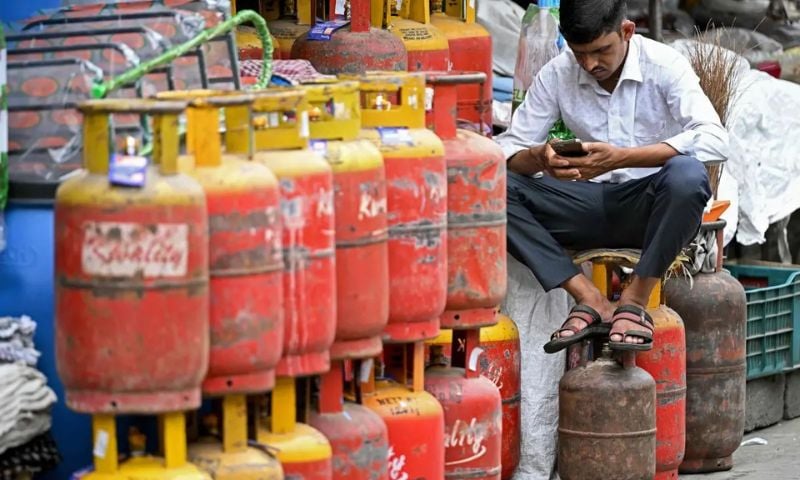
ISLAMABAD: India has been mulling the imposition of new charges on consumers of liquefied petroleum gas (LPG) or cooking gas and natural gas (NG) to finance a planned $42 billion strategic fuel reserve.
Disruptions in energy supplies due to the conflict in the Middle East exposed vulnerabilities in the country’s energy supply system.
The exposure has forced the Indian government to build a strategic buffer to absorb oil shocks like the one caused by the Iran-US war.
The proposed plan would enhance India’s strategic stockpiling capacity beyond crude oil to include liquefied petroleum gas (LPG) and liquefied natural gas (LNG).
The Indian government plans to create a multi-fuel buffer designed to protect consumers and industries from prolonged interruptions to international supplies.
Under the proposal, LPG consumers could face a levy of Rs 1.29 per kilogram, whereas natural gas users could be charged Rs 1.43 per cubic metre.
The charges could generate roughly $1.5 billion a year, according to Reuters, which cited sources familiar with the plan.
The proposed levies have yet to receive approval from Prime Minister Narendra Modi’s cabinet.
The additional charges could increase household gas bills by about 2 per cent, making the proposal politically sensitive at a time when energy prices and the cost of living remain major concerns.
The proposed reserve is expected to be developed over 10 years, with the funds primarily directed towards storage infrastructure.
The government would continue to finance strategic crude reserves separately, according to the sources cited by Reuters.
ALSO READ: India Faces Energy Squeeze as US Ends Oil Waivers
The planned stockpiles are intended to provide India with nearly two months of LNG and crude oil demand and about six weeks of LPG consumption.
Such reserves would give the world’s most populous country greater room to absorb disruptions to shipping routes, imports and international energy markets.
India’s import dependence
The International Energy Agency (IEA) has highlighted the vulnerability created by India’s dependence on imported energy.
India was already the world’s second-largest crude oil net importer in 2023, importing about 4.6 million barrels per day. The IEA expects crude imports to rise to about 5.8 million barrels per day by 2030 as refinery demand expands.
India’s exposure is not confined to crude oil. The IEA expects the country’s LNG imports to more than double from 2023 to 2030. LNG imports reached 36 billion cubic metres in 2024, making India the world’s fourth-largest LNG importer, and the agency projects demand to reach 64 billion cubic metres annually by 2030.
That rising dependence makes storage increasingly important as LNG is transported by specialised vessels and is vulnerable to interruptions at maritime chokepoints.
India’s reliance on imported gas could also increase if domestic production fails to keep pace with demand.
The IEA said in its latest gas market assessment that disruptions to LNG flows through the waterway since March had prompted demand-side measures and fuel switching across Asian markets.
India already maintains strategic crude oil reserves, but the scale of its existing storage is modest compared with its enormous consumption requirements. The country currently has strategic crude storage capacity of 5.33 million tonnes, with another 6.5 million tonnes under construction, according to figures cited by Reuters.
The US Energy Information Administration (EIA) estimated India’s strategic crude inventories at about 21 million barrels in the first quarter of 2026. By comparison, China held an estimated 1.54 billion barrels, Japan 263 million barrels and South Korea 78 million barrels.
The IEA requires its member countries to maintain oil stocks equivalent to at least 90 days of net imports and has repeatedly stressed the importance of emergency inventories in protecting economies from major supply disruptions.
For India, the challenge is balancing the cost of preparedness against the political and economic burden of paying for it.
A consumer-funded reserve could provide a predictable source of financing without putting the entire cost on the government budget. But even a relatively small levy can become contentious when applied to essential household fuels used by hundreds of millions of people.
The proposal also raises questions about how quickly the planned reserves could be built and whether the revenues generated by the levies would be sufficient to finance the infrastructure required.