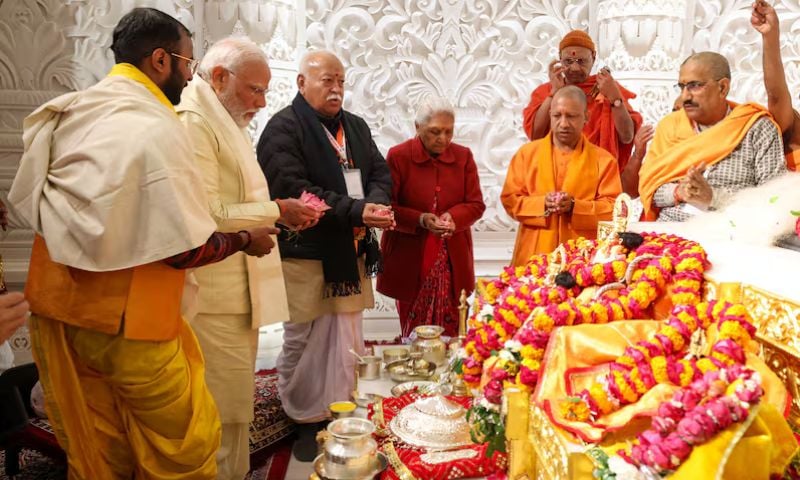
NEW DELHI: India’s opposition on Sunday questioned Prime Minister Narendra Modi’s silence after large-scale embezzlement of donations at the Ayodhya Ram temple, with Congress leaders Rahul Gandhi and Mallikarjun Kharge demanding an independent investigation into the financial affairs of the Shri Ram Janmabhoomi Teerth Kshetra Trust and transparency in the handling of devotees’ offerings.
In a joint letter, Rahul Gandhi and Mallikarjun Kharge said millions of devotees who had donated with “faith, devotion and trust” now felt “betrayed by the theft” and accused the prime minister of remaining silent on the controversy.
Our joint letter to PM Modi demanding an independent and comprehensive investigation into the financial affairs of the Shri Ram Janmabhoomi Teerth Kshetra Trust. Lakhs of devotees who donated their hard- earned money with faith, devotion and trust are feeling betrayed by the… pic.twitter.com/FxrQA0YDk7
— Mallikarjun Kharge (@kharge) July 19, 2026
The letter came weeks after police launched an investigation into the theft of donations at the temple.
Authorities have arrested eight people in connection with the case following an FIR registered on June 25 on a complaint filed by the Trust. Two senior functionaries associated with the Trust have also resigned.
While officials have not disclosed the amount embezzled, Indian media reports estimate the fraud at around 30 million rupees (about $314,000).
Opposition demands accountability
Sharing the letter on X, Congress president Kharge said it sought an “independent and comprehensive investigation” into the Trust’s financial affairs, adding that devotees who had contributed their hard-earned money were feeling “betrayed by the theft”.
In the letter, Gandhi and Kharge said Modi had announced the formation of the Trust in Parliament following directions from India’s Supreme Court, but argued that its members had been appointed solely by his government.
“It is public knowledge that the members of the Trust are affiliated with the RSS, VHP and its affiliates. Its disgraced former General Secretary was also your close associate,” the opposition leaders wrote.
They said the prime minister’s silence was “unacceptable” and urged him to ensure accountability and restitution.
“We urge you to immediately order an independent and comprehensive investigation into the financial affairs of the Trust, including the handling of all offerings, including cash, gold and silver,” the letter said.
The Congress leaders also demanded that the Trust’s accounts and the findings of any investigation be made public so devotees could know how their offerings had been managed and utilised.
“All those found responsible must be held accountable, irrespective of position or influence. The credibility of your government and the Trust rests on how transparently and swiftly you act. The people of India are watching,” they wrote.
Massive corruption scandal
The controversy erupted in early June after allegations surfaced that donations offered by devotees at the temple had been stolen. Police launched an investigation and arrested eight people responsible for handling donations at the shrine.
The Ram temple, inaugurated by Modi in 2024, has become one of India’s most prominent religious sites, attracting an average of about 90,000 visitors each day.
Devotees regularly donate cash, gold, silver ornaments and other valuables, generating a continuous flow of offerings.
The case has angered many devotees who regard temple donations as an act of faith.
Also Read: Massive Corruption Found in Indian Grand Ram Temple Funds
“When we donate, we believe the money is going for God’s work,” said Ashok Prasad Kushwaha, an auto-rickshaw driver in Delhi who has visited the temple three times in the past two years. “Now if that hard-earned money gets stolen from a place like a temple, it feels like personal loss.”
Transparency concerns at religious institutions
The allegations have renewed broader concerns over financial oversight at India’s major religious institutions, many of which manage vast donations but operate under different legal and regulatory frameworks.
The Tirumala Tirupati Devasthanams, one of the world’s wealthiest temple trusts, is estimated to hold assets worth about $31 billion. Similar concerns have previously emerged over the handling of donations at the Badrinath shrine.
Experts say the latest scandal has exposed weaknesses in financial transparency and independent oversight.
“The core systemic problem is the lack of transparency and accountability,” said Rahul Easwar, a Hindu activist and grandson of a former chief priest of Kerala’s Sabarimala temple.
He said major religious institutions should adopt stronger safeguards, including mandatory receipts, digital accounting systems, CCTV monitoring of donation handling and independent audits.
According to Indian media reports, those accused in the Ayodhya case exploited weaknesses in donation-counting procedures and surveillance systems.
Political analyst Anurag Naidu said institutions handling large public donations should be subject to stronger governance standards.
“Religious institutions have grown far beyond traditional places of worship,” he said. “They need institutional systems with financial controls and independent oversight.”
Dispute over Ram temple site
The allegations are especially sensitive because the temple stands on a site linked to one of India’s longest-running and most divisive religious disputes.
In 1992, Hindu extremist mobs demolished the Babri mosque at the site, triggering nationwide violence that killed more than 2,000 people.
In 2019, India’s Supreme Court awarded the disputed land for construction of the temple.
A nationwide fundraising campaign was launched for the temple construction. According to the temple trust, the campaign raised around $341 million.
Legal experts say India has no uniform national framework to ensure consistent financial transparency across all religious institutions, as they operate under different laws and tax systems.
Political analyst Anurag Naidu said temples handling huge donations now need institutional safeguards similar to major public bodies.
“Religious institutions have grown far beyond traditional places of worship,” he said. “They need institutional systems with financial controls and independent oversight.”
The latest controversy comes just ahead of the monsoon session of India’s Parliament, where the opposition is expected to press the government over the massive corruption scandal and demand greater transparency in the management of public donations to religious institutions.