NEW DELHI: India’s growing commercial and strategic engagement with Iran could expose New Delhi to increasing friction with the Trump administration as Washington steps up sanctions against Tehran and warns countries against helping Iran circumvent its economic restrictions.
The issue presents a delicate balancing act for India, which regards the United States as a crucial strategic partner in the Indo-Pacific while maintaining longstanding economic, energy and geopolitical interests in Iran.
The Trump administration has launched a fresh sanctions campaign against Iran under what it calls “Operation Economic Outcast”, while warning that countries continuing to facilitate Iranian trade could face secondary sanctions.
The latest US pressure has already brought India into Washington’s focus. The US Treasury Department has sanctioned four India-based companies and three Indian nationals over involvement in Iranian petroleum and petrochemical transactions.
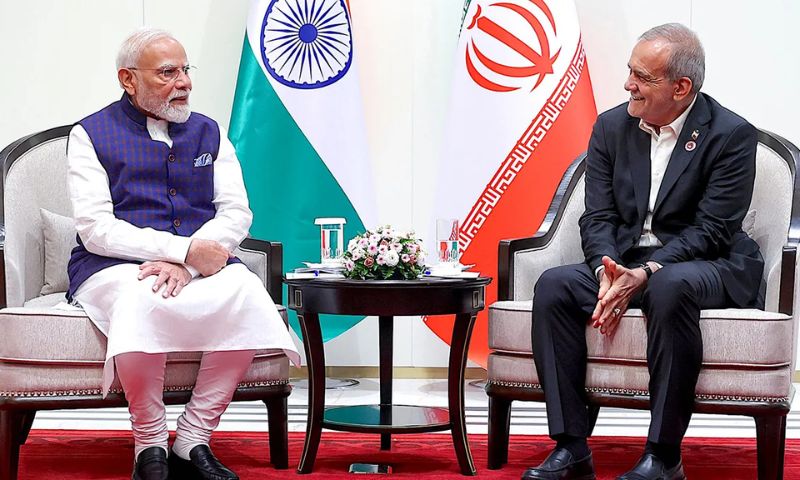
So far, however, Washington’s measures have stopped short of targeting India’s broader economic relationship with Tehran. The potential for further confrontation became more apparent after Prime Minister Narendra Modi met Iranian President Masoud Pezeshkian on the sidelines of the Shanghai Cooperation Organisation summit in Bishkek, Kyrgyzstan, on August 31.
The meeting was the first between the two leaders since the war erupted six months ago. According to Fox News, quoting an Iranian account of the meeting, President Pezeshkian expressed appreciation for India’s position towards Tehran.
Mr Modi, meanwhile, reaffirmed New Delhi’s interest in strengthening its longstanding relationship with Iran and expanding and diversifying bilateral trade.
Washington warns against helping Iran
US Secretary of State Marco Rubio has made clear that Washington will not tolerate efforts by foreign countries to help Iran evade American sanctions. Asked about the Modi-Pezeshkian meeting, Mr Rubio said that countries could maintain diplomatic contacts with Tehran, but warned that governments should not assist Iran in developing mechanisms to generate revenue that Washington believes could be used to support terrorism or advance Iran’s nuclear programme.
He added that countries choosing to facilitate such activities could themselves face US sanctions.
According to a US official, the administration remained engaged with economic partners to ensure that Iran does not acquire a nuclear weapon. The warnings are particularly significant for India because, although its relationship with Iran has been substantially reduced by previous rounds of sanctions, it has not disappeared.
Bilateral trade remains important
India has been among Iran’s leading trading partners in recent years, although bilateral commerce has fallen sharply from its peak in 2018-19.
Indian exports to Iran also include pharmaceuticals and agricultural products.
Iran is also an important destination for Indian rice. India exported more than $383 million worth of rice to Iran during the first six months of this year, according to the reported figures. Energy ties have also begun to re-emerge.
India resumed imports of Iranian crude oil in April, marking the first such purchases in seven years, after the Trump administration temporarily eased sanctions as it sought to limit the economic consequences of the Middle East conflict.
Iranian oil shipments to India were valued at approximately $707 million during the first half of the year. Any further tightening of US sanctions could therefore create difficulties for Indian companies, banks, shipping firms, insurers and other intermediaries involved in Iran-related commerce.
Chabahar remains a strategic concern
India’s interests in Iran extend beyond trade and energy. A particularly important element is Chabahar Port, which provides India with a maritime gateway to Afghanistan and Central Asia and potentially to wider markets in the region and Europe. For New Delhi, the port has long been viewed as a strategically important component of its regional connectivity plans.
However, the threat of US sanctions has repeatedly complicated India’s activities surrounding Chabahar and created uncertainty for companies involved in developing and operating the port.
The latest US campaign could therefore present New Delhi with another difficult calculation: how to preserve its strategic interests in Iran while avoiding measures that could jeopardise its much broader relationship with Washington.
Dubai trade route also under pressure
The impact of the sanctions campaign could extend beyond direct India-Iran transactions. The United Arab Emirates has suspended commercial and financial dealings with Iran, placing additional pressure on Indian exporters that have traditionally relied on Dubai as a major trading and financial hub for Iran-related business.
Any disruption to established payment, shipping and insurance channels could raise costs and complicate legitimate Indian exports to the Iranian market. Iran, meanwhile, has warned of serious consequences for countries that cooperate with what Tehran considers unlawful US measures.
India has previously demonstrated that it is prepared to resist US pressure when it considers vital national interests to be at stake. Its continued relationship with Russia, despite Washington’s opposition to some aspects of India-Russia economic and energy cooperation, is one example.
For New Delhi, higher international oil prices remain a major concern because India is one of the world’s largest oil importers and consumers. Any disruption in Middle Eastern energy supplies could increase import costs, inflationary pressure and risks to economic growth.
US-India relationship faces another test
The dispute over Iran comes at a sensitive time for US-India relations. Washington regards India as an important strategic partner in the Indo-Pacific, particularly as it seeks to strengthen regional cooperation and counterbalance China.
At the same time, relations between President Donald Trump and Prime Minister Modi have experienced tensions despite recent efforts by India to reset the bilateral relationship. The Iran sanctions issue could add another layer of difficulty.
READ ALSO: Iran Warns Countries Aligned with US Sanctions of “Difficulties” in Hormuz Strait
For Washington, imposing secondary sanctions on a major strategic partner such as India could carry diplomatic costs. For New Delhi, however, maintaining extensive trade and energy links with Iran could risk provoking further US action.
The balance may ultimately depend on how aggressively the Trump administration chooses to enforce its secondary-sanctions policy. India has considerably stronger commercial ties with the United States than with Iran, meaning that New Delhi would face significant economic incentives to avoid a confrontation with Washington.
The immediate question is therefore not whether India will abandon its relationship with Iran, but how far New Delhi can preserve its remaining economic and strategic interests in Tehran without triggering tougher US sanctions. With Washington intensifying its campaign against Iran, India’s ability to maintain that delicate balance is likely to face an increasingly difficult test.