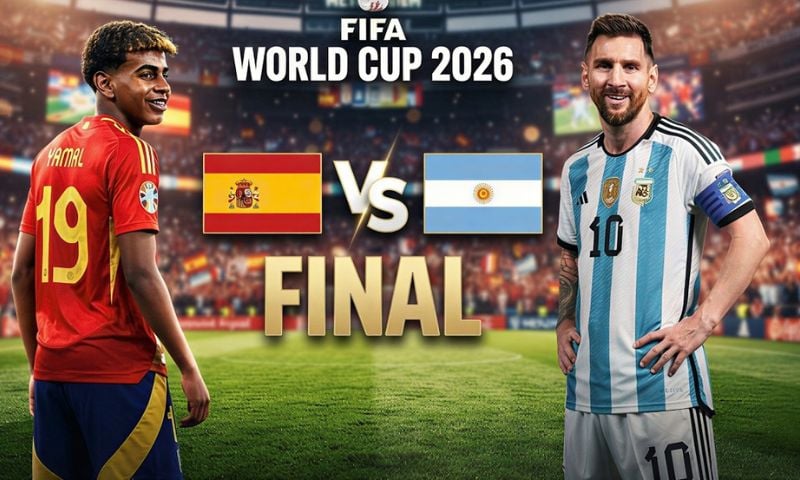



ISLAMABAD: FIFA World Cup 2026 final has become more than just a sporting spectacle, it has evolved into a geopolitical battleground where historical rivalries, political alliances, and cultural identities collide.
As Spain prepares to face defending champions Argentina on Sunday, the question of “who supports who” has exposed deep divisions that transcend the beautiful game.
In a remarkable display of regional animosity, Latin American nations that traditionally unite behind their continent’s representatives have coalesced around an unlikely ally: Spain. Meanwhile, Palestinians and Arab communities worldwide have thrown their weight behind La Roja, driven by Madrid’s vocal support for their cause.
Read Also: Messi’s Argentina, Spain Brace for World Cup Final
Latin America turns its back on Argentina
The flood of memes, jokes, and criticism across social media has made one thing abundantly clear: Argentina has become the exception to Latin American solidarity. One viral photoshopped image showing Spain’s star Lamine Yamal wearing a Brazilian jersey with the caption “The hope of the Brazilian people” captures the sentiment sweeping across the region.
“It’s not just about football anymore,” explains Colombian sociologist German Gomez. “The dynamic of solidarity has been broken with Argentina.”
The animosity stems from widespread perceptions that Argentina has received preferential treatment from FIFA.
Brazilian fan Francisco Santos, 42, trading World Cup stickers in Sao Paulo, expressed what many feel: “Argentina has had help from referees. If Brazil could not become six-time champions, I would rather see Spain become two-time champions than Argentina become four-time champions.”
Reasons to back Spain 🇪🇸 for the World Cup ⚽️ final:
🇪🇸 wants a Free Palestine 🇵🇸
🇪🇸 will never bend the knee to Trump 🇺🇸
🇪🇸 calls out genocide & refuses to turn awayViva España 🇪🇸
🇪🇸 💚 🇵🇸 pic.twitter.com/VLvrD9Gt9Y
— Howard Beckett (@HowardRBeckett) July 17, 2026
‘Argentina has had help from referees’
The allegations of favouritism have taken root across the continent. In Bogota, finance worker Juan Camilo Abusaid, 28, declared: “We’re going to cheer for Spain.” Mexican police officer Antonio Lopez, 51, acknowledged Messi as a “legend” but added: “If you’re going to sweat and break your back on the pitch to become champions twice, I accept that. If referees are going to help you, I don’t.”
The sentiment has even reached the highest levels of government. When Mexican President Claudia Sheinbaum jokingly asked journalists which team they supported, the unified response was “Spain! Spain!”
🇮🇩🇪🇸🇦🇷This isn’t Spain. It’s Indonesia, where a huge crowd of Indonesians marched carrying Spanish flags to support Spain ahead of tomorrow’s 2026 World Cup final against Argentina. pic.twitter.com/aG6a0Rz8k3
— The Saviour (@TheSaviour) July 18, 2026
‘We are unbearable’: Argentinian pride meets regional backlash
Messi himself has acknowledged the strong feelings surrounding the team. “Four years ago, we achieved what we wanted: to play the final and be the best for four years. Once again, we have shown that nobody gives us anything for free, and we have put ourselves among the two best again,” he said, adding defiantly: “Let it hurt whoever it hurts.”
Read Also: Mbappe Becomes World Cup’s All-Time Top Scorer
Argentine fans have embraced the role of villain. A popular fernet brand launched an advertising campaign under the slogan “We are unbearable,” showing fans from different teams sitting in a therapy circle complaining about Argentina’s unbridled passion for football.
A fan unfurled the PaIestinian flag at Argentina fans’ meetup in New York ahead of their matchup vs Spain in the FIFA World Cup Finals.
Some fans demanded it be taken down, but the police stated it was legal. ✊ pic.twitter.com/tadjiv36sB
— 𝓙𝓲𝓶𝓶𝔂 𝓙 (@JimmyJ4thewin) July 18, 2026
Palestine rallies behind Spain
For Palestinians, the final carries entirely different political weight. Spain’s official recognition of the State of Palestine in May 2024, coupled with Prime Minister Pedro Sanchez’s calls for a ceasefire and humanitarian aid to Gaza, has made La Roja the natural choice for millions.
Spain in solidarity with Palestine and Palestine in support of Spain the World Cup . pic.twitter.com/s84jwoJmS2
— Mustafa Barghouti @Mustafa_Barghouti (@MustafaBarghou1) July 16, 2026
“I’m completely behind Spain because they stood up for Palestine,” said Ahmed al-Bozm, 33, in Gaza City. “We love you from Palestine,” he added, sending a message to Lamine Yamal, who waved the Palestinian flag during Barcelona’s La Liga title celebrations.
In Gaza, where following the tournament has become increasingly difficult after more than two years of Israeli attacks, football has remained an important escape. Former player and stadium manager Adnan al-Afifi has organized World Cup-themed exhibition matches at the Palestine Sports Club, the only football club still operating in the Strip.
🇦🇷🇪🇸 Conor McGregor dropping a massive bet on the World Cup final.
Putting money on Argentina to beat Spain 3-2 within 90 minutes.
All because some random guy on X predicted this exact final and score five years ago.
The Notorious going full superstitious mode.
Writer: Sol…
— Mario Nawfal (@MarioNawfal) July 19, 2026
New York’s ‘Little Palestine’ chooses Spain
The sentiment extends far beyond Gaza. In Brooklyn’s Bay Ridge neighborhood, known as “Little Palestine,” the choice is clear. “You don’t need to finish the question,” said Zein Rimawi, 72, chair of the Arab American Federation. “I support countries that support our causes, especially the Palestinian cause.”
Palestinian American business owner Mahmoud Kasem installed a large TV outside his restaurant and gave out free falafel for major Arab teams’ matches. “When Palestine was bombed, they took a stance. When Lebanon was bombed, they took a stance,” he said of Spain. “They stand with humanity. They stand with freedom.”
The Israel factor
The political dimension has been further complicated by Argentina’s ties to Israel. President Javier Milei, who has pursued pro-Israel policies, has received public support from Israeli Prime Minister Benjamin Netanyahu, who says he will be cheering for Argentina.
Prime Minister Netanyahu met with the Argentine ambassador to Israel and conveyed a message to President Millay ahead of the World Cup final: “Javier, you are a true friend. We support you and support Argentina tomorrow – good luck!”. 🇮🇱🇦🇷 pic.twitter.com/nzA1TGxAQv
— Eli Afriat 🇮🇱 (@EliAfriatISR) July 18, 2026
Some fans have noted Israeli flags spotted during Argentina’s match with Egypt. However, others argue the Argentinian team itself has not taken a political position, pointing to the 2018 cancellation of a friendly match with Israel in Jerusalem after pressure from Palestinian rights activists.
Football cannot be separated from politics
As the world turns its attention to Sunday’s final, the message from both sides is clear: football and politics are inextricably linked.
Colombian sociologist Gomez noted that while Diego Maradona was seen as a revolutionary who confronted FIFA’s power, current narratives perceive Messi as FIFA’s “golden boy.”
Spain’s World Cup final run takes a geopolitical dimension as Iran publicly backs Madrid | #Gravitas
(Written by @PassionForNews) #FIFAWorldCup2026 #GoalFIFA2026
READ: https://t.co/jXjCcLQyOihttps://t.co/jXjCcLQyOi
— WION (@WIONews) July 16, 2026
Spanish sporting figures, including Lamine Yamal and former Manchester City coach Pep Guardiola, have expressed solidarity with Palestinians, gestures that have come to symbolize more than football.
Meanwhile, Argentine fans and some players have faced accusations of racism, including a chant mocking black players on the French team and incidents of racist abuse during this tournament.
🇪🇸 ¡VAMOS, ESPAÑA!
The EUIPO headquarters are lighting up in the colours of Spain as we support our host country ahead of the FIFA World Cup 2026 final.
Did you know that the Spanish Football Federation is also one of the most active users in the world of sports? pic.twitter.com/bdIyhOzbLs
— European Union Intellectual Property Office (@EU_IPO) July 18, 2026
A final beyond football
Regardless of who lifts the trophy on Sunday, the 2026 World Cup final has already made history as one of the most politically charged matches in football history.
For Latin Americans, it’s about perceived injustice and regional pride. For Palestinians and Arab communities, it’s about solidarity and recognition. For Argentina, it’s about defending their crown against a continent that has turned against them.
Read Also: Trump to Present Diamond-Encrusted Rings as FIFA Rewrites World Cup Tradition
As Hamas al-Maghribi, head coach of Gaza’s amputee football team, put it: “These gestures mean a lot to us. They make us feel that someone sees what we are going through.”
Read Also: How France is Still Part of FIFA World Cup Final
One thing is certain: when the whistle blows on Sunday, millions will be watching not just for the football, but for what the result will mean far beyond the pitch.
This woman found a children’s book that predicted Spain would beat Argentina in the World Cup final 2-1
The World’s Game by Argentine-American author Yamile Saied Méndez was published June
Scary if it turns out to be right on the money
Writer: Ianpic.twitter.com/WKl2PFsy7G
— Mario Nawfal (@MarioNawfal) July 17, 2026
“We respect every national team, regardless of where they come from,” said a Pakistani football fan, Asad Khan who is a university student. “Argentina is a great footballing nation and a school of football in terms of talent and performance. Supporting Spain does not mean we are enemies of the Argentinian team. We wish them well, too.”