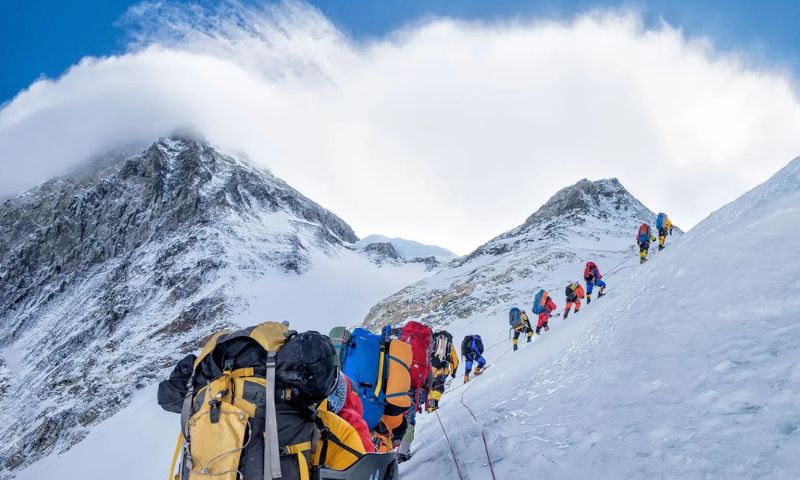
GILGIT: The Gilgit-Baltistan government has ordered an investigation into a series of recent mountaineering deaths, including the Broad Peak catastrophe that claimed the lives of 10 international climbers, while announcing a sweeping review of the region’s trekking and mountaineering regulations.
The government says the response to repeated tragedies cannot be limited to launching another inquiry after every accident. Chief Minister Amjad Hussain has instead ordered a comprehensive overhaul of the rules, procedures and safety mechanisms governing trekking and mountaineering in the region.
Sajid Ali Sadpara, Pakistan’s youngest high-altitude mountaineer and son of legendary climber Muhammad Ali Sadpara, is carrying his family’s legacy to the world’s highest peaks.
He has summited 10 of the 14 eight-thousanders, including 8 without supplemental oxygen. From K2 to… pic.twitter.com/FIuXGljsYH
— Sajjad Tarakzai (@SajjadTarakzai) August 17, 2026
Among those killed in the recent tragedies were British-Nepali mountaineer Nirmal “Nimsdai” Purja, who became the fastest climber to scale all 14 of the world’s 8,000-metre peaks, and acclaimed Omani climber Nadhira Ahmed Abdullah Al Harthy.
Broad Peak Tragedy Under Investigation
A three-member committee headed by Forest, Wildlife and Parks Secretary Subtain Ahmed has been tasked with investigating the Broad Peak incident and identifying any negligence, administrative lapses or shortcomings that may have contributed to the deaths.
Farewell to a brave mountaineer.
Pakistani mountaineer Sohail Sakhi, 30, was laid to rest in his hometown of Aliabad, Hunza, on Sunday, amid tears and profound grief.
Sakhi was among 10 international climbers who went missing after an avalanche struck Broad Peak on July 30.
His… pic.twitter.com/8NiZmcJ9wH— Sajjad Tarakzai (@SajjadTarakzai) August 16, 2026
The committee will also review the existing 1999 Trekking Rules clause by clause and assess whether the current regulatory framework remains adequate in the face of changing conditions and risks in the mountains.
It has been given 15 days to submit its findings, recommendations and proposed amendments to the relevant laws and standard operating procedures.
Safety Chain To Face Complete Review
The review will cover the entire safety chain, beginning with permits and climber registration and extending to mandatory pre-expedition briefings and post-expedition debriefings.
The first phase of the Broad Peak recovery operation has ended. Seven of the 10 climbers who lost their lives in the devastating avalanche have been brought to the military hospital Skardu by Pakistan Army Aviation.
Among them are legendary Nepali mountaineer Nirmal “Nimsdai”…— Sajjad Tarakzai (@SajjadTarakzai) August 6, 2026
The government will also examine the appointment and responsibilities of liaison officers and mountain guides, as well as requirements relating to safety equipment.
Insurance arrangements for liaison officers, guides and porters will be reassessed, alongside porter wages, welfare and working conditions.
Medical facilities and evacuation arrangements will also come under scrutiny.
Search And Rescue Capacity In Focus
A key part of the review will be the government’s ability to respond when climbers encounter emergencies in remote and restricted areas.
The authorities will assess search-and-rescue capacity, helicopter evacuation arrangements, weather forecasting and early-warning systems, emergency communications and mechanisms for rapid response.
The mountains have finally let them go.
The bodies of legendary Nepali mountaineer Nirmal “Nimsdai” Purja, Chinese climber Wang Zhong, and Nepali guides Nima Sherpa and Kili (Kilu) Pemba Sherpa have been airlifted to Skardu.
They will now begin their final journey home, where… pic.twitter.com/te8LDevzO6— Sajjad Tarakzai (@SajjadTarakzai) August 6, 2026
The government will also reassess open and restricted zones, trekking routes and mountain passes in light of current ground realities and emerging risks.
Digital Permits And Stronger Coordination
The proposed reforms include the introduction of a digital permit and registration system aimed at improving the tracking and management of expeditions.
The government also plans to strengthen coordination among departments involved in trekking, mountaineering, tourism, wildlife and emergency response.
The measures reflect a broader attempt to move from a reactive response to mountain accidents towards a more coordinated safety system covering climbers, guides, liaison officers and porters.
The government says the committee’s recommendations will form the basis for amendments to the existing laws and safety SOPs, with the 15-day deadline intended to accelerate the reform process.