
Key Points
- One person killed, 17 others injured
- Berlin Pride celebrations called off
- Suspect linked to Islamist circles identified
ISLAMABAD: In Berlin, one person was killed and at least 17 others injured after a vehicle drove into a crowd near Germany’s annual Christopher Street Day (CSD) Pride celebrations on Saturday evening, prompting the event’s cancellation and a citywide manhunt for the suspect.
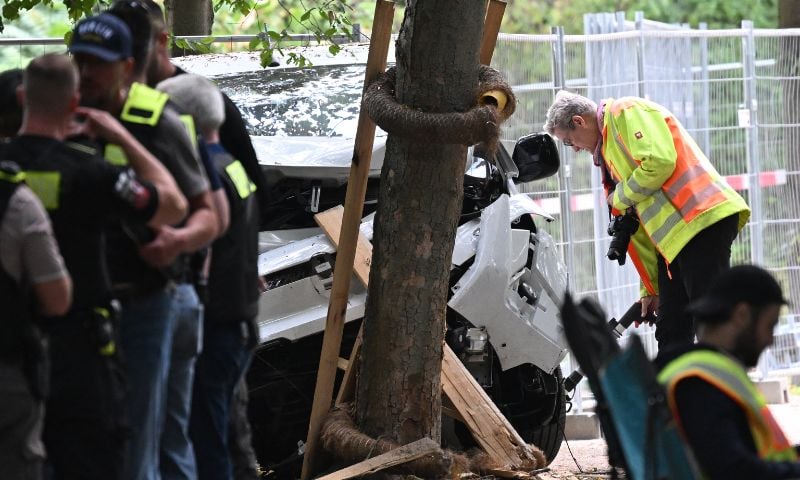
Berlin police said a white van entered Tiergarten park shortly before 10 p.m. local time, striking several people before crashing into a tree. Emergency services said several victims suffered serious injuries, with some in life-threatening condition, according to Reuters.
Authorities said the driver fled the scene on foot. Police later identified a 21-year-old suspect, known to law enforcement and allegedly linked to religious extremist circles in the German capital.
Investigators have urged the public not to approach him, warning that he may be armed and dangerous. The motive for the attack remains under investigation, according to AP News.
The incident brought an abrupt end to one of Europe’s largest LGBTQ+ events, which attracts hundreds of thousands of participants each year.
ALSO READ: Man Arrested After Car Ramming ‘Attack’ Injures 28 in Germany
Berlin police declared a major incident and asked attendees to leave the area as dozens of ambulances and emergency personnel responded to the scene, according to The Guardian.
German Chancellor Friedrich Merz condemned the attack, calling it “an attack on our society,” while Berlin Mayor Kai Wegner described it as a brutal assault on the city’s open and tolerant values and pledged full support for the ongoing investigation.
The attack is the latest in a series of vehicle-ramming incidents in Germany in recent years, renewing concerns over security at major public gatherings.
Berlin attack latest of series in Germany
Germany has witnessed a string of vehicle-ramming attacks in recent years, heightening security concerns at public gatherings.
The deadliest was a decade ago. In December 2016, a Tunisian extremist drove a truck into a Christmas market in Berlin, killing 12 people.
More recently, six people were killed at a Christmas market in Magdeburg in December 2024, while attacks in Munich and Mannheim in 2025 claimed four lives combined. In May 2026, two people were killed after an SUV ploughed into pedestrians in Leipzig.
Vehicle-ramming attacks have become a recurring security challenge globally over the past decade, largely because they require little planning or access to sophisticated weapons.
One of the deadliest incidents occurred in July 2016, when a Tunisian national drove a 19-tonne truck through Bastille Day celebrations in Nice, France, killing 86 people and injuring more than 400.
In December of the same year, a truck attack at a Christmas market in Berlin left 12 people dead.
The United Kingdom has also experienced multiple such attacks, including the March 2017 Westminster Bridge attack, which killed five people, and the June 2017 attack near London Bridge and Borough Market that claimed eight lives.
In Spain, 16 people were killed when a van struck pedestrians on Barcelona’s Las Ramblas in August 2017, while Sweden suffered a deadly attack in Stockholm earlier that year that killed five people.
North America has not been spared; a man drove a rented truck into crowds celebrating Canada’s Filipino heritage festival in Vancouver in April 2025, killing 11 people, while New Orleans witnessed a deadly New Year’s Day vehicle attack in January 2025 that left 14 dead.
Security experts say the incidents highlight the enduring appeal of low-cost, high-impact attacks targeting crowded public spaces.
Across Europe, the tactic has been used in several high-profile attacks, including the 2016 Bastille Day attack in Nice, France, which killed 86 people.
Similar incidents in London, Barcelona and Stockholm underscored the persistent threat posed by vehicles being used as weapons against civilians.