Key Points
- $35.2bn required for physical infrastructure, $22.7bn for economic and social losses
- Over 371,888 housing units damaged or destroyed, majority of population displaced
- Economy contracted by about 84 per cent, with health and education systems largely incapacitated
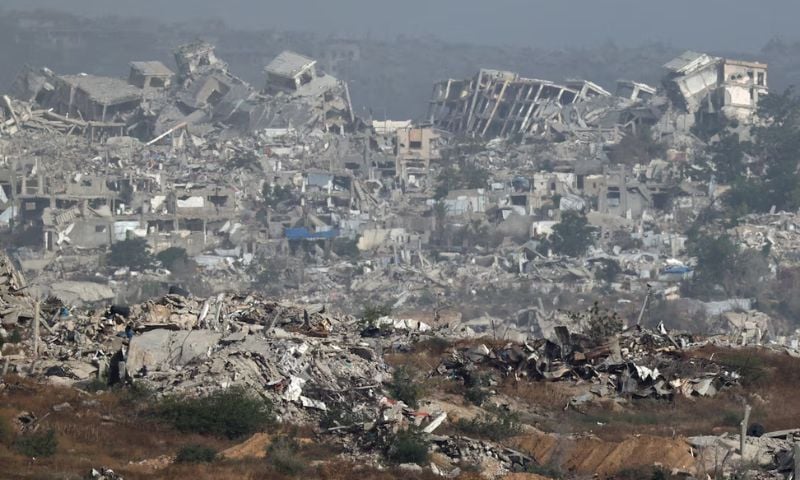
ISLAMABAD: A joint assessment by the United Nations, World Bank and European Union has estimated Gaza’s rebuild cost at $71.4 billion for the next decade, highlighting the vast scale of destruction and economic collapse following two years of Israeli aggression.
The estimate, published in the latest Rapid Damage and Needs Assessment, provides the most comprehensive picture yet of losses across infrastructure, livelihoods and public services.
It places $35.2 billion, the cost of rebuilding physical assets, including housing, transport, energy and water systems, alongside $22.7 billion in economic and social losses linked to disrupted services, lost income and declining human development.
Housing sector bears the brunt
The report identifies housing as the single largest component of destruction, with more than 371,888 units damaged or destroyed.
The scale of damage has left well over half of Gaza’s population without a stable shelter, compounding an already severe humanitarian crisis.
Public infrastructure has also suffered extensive damage. More than half of Gaza’s hospitals are no longer functional, sharply limiting healthcare access.
The education system has been nearly wiped out, with almost all schools affected, either destroyed or rendered unusable. Water, sanitation and electricity networks have similarly been degraded, undermining basic living conditions.
Economic collapse deepens crisis
Beyond physical damage, the assessment underscores a near-total economic breakdown. Gaza’s economy is estimated to have contracted by around 84 per cent, one of the steepest declines recorded in a conflict-affected territory in recent decades.
The collapse reflects halted production, widespread business closures and the near disappearance of formal employment.
Analysts involved in the assessment warn that recovery will require not only rebuilding infrastructure but restoring institutions, markets and basic governance capacity.
Phased recovery plan outlined
The report proposes a phased reconstruction strategy, beginning with the immediate recovery needs of roughly $10.8 billion to restore essential services and humanitarian support.
A further $15.5 billion is projected for short-term stabilisation over the 18 months, leading into a longer-term rebuilding phase, which brings total needs to $71.4 billion over 10 years.
The sequencing reflects the difficulty of launching large-scale reconstruction amid ongoing instability and limited access, with early efforts focused on restoring minimum living conditions.
Estimates rise as damage broadens
The latest figure marks a significant increase from earlier assessments. Initial estimates in 2024 by the United Nations and the World Bank had placed physical damage at about $18.5 billion. A 2025 interim assessment raised the overall recovery needs to $53.2 billion.
Subsequent analyses by UN agencies, including the United Nations Conference on Trade and Development, pointed to a broader economic collapse and suggested reconstruction costs could approach $70 billion.
The latest $71.4 billion estimate reflects both continued destruction and a more comprehensive accounting of economic and social losses.
Converging but cautious global estimates
Although methodologies differ, international institutions and policy analysts are increasingly converging around a reconstruction requirement in the $50 billion to $70 billion range or higher.
Variations stem from limited on-ground access, evolving damage assessments and differing assumptions about recovery timelines.
The joint assessment by the United Nations, World Bank and European Union is widely regarded as the most authoritative to date, combining satellite imagery, sectoral modelling and post-disaster evaluation frameworks.
Rebuilding beyond infrastructure
The report emphasises that reconstruction will extend beyond rebuilding physical structures. Restoring Gaza’s economy will depend on reviving the private sector, rebuilding human capital and re-establishing functioning public institutions.
It cautions that without sustained international financing and a stable operating environment, recovery could be prolonged, with long-term implications for poverty, employment and regional stability.