


ISLAMABAD: While condemning the May 9 violent events in Pakistan, former Saudi Ambassador to Pakistan Dr Ali Awad Al-Asseri has termed political stability essential for the economic development and prosperity of the South Asian country.
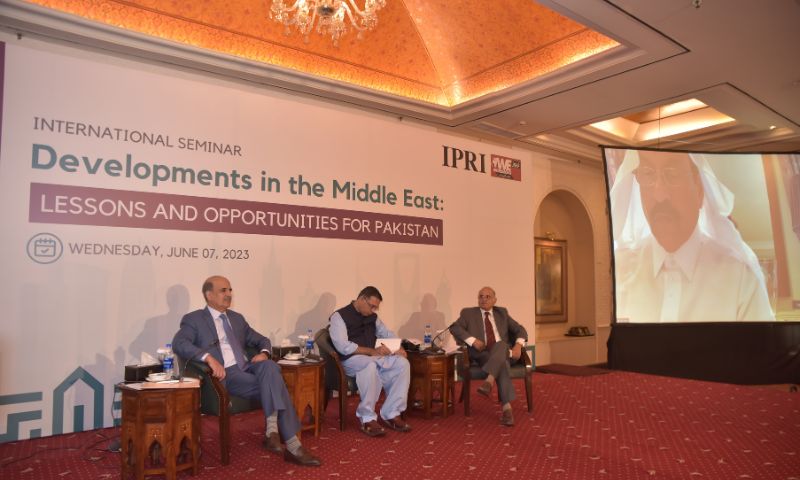
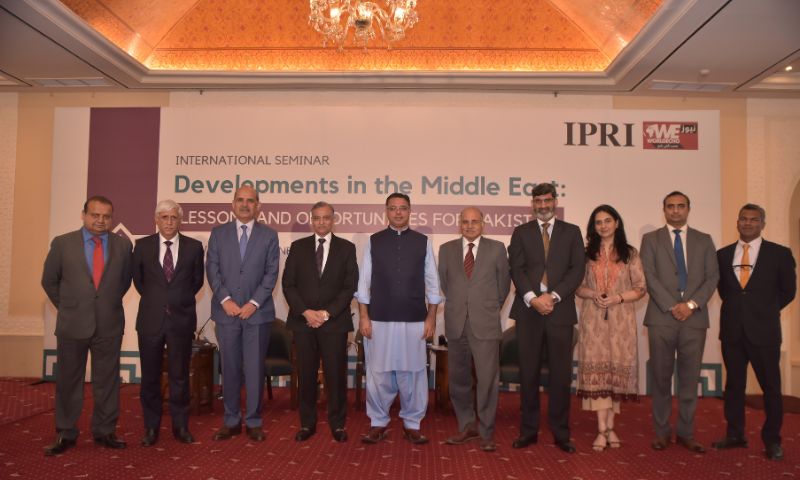
Speaking at a seminar titled “Developments in the Middle East: Lessons and Opportunities for Pakistan”, organized by WE News in collaboration with the Islamabad Policy Research Institute (IPRI), on Wednesday, the former Saudi Ambassador said that political instability was a major obstacle to the development and progress of Pakistan. Dr Al-Asseri emphasized that political stability was a must for the economic development of Pakistan.
In a video-link speech, the former Ambassador stressed the importance of enhancing security, economic, and trade relations between Pakistan and Saudi Arabia. He urged the Pakistani government to create a conducive environment for investment and capital protection and to highlight the significant investment opportunities available in various sectors.
Reflecting on Saudi Arabia’s transformation into a modern developed state under the vision of Crown Prince Muhammad Bin Salman, Dr. Al-Asseri highlighted the significant impact of Vision 2030, not only on Saudi Arabia but also on the broader region.
Dr Al-Asseri pointed out three major developments shaping the region — “China’s emergence as a major investor with political influence, Saudi Arabia’s socio-economic transformation under Vision 2030, and the diversification of Saudi Arabia’s relationships with the United States and China”. He said that Saudi Arabia was moving towards reconciliation with Iran and termed it a promising development. He said that the new environment was conducive to trade and collective prosperity.
Dr Al-Asseri highlighted the growing trade relationship between China and Arab states and emphasized their shared interest in the United States guaranteeing security in international commerce in the region. He also mentioned the significant investments in the region, with China being one of Saudi Arabia’s largest trading partners and a major crude oil importer.
Potential of Saudi-Pak Cooperation
While pointing out potential opportunities for Saudi-Pak cooperation, Asseri said that BRI and the Vision 2030 are interlinked, and Pakistan must use this opportunity to integrate its economy with Central Asia and other countries. He also called for enhanced cooperation between the business chambers of both countries and noted the potential for Pakistani manpower in the finance, Information Technology, and infrastructure sectors.
Al-Asseri said that there are more than 2 million Pakistani workers in Saudi Arabia, who send $5 billion remittances to Pakistan annually. He called upon the chambers of commerce and industries of the two countries to cooperate more profoundly and take interaction to a new level.
The former envoy said that Saudi Arabia offered opportunities under the Vision 2030 and declared that Saudi and Pakistani interests are aligned with a rising China. He called for political stability in Pakistan and said that without putting the house in order, democracy was meaningless.
Appreciating the Pakistani army, Al-Asseri said that it played the role of vanguard in the border region of Saudi Arabia. He further said that apart from economic relations between the two countries, cultural relations were also being developed.
During the seminar’s opening, the President of IPRI, Ambassador Dr Raza Muhammad, underscored the importance of greater cooperation with Middle Eastern states and highlighted ongoing regional socio-political developments as the way forward. He emphasized the significance of learning from inter-regional developments, citing the example of Europe’s journey from animosity to the formation of the European Union.
On the occasion, Ammar Masood, Chief Editor of WE News, emphasized the need for promoting dialogue in a polarized society and exploring avenues for greater regional cooperation. He highlighted trade, development, and cultural cooperation as key areas that need to be harnessed for fostering partnerships and dispelling misconceptions.
While flagging the potential of Pakistan in the Middle East, he said that new areas of cooperation could be explored and stated that dialogue serves as the cornerstone for building bridges to dispel misconceptions.
Ammar Masood also illustrated that trade and development in interstate relations and cultural cooperation as soft power need to be harnessed. He also brought to the fore the dynamics of truth, integrity, and impartiality as values that go on to cement society with the world outside for a promising partnership.
Vice-Admiral Khan Hasham bin Siddiqui discussed the paradigm shift in US policy towards the Gulf and the increasing interest of China, which is reshaping the region’s landscape. He called for progressive and business-centered policies in Pakistan, considering the significant influx of investments in the Gulf.
Azfar Ahsan, former Minister of State and Chairman of the Board of Investment (BOI), highlighted the opportunities arising from billions of dollars pouring in annually from China and Arab states. He emphasized the need to facilitate existing local and foreign investors and create a conducive environment for investment. Ahsan stressed the importance of collaboration among stakeholders to transform Pakistan and overcome bureaucratic challenges.