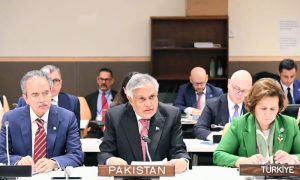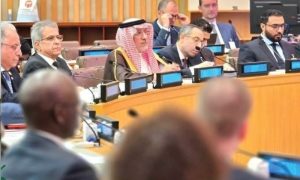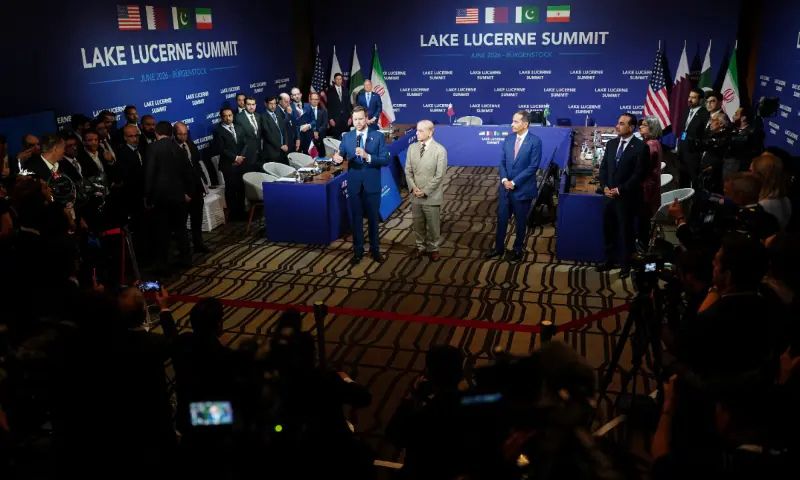
LAKE LUCERNE, Switzerland: The first round of Pakistan and Qatar mediated talks between the United States and Iran concluded in Switzerland on Sunday after approximately 80 minutes of discussions, according to Iran’s semi-official Fars news agency, which cited a source familiar with the Iranian negotiating team.
The source, cited by Fars news agency, said the meeting was paused for “internal consultations” after the initial round of negotiations at the Swiss-hosted venue, dubbed the Lake Lucerne Summit.
نشست چهارجانبۀ سوئیس پس از ۸۰ دقیقه گفتوگو جهت مشورت های داخلی متوقف شد. https://t.co/EVzgLVXAdq
— خبرگزاری فارس (@FarsNews_Agency) June 21, 2026
Hussein Gurbanzadeh a member of Iran’s team negotiating with the US, told state television, “In today’s negotiations, we discussed the issue of our frozen assets and the arrangements for their release.”
He added that the first round US-Iran talks focused on sanctions relief tied to Iran’s energy sector.
“In Switzerland, we discussed the temporary exemption from sanctions on oil and its derivatives, and the final draft of a proposal on this matter has been completed,” Gurbanzadeh explained.
The talks are a follow-up to the recently signed Islamabad Memorandum of Understanding (MoU) between Tehran and Washington.
The talks are being facilitated by Pakistan and Qatar as part of a broader diplomatic effort to maintain dialogue between the two sides.
The US delegation is led by US Vice President JD Vance, while the Iranian team is headed by Parliament Speaker Mohammad Bagher Ghalibaf and Foreign Minister Abbas Araghchi.
The technical-level talks between the US and Iran began in Switzerland on Sunday under the Islamabad Memorandum of Understanding (MoU) to advance a comprehensive and permanent agreement between Washington and Tehran.
A member of Iran’s team negotiating with the US told state media on Sunday that a draft has been finalised regarding sanctions waivers for Iranian oil.
The Iranian negotiator added that the waivers would be issued soon.
PM Sharif says US, Iran committed to peace
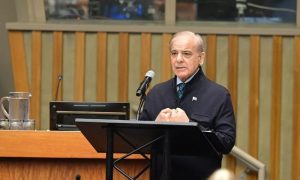
Mediator Pakistan’s Prime Minister Shehbaz Sharif said Iran’s leadership was sincere in its efforts for regional peace, while also describing US President Donald Trump as a peace-loving personality.
“Iranian Parliament Speaker Mohammad Bagher Ghalibaf and Iran’s leadership are sincere in their efforts for peace in the region,” Prime Minister Sharif said during an informal interaction with media in Bürgenstock.
Speaking to media, on the sidelines of the Lake Lucerne Summit between the US and Iran, Prime Minister Sharif said Iran’s supreme leader Ayatollah Mojtaba Khamenei, President Masoud Pezeshkian, parliament speaker Mohammad Bagher Ghalibaf and Foreign Minister Abbas Araghchi have been “very, I think, straight and handled this entire crisis with a sense of dignity to de-escalate this situation”.
“I think they genuinely mean promoting peace in the region, [the] Iranian leadership. I think so is President Trump and … I have no second thought about the fact that he is a man of peace,” PM Sharif said.
“He has demonstrated that during the war between Pakistan and India, when the two countries were very close to the nuclear flashpoint and President Trump’s dynamic and courageous leadership, entering and doing effectively, saved hundreds of millions of lives.”
Responding to a question about US Vice President JD Vance saying he “loves” Pakistan, the premier has responded that a “renewed friendship between the United States of America is a very encouraging sign, and I am really grateful to President Trump for supporting Pakistan and promoting economic cooperation between the two countries and counterterrorism.
“I think this friendship, this new relationship, will usher into a period of very close coordination and cooperation between the two countries,” PM Sharif added.
Pakistan PM says important opportunity for global peace
Pakistan’s Prime Minister Shehbaz Sharif on Sunday described the start of the US-Iran negotiations in Switzerland as an important opportunity for global peace and said the talks had become possible due to the prudent leadership of US President Donald Trump.
Speaking alongside US Vice President JD Vance and Qatari Prime Minister Sheikh Mohammed bin Abdulrahman bin Jassim Al Thani at the opening of the Pakistan-mediated talks, Prime Minister Sharif said dialogue remained the best path to resolving disputes and promoting stability.
PM Sharif also praised Chief of Defence Forces and Chief of Army Staff Field Marshal Syed Asim Munir for his role in the diplomatic efforts that helped bring the parties to the negotiating table, adding, “We can work together to establish unity in the world.”
Qatari PM Pakistan’s mediation efforts
Speaking on the occasion, Qatar’s Prime Minister Sheikh Mohammed bin Abdulrahman bin Jassim Al Thani has thanked both the US and Iranian delegations for their efforts to make peace in the Middle East, as well as Pakistan’s leadership in initiating the mediation process.
“I think that every one of you has highlighted how important and historic this is, not only on the security of the region but also for the security of the world and for the global economy,” he said.
“I would like to thank all of you for your leadership and determination that put us in this room … this is just the beginning and I wish everyone all the best.”
He added that Qatar would support the mediation process “until the end – until we reach a solution.”
JD Vance hails ‘historic’ moment
JD Vance described the opening of Pakistan-mediated peace talks between the US and Iran as a “historic” moment and expressed hope that the negotiations would help reset relations between Washington and Tehran.
Vance said the talks offered an opportunity to move beyond decades of tensions.
“This is a historic meeting,” Vance said. “The goal is to turn over a new leaf, to transform our relationship with the people of Iran and to extend an outstretched hand.”
The talks, dubbed the “Lake Lucerne Summit”, are being held as a follow-up to the Islamabad Memorandum of Understanding (MoU) signed recently between Tehran and Washington, with Pakistan and Qatar facilitating the negotiations.
Vance praises Pakistan’s role
Talking to reporters, Vance praised Prime Minister Shehbaz Sharif and Chief of Defence Forces and Chief of Army Staff Field Marshal Syed Asim Munir for their role in bringing the two sides to the negotiating table.
Referring to Prime Minister Sharif, Vance said he was a “dear friend of the president’s, dear friend of mine” whose “very careful and skilled negotiations got us to this point”.
The US vice president also paid tribute to Field Marshal Munir, saying he had spoken with Field Marshal Munir extensively over recent months.
“I’ve probably talked to Field Marshal Munir more than I’ve talked to anybody else over the last three months,” Vance said.
“He is of course a great military leader, but I think he’s shown himself to be a great diplomat.”
Vance added that Pakistan’s role had been recognised internationally and said he hoped the current momentum could be carried forward in future diplomatic efforts.
Vance says significant progress made in recent hours
JD Vance said that significant progress has been made over the past few hours, while stressing the need for positive dialogue on key issues. He also said that he expects additional progress in the coming hours.
Speaking on recent developments, Vance praised the roles played by Pakistan’s Prime Minister Shehbaz Sharif and Chief of Defence Forces Field Marshal Syed Asim Munir, describing their contributions as commendable.
He also described Field Marshal Munir as an excellent military commander.
Vance said Pakistan’s role had been appreciated around the world and expressed a desire to build on the current momentum in the future.
“We’ve made great progress in last few hours […] we’ve found great partners in Pakistan, Qatar.”
The US vice president said Washington wanted Iran to play a positive role in efforts for peace, while adding that peace in the Middle East remained a priority.
He also voiced concern over the situation in Lebanon and said US President Donald Trump was working to reduce tensions in the country.
Referring to Iran, Vance said the country had been a source of regional instability, adding that positive discussions were needed on the issues at hand.
Vance said President Trump has asked to turn over “a new leaf” to transform the US relationship with Iran and that the technical talks would allow for both sides to sit together and work to resolve issues.
Negotiations for permanent end to conflict
Qatar’s foreign ministry said specialised technical and expert groups had been formed to negotiate the terms of a final agreement, while follow-up groups would oversee implementation of the MoU and monitor progress.
The ministry added that Qatar would continue to work with Pakistan and “all concerned parties to create a positive environment that enables the negotiations to achieve their objectives, based on its firm belief that dialogue and diplomacy represent the optimal path for addressing conflicts and resolving disputes”.
Iranian state broadcaster IRIB reported that delegations from Iran, the United States, Pakistan and Qatar were holding negotiations in Switzerland on a comprehensive ceasefire in Lebanon and Iran’s frozen assets.
A day earlier, Pakistan’s Foreign Office announced that technical-level discussions between the United States and Iran would be held in Bürgenstock on Sunday.
“Representatives of the United States and Iran, along with mediators from Pakistan and Qatar, will participate in the discussions,” the Foreign Office said in a statement, adding that Islamabad would continue to facilitate the process in its role as mediator.
Pakistani mediators hold meetings with US and Iranian negotiators
Ahead of the talks, Pakistan’s Prime Minister Shehbaz Sharif and Chief of Defence Forces and Chief of Army Staff Field Marshal Syed Asim Munir met the Iranian delegation in Bürgenstock.
The Iranian side was led by Parliament Speaker Mohammad Bagher Ghalibaf and Foreign Minister Abbas Araghchi.
Officials said the meeting reflected Pakistan’s continued commitment to constructive dialogue, regional stability and diplomatic engagement at a critical stage in the negotiations.
US Vice President JD Vance also praised Pakistan’s diplomatic role ahead of the talks.
Ahead of talks, Vance held a brief meeting with Prime Minister Sharif and Field Marshal Munir on the sidelines of the gathering.
Officials and mediators from Qatar were also present, underscoring the broader regional effort to sustain momentum in the dialogue process.
Qatar praises Pakistan’s mediation
Meanwhile, Qatari Foreign Ministry spokesperson Dr Majed bin Mohammed Al-Ansari expressed appreciation for Pakistan’s role as a mediator and commended its close cooperation in supporting the negotiations.
According to a statement issued by the ministry, Al-Ansari also welcomed the commitment of both the United States and Iran to diplomatic solutions and thanked Saudi Arabia, Turkiye, Egypt, the United Arab Emirates and other countries for helping create favourable conditions for the talks.
He reiterated Qatar’s support for Pakistan-led diplomatic efforts aimed at securing a final agreement that would promote sustainable peace, security, stability and prosperity across the region.
The high-level US-Iran talks are taking place days after the United States and Iran electronically signed the Islamabad MoU aimed at ending the conflict in the Middle East and reopening the Strait of Hormuz.
US President Donald Trump announced the signing on June 15, saying the agreement included provisions on the reopening of the Strait of Hormuz and the lifting of the US blockade on Iranian ports.
Trump and Iranian President Masoud Pezeshkian signed the agreement on behalf of their respective countries, while Pakistan’s Prime Minister Shehbaz Sharif later signed the Islamabad MoU as mediator, formally sealing the deal.
Pezeshkian says Islamabad MoU benefits Iranian people
Iranian President Masoud Pezeshkian said the provisions of the Islamabad Memorandum of Understanding between Iran and the United States are “largely in the interests of the Iranian people”, adding that negotiations between the two sides would help Iran access its financial resources and decide how they are used.
Speaking at a seminar on monetary and banking policies in Tehran, Pezeshkian said Iran had exported more than 16 million barrels of oil in recent days and described the achievements of the talks as “very clear”.
“We will be able to access our own resources and make our own decisions regarding them,” he said.
Pezeshkian expressed hope that the $6 billion in Iranian funds held in Qatar would be unfrozen as negotiations progress, adding that Central Bank Governor Abdolnasser Hemmati was participating in the Switzerland talks to discuss how the funds should be utilised.
Referring to Washington’s position on Iran’s nuclear programme, Pezeshkian reiterated that the Islamic Republic would not seek to develop nuclear weapons, saying the stance was consistent with the country’s long-standing policy and religious decree against atomic arms.
He also said Israel was unhappy with the ongoing negotiations and accused it of seeking to prolong conflict in the region, particularly in Gaza and Lebanon.