CALIFORNIA, USA: Discrepancies between FIFA’s official attendance figures and visible empty seats during the opening days of the 2026 FIFA World Cup have raised questions about stadium occupancy, prompting the governing body to defend its reporting methods.
Despite FIFA’s repeated claims of “unprecedented demand” and record-breaking ticket sales, television viewers have spotted noticeable gaps in stadium stands during several early group-stage matches. FIFA insists the numbers are accurate, but the visual evidence has sparked debate online and in the media.
FIFA reveal 2026 World Cup attendance figures after empty seats galore 😳 https://t.co/yEAGPf31L1
— Daily Star Sport (@DailyStar_Sport) June 15, 2026
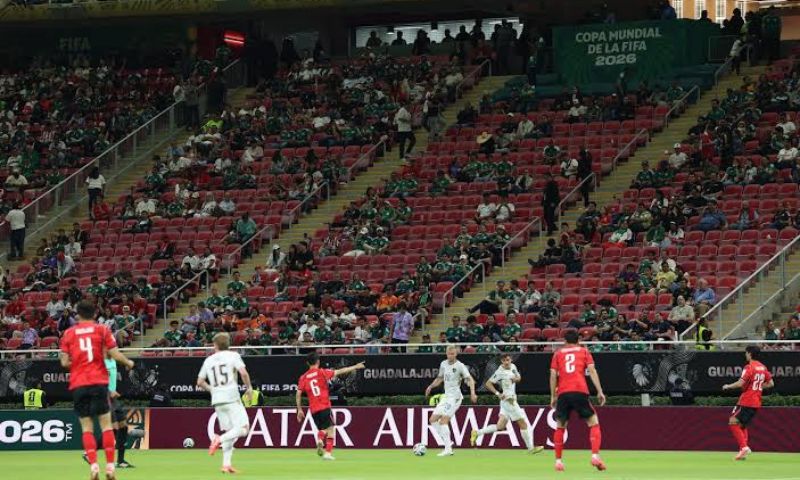
The discrepancy was most visible during Canada’s 1-1 draw with Bosnia and Herzegovina, where entire sections appeared sparsely populated even as official figures suggested a near-capacity crowd. Similarly, Qatar’s 1-1 stalemate with Switzerland on Saturday at Levi’s Stadium in Santa Clara drew an announced attendance of 67,966, just 861 seats shy of the venue’s official capacity of 68,827, according to analysis by The Athletic.
Yet photographs and broadcast footage showed visible pockets of empty seats, which quickly circulated on social media. South Korea’s 2-1 victory over Czechia in Zapopan, Mexico, faced similar scrutiny. The announced crowd of 44,985 at a stadium with a listed capacity of 45,664, meaning just 679 empty seats, appeared to contradict images showing numerous vacant sections.
According to FIFA’s figures attendance has been only 1,574 short of capacity across the opening six games of the World Cup.
There have been three official sellouts but at other grounds the gaps in the stands have appeared very different to the attendance figures released.… pic.twitter.com/0ymqSpC9zK
— The Athletic | Football (@TheAthleticFC) June 14, 2026
FIFA, however, stands by its data.
“Official attendance figures reflect the number of tickets scanned and spectators present within the stadium footprint, rather than visual assessments of seating occupancy at any given moment during the match,” FIFA said in a statement posted to X.
The organisation also noted that spectators frequently move around stadiums during games, visiting concourses, buying food, or seeking shade, leaving their assigned seats empty even while remaining inside the venue.
“Please note that, during last night’s match in Guadalajara, several ticketed fans could be seen standing in concourses rather than staying in their assigned seats throughout the match,” FIFA added.
Official attendance figures reflect the number of tickets scanned and spectators present within the stadium footprint, rather than visual assessments of seating occupancy at any given moment during the match. FIFA works closely with stadium authorities and ticketing teams to… pic.twitter.com/UIJ0y9xTFp
— FIFA Media (@fifamedia) June 12, 2026
Before the tournament kicked off on June 11, FIFA President Gianni Infantino set high expectations. “We sold until today over 6 million tickets,” he said during a press conference, describing demand as “unprecedented, by a factor of 10 or more.” FIFA also declared the tournament was on track to set “new benchmarks for attendance and global engagement.”
An analysis by The Athletic found that FIFA’s official attendance figures and stadium-capacity estimates suggested just 1,574 seats remained unfilled across the tournament’s first six matches, a remarkably tight margin.
However, critics argue that “no-shows”, ticketed fans who simply do not attend, cannot fully explain the scale of the empty sections visible on television. In the lead-up to the competition, organisers faced criticism over high ticket prices that may have dampened fan demand, as well as concerns about ticket distribution across the resale marketplace.
Whoever sells the tickets to FIFA World Cup really messed up.
Empty seats in the middle of the stadium everywhere during one of the biggest matches…. pic.twitter.com/0H0tB20jy8
— Jon Brooks (@jonbrooks) June 13, 2026
Data shared with Newsweek and published on TicketData.com showed that roughly 25,000 tickets were still available directly from FIFA the day before the competition commenced, with more than 170,000 listed on the resale marketplace. Thousands of tickets remain available through FIFA’s official resale platform for upcoming fixtures, including Switzerland vs. Canada on June 24.
Questions over attendance are not unique to the 2026 tournament. Similar concerns emerged during the World Cups in Brazil (2014) and Qatar (2022), where FIFA also attributed visible empty seats to ticket holders who purchased but did not attend.
FIFA has said additional tickets will continue to be released throughout the tournament. Nevertheless, the gap between official figures and on-screen visuals remains an awkward subplot for a tournament that was expected to set new standards for global engagement.
As one social media user commented while sharing a photo of empty rows during a marquee match: “Six million tickets sold, just not sure all six million showed up.”