


Key points
- E1 lies between Jerusalem and Maale Adumim
- Leaders warn project could divide the West Bank
- Businesses warned of legal and reputational risks
ISLAMABAD: Seven European and Western countries have condemned Israel’s construction tender for a settlement project in the E1 area of the occupied West Bank, warning that the plan could undermine Palestinian territorial contiguity and prospects for a two-state solution.
“The E1 settlement will undermine the prospect of the two-state solution by driving a wedge through the West Bank and harming the territorial contiguity of the Palestinian Territories,” reads the statement from Britain, France, Germany, Italy, the Netherlands, Canada and Norway.
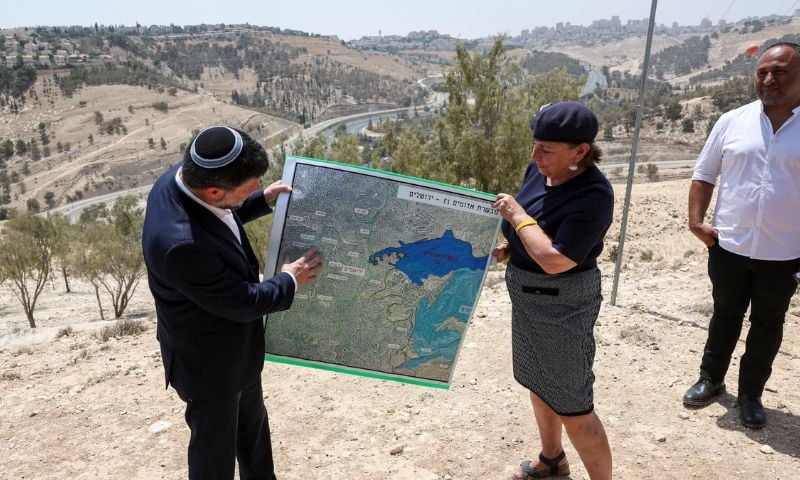
They condemned Israel’s decision to publish construction tenders for a settlement project in E1, which is a strategically sensitive area of the occupied West Bank between East Jerusalem and the Israeli settlement of Maale Adumim.
The governments said the international community has long opposed Israeli settlement expansion. They reaffirmed that Israeli settlements in the West Bank are illegal under international law, citing the position of the United Nations Security Council.
They said the decision was particularly concerning amid what they described as grave instability in the West Bank.
They highlighted with disapproval the unprecedented levels of violence by Israeli settlers against civilians and serious restrictions on the Palestinian economy.
The leaders urged Israel to withdraw the plans immediately and end its expansion of settlements in the West Bank. Israel’s settlement policy would further undermine prospects for peace and further hurt its international standing.
READ ALSO: UK Summons Israeli Envoy Over West Bank Settlement Plan
They also warned businesses against bidding for the construction tenders.
“Companies should consider the potential legal and reputational consequences, including the risk of involvement in serious breaches of international law, powerful European nations warned the aspirant businesses to bid against Israeli tenders.
The E1 area, east of Jerusalem, has long been a major point of international concern because development there could establish a built-up corridor between Jerusalem and Maale Adumim, potentially restricting territorial continuity between northern and southern parts of the West Bank.
The seven governments reiterated their commitment to a comprehensive, just and lasting peace based on a two-state solution and said they would continue to act in its interest.
Israel’s settlement threatens contiguity of the State of Palestinian
In the two-state formula supported by the United Nations, the Palestinian state is envisaged as a single, viable and sovereign territory, rather than a collection of disconnected enclaves.
Recent UN statements explicitly describe the envisioned Palestinian state as “contiguous” and include both the West Bank and Gaza as part of that state. The framework is based on the pre-1967 lines, with Jerusalem envisaged as the capital of both states.
This is why the geography of illegal settlements matters to the peace process. Territorial contiguity means that Palestinian areas in the West Bank should remain sufficiently connected to function as one state.
Contiguity is essential to allow people, goods and institutions to move between different parts of the territory without being separated by Israeli settlements, roads or other permanent infrastructure.
The concern over E1 is particularly acute because the area lies between East Jerusalem and the large Israeli settlement of Maale Adumim.
The UN secretary-general said in his June 2026 report that development in E1 could effectively sever the connection between the northern and southern West Bank, with severe consequences for the territorial contiguity of the Occupied Palestinian Territory and the two-state solution.
UN Security Council Resolution 2334, adopted in 2016, said Israeli settlements in territory occupied since 1967, including East Jerusalem, have no legal validity and constitute a major obstacle to the two-state solution.
It also said the Council would not recognise changes to the June 4, 1967 lines, including Jerusalem, except those agreed by the parties through negotiations.
The explicit UN position is that the West Bank, East Jerusalem and Gaza constitute a single Palestinian territorial unit.
The UN has repeatedly stressed the need to preserve the “territorial unity, contiguity and integrity” of the occupied Palestinian territory.