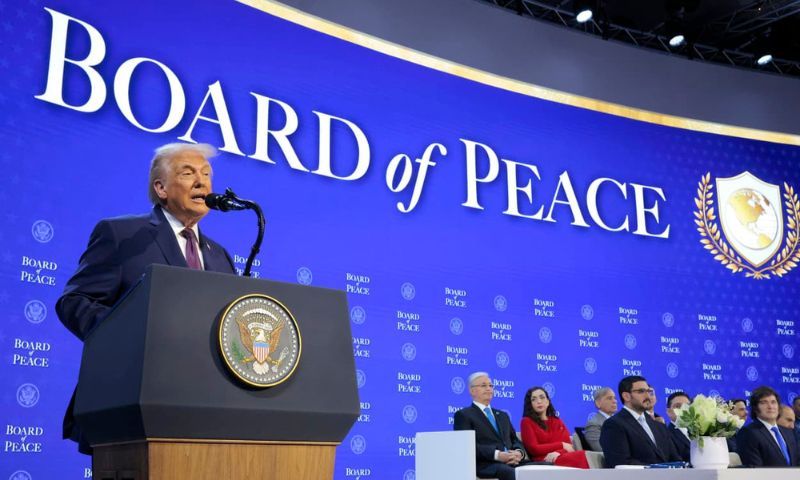
WASHINGTON: U.S. President Donald Trump’s Board of Peace has emerged as one of the most debated elements of his administration’s Gaza strategy, with supporters describing it as a bold new diplomatic mechanism while critics warn it could weaken established international institutions and concentrate excessive authority in Washington.
The Board of Peace was initially established to oversee the implementation of Trump’s post-war Gaza plan, including supervising reconstruction efforts, coordinating international funding, and monitoring the phased disarmament of Hamas and other armed groups alongside the gradual withdrawal of Israeli forces from Gaza. Trump has also indicated that the body could eventually expand its role to address conflicts beyond Gaza.
According to Reuters, the board is chaired by President Trump and includes senior figures such as U.S. Secretary of State Marco Rubio, former White House adviser Jared Kushner and former British Prime Minister Tony Blair. More than two dozen countries have joined as founding members, although several major powers and many Western allies have declined to participate.
The initiative has drawn criticism from human rights advocates and several diplomats, who argue that its governance structure gives disproportionate influence to the United States and lacks meaningful Palestinian representation. Critics have described it as an “imperial” model that risks bypassing existing multilateral institutions, particularly the United Nations, which has traditionally coordinated peacekeeping and post-conflict reconstruction efforts.
Questions have also been raised about the board’s legal authority and long-term mandate. Although the U.N. Security Council adopted a U.S.-drafted resolution recognizing the body’s role in Gaza and authorizing an international stabilization force through 2027, analysts note that many operational details remain unclear, including how decisions will be enforced and how the board will coordinate with existing international agencies.
Supporters of the initiative, including Trump allies, argue that traditional international organizations have struggled to resolve prolonged conflicts and that the Board of Peace offers a more flexible, results-oriented framework capable of bringing together governments willing to commit political and financial resources.
They contend that the mechanism could accelerate reconstruction and security arrangements that have repeatedly stalled under conventional diplomatic processes.
Despite recent announcements by the Trump administration that Hamas had agreed in principle to a broad roadmap toward disarmament, significant uncertainties remain. Hamas has disputed aspects of the U.S. characterization, Israel has yet to formally endorse the latest proposal, and negotiators acknowledge that implementation would require lengthy verification and phased compliance from all sides.
As a result, the Board of Peace remains both a centerpiece of Trump’s Middle East diplomacy and one of its most contentious features, reflecting broader debates over the future of international conflict resolution and the balance between U.S.-led initiatives and multilateral institutions.
The Board of Peace announced on Friday that Hamas has agreed to a detailed roadmap for implementing the next phases of the Gaza ceasefire, following months of negotiations mediated by Egypt, Qatar, Türkiye and the United States.
In a statement posted on X, the Board of Peace said the agreement advances US President Donald Trump’s vision for new governance, security, humanitarian relief, reconstruction and economic recovery in Gaza, as outlined in the Comprehensive Peace Plan and UN Security Council Resolution 2803.