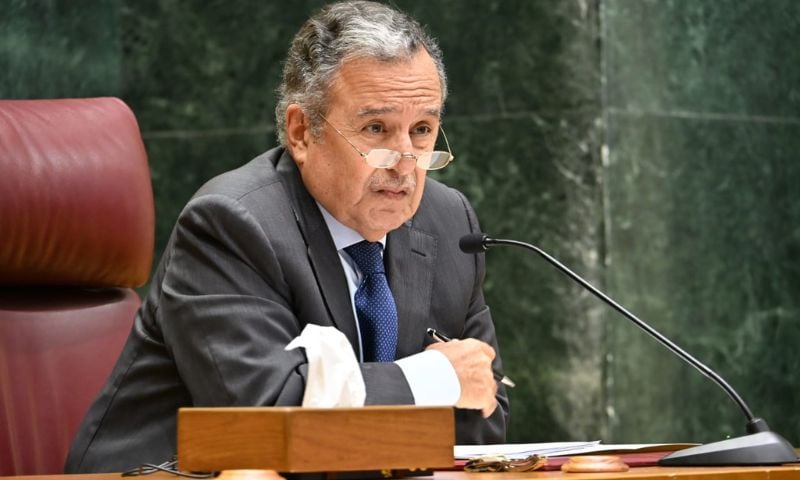
CAIRO, Egypt: Arab League Secretary-General Nabil Fahmy on Saturday called on the United States and Iran to immediately de-escalate tensions and return to negotiations under the Islamabad memorandum of understanding.
In a statement, Fahmy warned that continued confrontation could push the Middle East deeper into violence, destruction and economic instability. He urged both sides to uphold the Islamabad MoU, respect freedom of navigation through the Strait of Hormuz and pursue diplomacy to prevent further regional escalation.
The Arab League chief condemned Iranian attacks on Arab countries, saying regional states should not bear the consequences of a conflict in which they are not direct parties.
Stressing the need to safeguard regional security and stability, he urged Washington and Tehran to honour their commitments under the Islamabad MoU and resolve their differences through dialogue.
Arab League Secretary-General warns of the dangerous consequences of the current regional escalation, urging the #US & Iran to immediately de-escalate & return to talkshttps://t.co/FoM6Y1Khwz#KUNA #Kuwait pic.twitter.com/AXKMDjW5tq
— Kuwait News Agency – English Feed (@kuna_en) July 19, 2026
The Islamabad MoU was signed on June 18 by US President Donald Trump, Iranian President Masoud Pezeshkian, and Pakistan’s Prime Minister Shehbaz Sharif, following Islamabad brokered a ceasefire between Washington and Tehran.
Under the Islamabad MoU, the US and Iran committed to halt military operations, reopen the Strait of Hormuz to commercial shipping, and negotiate a comprehensive agreement covering Iran’s nuclear programme, US sanctions, and a permanent ceasefire within 60 days.
Iran attacks Bahrain and Kuwait
Kuwait said Iran hit a power and water plant on Sunday causing a fire, the latest attack on energy infrastructure in the Gulf state, as Bahrain also accused Tehran of targeting civilian sites.
It was the third attack in as many days on a power and water facility in Kuwait, according to authorities, which also reported that an oil facility had been hit on Saturday.
“As a result of the heinous Iranian aggression on Kuwait, a power and water distillation plant, for the second time in two days, has been subjected to an attack that caused a fire in some facilities of the station,” the Kuwaiti ministry of electricity, water and renewable energy said in a statement on X.
“A large number of power generator units were affected, prompting an emergency protocol to be launched,” it added.
وزارة الكهرباء و الماء :
تعرض محطة القوى الكهربائية و تقطير المياه لهجوم ثان أدى لاندلاع حريق في بعض مرافقها
📞م. فاطمة جوهر حيات – المتحدث الرسمي باسم وزارة الكهرباء والماء و الطاقة المتجددة#الكويت #قناة_الأخبار pic.twitter.com/M2ZThdAdi3
— قناة الأخبار (@newsktv) July 19, 2026
Firefighters are working to extinguish the blaze, the ministry added.
Earlier, Kuwait and Bahrain’s militaries said they were responding to Iranian aerial attacks, and air raid sirens sounded in the two Gulf countries as Tehran pressed its strikes across the region.
Bahrain also accused Iran of targeting civilians in its attacks.
In the early hours of Sunday, Iran’s army said it had targeted two US bases in Kuwait with drones in response to American attacks on Iranian territory.
Iran said earlier it carried out “large-scale attacks with kamikaze drones against the US military’s ammunition depot at Camp Udairi and the Patriot radar system and air surveillance radar at Ali Al Salem Air Base in Kuwait”, according to a statement on state media.
Central Command (CENTCOM) said two service members were killed on Friday as they “defended against Iranian ballistic missile and drone attacks”.
It said another service member was still missing in action.