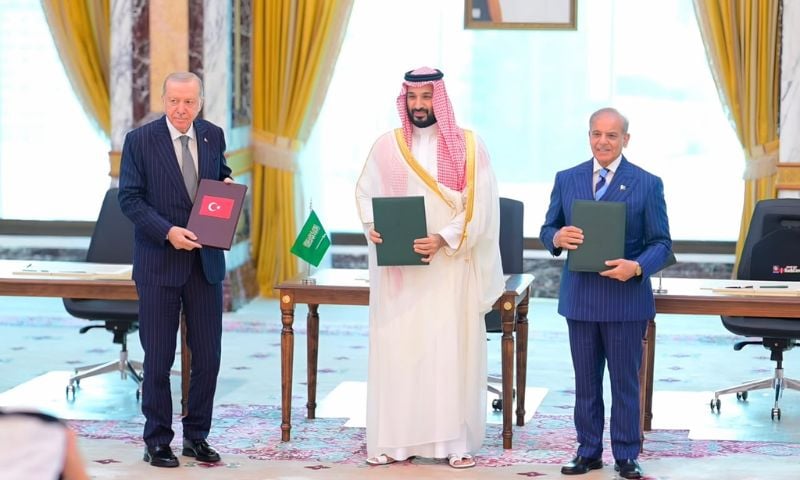
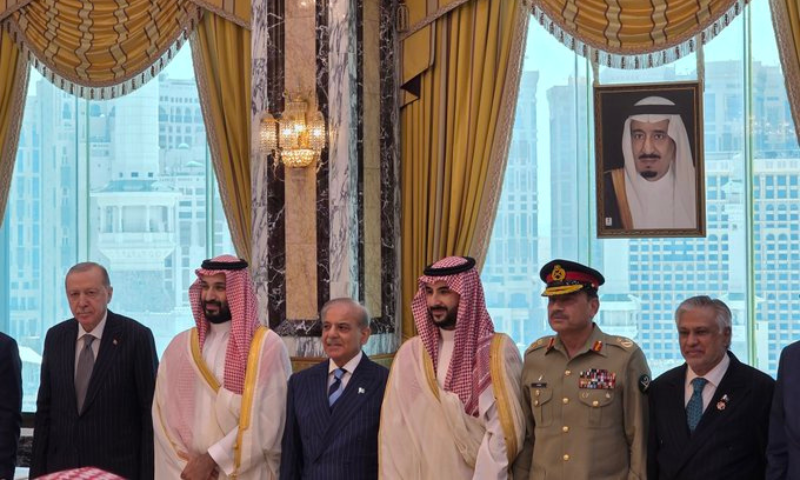
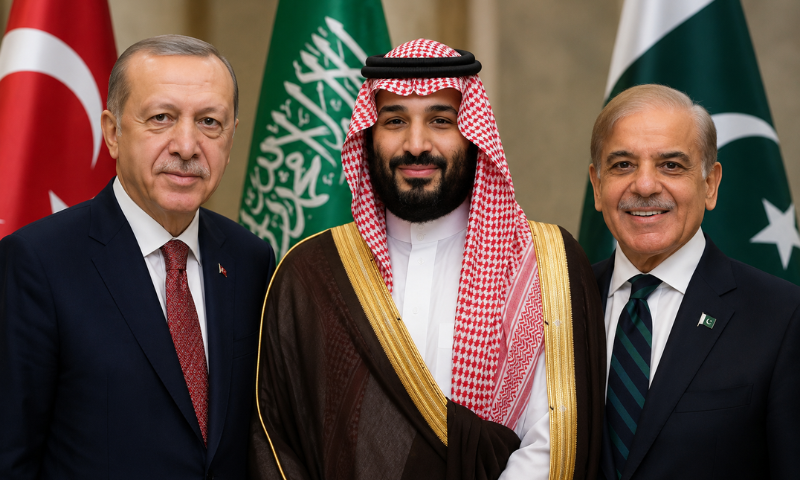
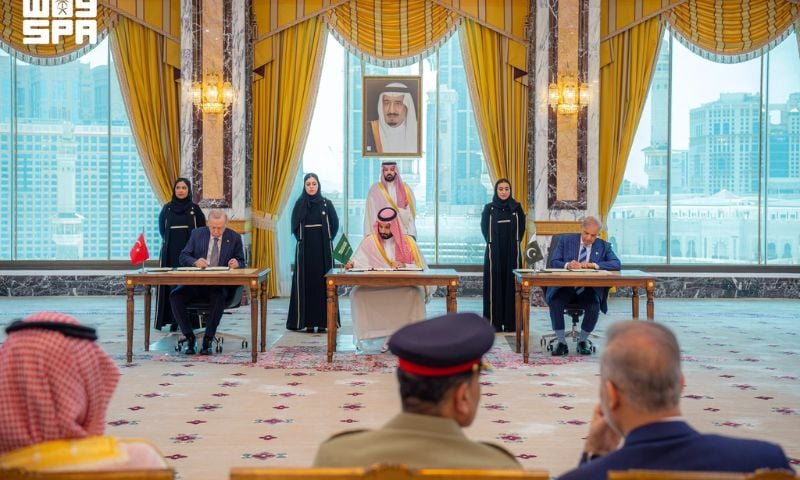
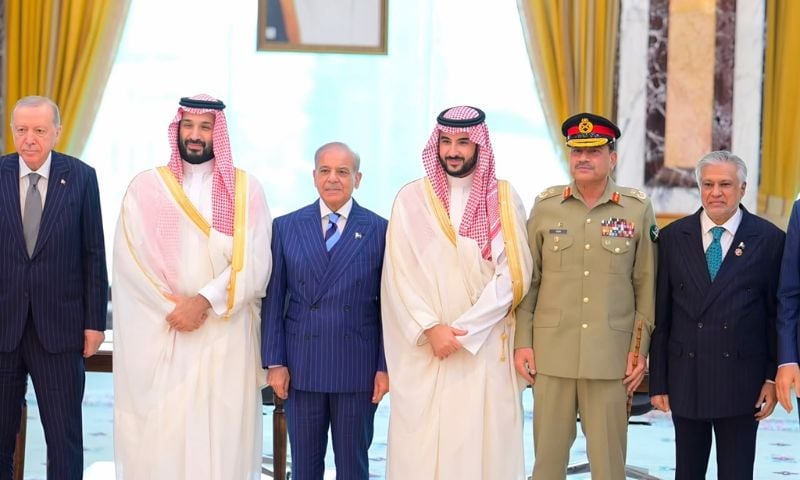
ISLAMABAD: The signing of the landmark Makkah Agreement on Joint Defence by Pakistan, Saudi Arabia and Türkiye has drawn strong and positive reactions on social media, with analysts describing the pact as a significant development for regional security, strategic cooperation and collective deterrence.
The agreement, signed in Makkah on August 7, brings together three influential Muslim countries in a framework aimed at strengthening defence cooperation and security coordination.
The Organisation of Islamic Cooperation (OIC) Secretary-General welcomed the agreement, describing it as an important strategic step that reflects the three countries’ commitment to strengthening regional and international cooperation.
Mr Hissein Brahim Taha, Secretary-General of the Organisation of Islamic Cooperation (OIC), said the agreement reflects the three countries’ commitment to strengthening regional and international cooperation.
#OIC Secretary-General Welcomes the Mecca Agreement on Joint Defense between #saudiarabia, #Pakistan and #Türkiye pic.twitter.com/R2CuclSGJP
— OIC (@OIC_OCI) August 7, 2026
Pakistani politician and foreign policy expert Mushahid Hussain Sayed described the defence pact as a “welcome & timely development” at a crucial moment of regional turbulence and transformation.
“This Defence Pact is a welcome & timely development at a crucial moment of turbulence & transformation,” Mushahid Hussain said in a post on X.
He linked the agreement to Pakistan’s recent diplomatic initiatives, including its role in facilitating the Islamabad MoU between Iran and the United States and the launch of the R-4 diplomatic coordination mechanism involving Pakistan, Türkiye, Saudi Arabia and Egypt.
Mushahid Hussain said the pact had a “3-fold significance”, arguing that it represented an important Pan-Islamic military institutional initiative among three key Muslim countries and would strengthen Pakistan’s security at a time of changing regional alignments.
US-based Gulf security analyst Dr Dania Thafer described the agreement as a new “NATO-style pact”, saying it provides Saudi Arabia with an “elastic defense agreement” capable of addressing multiple security challenges.
She said the arrangement combines Türkiye’s defence capabilities with Pakistan’s strategic deterrence, while allowing Saudi Arabia to strengthen its security options without abandoning its relations with Washington.
Defence and security analyst Major General (retd) Zahid Mahmood said the partnership should be viewed as a framework for regional stability, deterrence and collective security rather than a military alliance directed against any particular country.
“The Pakistan–Türkiye–Saudi Arabia defence partnership should be understood for what it is: a strategic framework for regional stability, deterrence and collective security, not a military bloc directed against any state,” he said.
He said the agreement could deepen defence cooperation, strengthen crisis management, improve military interoperability and promote diplomatic coordination among the three countries.
Zahid Mahmood also stressed that Pakistan would continue pursuing a balanced foreign policy while maintaining constructive engagement with the United States, China, Iran and other regional partners.
Brig. (retd) Syed Ghazanfar Ali said the agreement had emerged amid growing regional tensions and concerns over the security of Gulf states. He said Pakistan’s military capabilities and recent diplomatic role in facilitating dialogue between the United States and Iran had strengthened its position as a key security partner.
He said the pact would also enhance counterterrorism cooperation among the three countries and prevent non-state actors from using their territories against any member. He described Pakistan’s military and diplomatic strength as key factors behind the growing strategic partnership.
Former diplomat Waheed Ahmad described the agreement as a “win-win situation” for Pakistan, Saudi Arabia and Türkiye, stressing that it was defensive in nature and not directed against any country. He said its significance was further underscored by the three countries’ commitment to the agreement in Makkah.
Ahmad said the pact could eventually develop into a broader regional security framework, with other Muslim countries potentially joining it. He also said the agreement could contribute to diplomatic efforts aimed at reducing tensions in the Middle East.
Former diplomat A.M. Shahid termed the agreement a welcome development, saying the commitment by the three countries to jointly respond to attacks would strengthen their collective defence capabilities.
He said Pakistan’s existing defence cooperation with Gulf and Arab countries, combined with Türkiye’s advanced defence industry, could give the new partnership greater strategic weight. He added that the agreement could reshape regional security dynamics and further enhance Pakistan’s diplomatic standing.