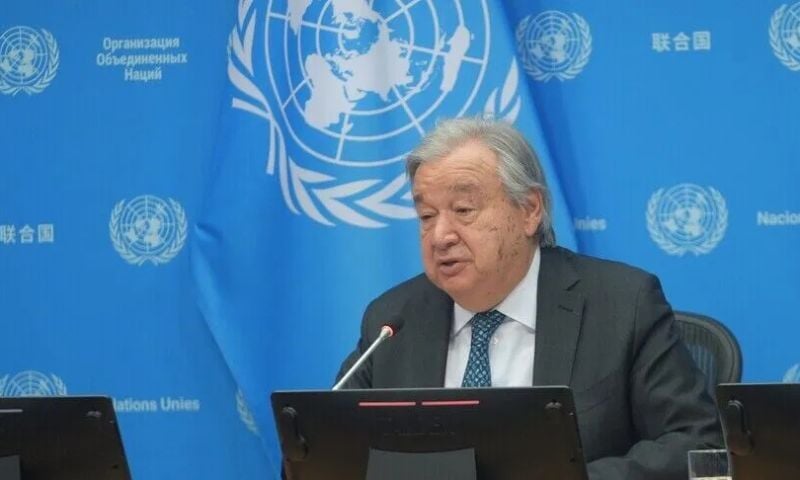
UNITED NATIONS: United Nations Secretary-General Antonio Guterres warned on Thursday that an “alarming disregard for international law” is fuelling the Middle East conflict, cautioning that the region is being pushed towards “the edge of the unimaginable”.
Addressing a UN Security Council meeting on the peaceful settlement of disputes, Guterres said conflicts were growing in “number, complexity, length and scope”, while violations of international law increasingly went unpunished.
“Today, conflicts are increasing in number, complexity, length and scope,” he said. “Impunity is spreading. Violations are going unanswered.”
Warning that the regional crisis was escalating rapidly, Guterres said: “The situation is getting out of control. It is teetering on the edge of the unimaginable.”
“The region is being pulled into an ever-widening circle of confrontation. One crisis feeds another. One escalation triggers the next,” he said.
“As this dynamic spreads, the political objectives are becoming increasingly obscured by the confrontation itself.”
The situation in the Middle East is getting out of control.
It’s time to step back.
My clear & consistent message to leaders:
The fighting must stop everywhere.
Freedom of navigation must be restored.
Diplomacy is the only way forward. pic.twitter.com/ZfOdMyq1Td
— António Guterres (@antonioguterres) July 23, 2026
Maritime security
The UN chief urged all parties to restore freedom of navigation through two of the world’s most strategic maritime chokepoints.
“International navigational rights and freedoms in and around the Strait of Hormuz and Bab al-Mandab must be fully restored,” Guterres said.
He stressed that diplomacy remained the only viable path to resolving the region’s mounting crises.
“Diplomacy is the only way forward,” he told the Council.
Concern over Gaza and West Bank
Turning to the conflict in Gaza, Guterres said civilians continued to suffer despite the ceasefire.
He said people were still being killed in their homes and communities “as Israel increases its control of Gaza.”
“At the same time, living conditions remain intolerable, and horrific diseases are spreading, with humanitarian operations heavily impeded,” he said.
The Secretary-General also expressed concern over developments in the occupied West Bank, warning of “creeping annexation” amid continuing violence, extensive Israeli military operations, settlement expansion and “large-scale displacement.”
Pakistan urges preventive diplomacy
Speaking during the Security Council debate, Pakistan’s Permanent Representative to the United Nations, Ambassador Asim Iftikhar Ahmad, welcomed the Secretary-General’s recommendations aimed at strengthening the UN’s mechanisms for the peaceful settlement of disputes.
He said the proposals, made in follow-up to Security Council Resolution 2788 (2025), would reinforce both the UN’s dispute-resolution framework and implementation of the UN Charter.
Today, the imperative of peaceful settlement is more urgent than ever before. At a time when armed conflicts are growing across regions, the costs of delayed diplomacy are becoming more evident. Every new crisis underscores a simple truth: there is no military substitute for a… pic.twitter.com/ITgheZpBLd
— Permanent Mission of Pakistan to the UN (@PakistanUN_NY) July 23, 2026
The Pakistani envoy expressed hope that the United Nations system would pursue the recommendations with “consistency, adequate resources and political resolve.”
“Diplomacy must not be the instrument we scramble for after peace has failed,” Ahmad said.
“It must be the means through which we prevent that failure.”
He argued that the Security Council too often became engaged only after positions had hardened and trust had collapsed, leaving little room for compromise.
“The costs are visible in protracted conflicts, unresolved disputes and situations of foreign occupation, where inaction manifests in acute human suffering,” he said.
Referring to Jammu and Kashmir, Ahmad reiterated Pakistan’s commitment to the peaceful settlement of the dispute in accordance with UN Security Council resolutions affirming the Kashmiri people’s right to self-determination.
China calls for respect for international law
China also urged restraint and reaffirmed the central role of the UN Security Council in authorising the use of force.
“Use of force without the authorisation of the Security Council should be opposed,” China’s Deputy Permanent Representative to the United Nations, Ambassador Sun Lei, told the Council.
He said renewed conflict in the Gulf served no one’s interests and urged all parties to exercise restraint and end hostilities.
Sun said restoring safe navigation through the Strait of Hormuz remained a shared international objective.
He also criticised the inconsistent application of international law. “International equity and justice must be upheld,” he said.
“The world should not regress to the law of the jungle.”
Sun added that genuine multilateralism remained essential to preventing future conflicts.
US urges Iran to return to talks
Representing the United States, Deputy Permanent Representative to the United Nations Tammy Bruce said Washington remained committed to resolving international disputes through peaceful means.
She said the United States continued to pursue diplomatic initiatives in conflict zones including Sudan, Gaza, the Democratic Republic of Congo, Ukraine and the Gulf.
Bruce said the United States and its partners had brokered the 20-Point Comprehensive Plan to End the Gaza Conflict, which was endorsed by the Security Council through Resolution 2803.
On the Gulf, Bruce said the United States had pursued “productive, good-faith diplomacy” with Iran, culminating in the signing of a memorandum of understanding between the two countries.
“As we have long said, and has been obvious, the President’s preference is dialogue over conflict,” she said.
“We urge Iran to return to dialogue,” she said.
She added that unless Iran re-engaged diplomatically and respected agreed commitments, “the United States will act to help restore conditions in the Strait of Hormuz.”
Bruce also accused Iran of continuing to support Yemen’s Houthi militia in violation of UN arms embargoes, alleging that Tehran had facilitated the transfer of fighters into Yemen through unauthorised flights to Sana’a.