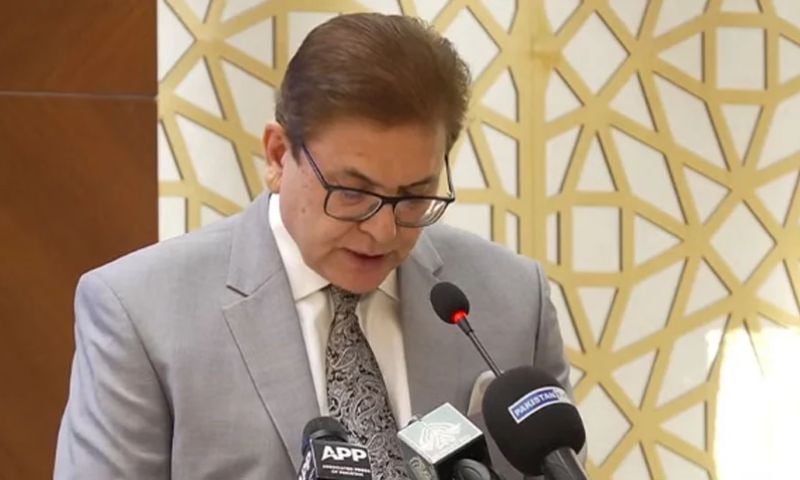
ISLAMABAD: Pakistan’s Special Representative for Afghanistan, Muhammad Sadiq, on Wednesday said that durable peace and stability in Afghanistan require a broad-based political arrangement and meaningful engagement with the country’s entire population.
Addressing a seminar in Islamabad titled “Afghan Conundrum: Conference on Afghan Predicament, Trajectory to Peace”, Muhammad Sadiq said Afghanistan’s position at the crossroads of South, Central and West Asia means developments there have implications for trade, security and stability across the wider region and beyond.
He said Afghanistan’s current governing structure remained narrow and unrepresentative, with the exclusion of women from public life being one of the most visible examples.
Pakistan’s Special Representative on Afghanistan Ambassador Sadiq Khan, while addressing the conference, highlights Afghanistan’s strategic position and core challenges. He says Afghanistan’s governing structure remains narrow and unrepresentative, stressing that durable… pic.twitter.com/e3FMVJpDAi
— Pakistan TV (@PakTVGlobal) September 30, 2026
Presence of terrorist organisations in Afghanistan
The special representative also said the continued presence of terrorist organisations on Afghan soil posed a direct threat to neighbouring countries and the wider region.
He said the current regime in Kabul remained in denial about the issue, adding that it neither acknowledged the scale of the militant presence nor addressed it in a verifiable manner.
“In our assessment, the core challenge in Afghanistan today is twofold… The first fold is the absence of an inclusive governing framework… The second fold, even more critical, is the continued presence of militant organisations on Afghan soil,” Sadiq said.
“When governance is exclusive and armed groups have space, the vacuum is exploited. For Pakistan, this has meant a tangible increase in cross-border security challenges. For our Central Asian partners, it has raised legitimate concerns about border stability,” he said.
“Afghanistan cannot be treated as a bilateral issue. It is a collective responsibility under the mandate of the United Nations, OIC and SCO.”
Unfortunately, Sadiq said, the Taliban regime is in a “state of denial” on the issue of the presence of terrorist groups in Afghanistan.
“It does not acknowledge the scale of this presence nor does it address it in a verifiable manner. This denial keeps Afghanistan away from the cure,” he said.
Challenges for Pakistan
Defence analyst Maj Gen (retd) Zahid Mahmood, in his remarks, highlighted the challenges emanating from Afghanistan for Pakistan and the international community.
He said continued instability in Afghanistan could affect the wider region, while external actors exploit instability by using non-state actors as proxies.
“Afghanistan needs peace with itself before it can have peace with the world, and this, in my view, is Afghanistan’s fundamental strategic predicament. He said Afghanistan’s first frontier of peace, therefore, is not its border with Pakistan, Iran or Central Asia; it lies within Afghanistan itself,” he said.
“The problem begins with the structure of the state,” the analyst said. He added that Afghanistan today suffers from three interconnected deficits. “Number one is legitimacy, number two is institutional capacity, and number three is political inclusivity,” Maj Gen (retd) Zahid Mahmood added.
He said that the greatest challenge emerging from Afghanistan is not simply terrorism; it is the convergence of terrorist sanctuaries, limitations in state control, and proxy geopolitics.
Defence analyst Maj Gen (retd) Zahid Mahmood addresses the conference, highlighting the challenges emanating from Afghanistan for Pakistan and the international community. He says continued instability in Afghanistan could affect the wider region, while external actors exploit… pic.twitter.com/9PM7sZeytJ
— Pakistan TV (@PakTVGlobal) September 30, 2026
“The presence and operational space available to TTP (Tehrik-e-Taliban Pakistan), ISIL, ISK, Al-Qaeda and AQIS, ETIM, BLA, IMU, and other terrorist networks has made Afghanistan unfortunately a sanctuary for terrorists and exporters of regional insecurity,” he warned.
He added that there is additional danger: external actors are exploiting such an environment by cultivating non-state actors as instruments of proxy competition.
“Kabul’s commitment that Afghanistan will not be used against another country must translate into concrete and verifiable action,s not assurance alone,” he concluded.
Peaceful Afghanistan
Russian Representative Ambassador Zamir Kabulov, addressing the conference, said, “We want to see Afghanistan as a peaceful country that lives in harmony with all its neighbours.
Afghanistan is at a crossroads, but this crossroads should be operational for both nations and the whole region to benefit from that
He said Russia is doing its best to support Afghanistan to become self-sufficient, first of all economically.
Russian Representative Ambassador Zamir Kabulov addresses the conference, saying, “we want to see Afghanistan as a peaceful country”.#Afghanistan #ZamirKabulov #AfghanPeace #Russia #PakistanTV pic.twitter.com/pSr3fw0dEX
— Pakistan TV (@PakTVGlobal) September 30, 2026
Russian analyst Dr. Vladimir Sotnikov, said the regional security issue is a test for international diplomacy, while the UN continues to flag exclusionary governance and restrictions on women in Afghanistan.
He also highlighted that lack of broad political participation can undermine legitimacy.
Dr. Vladimir Sotnikov, while addressing the conference, says the regional security issue is a test for international diplomacy while the UN continues to flag exclusionary governance and restrictions on women in Afghanistan. He also highlights that lack of broad political… pic.twitter.com/j3rvkY3tXa
— Pakistan TV (@PakTVGlobal) September 30, 2026
Violence in Afghanistan weaponising youth
Pakistani Security analyst Dr. Maria Sultan said violence in Afghanistan is weaponising youth and fueling economic collapse, with 80% unemployed and the youth bulge being weaponised to fuel terrorist recruitment.
She said terrorism emanating from Afghanistan is not just a Pakistani problem and that no state can tackle a structure of violence fueled by ideology and weaponised youth.
Dr. Maria Sultan says violence in Afghanistan is weaponising youth and fueling economic collapse, with 80% unemployed and the youth bulge being weaponised to fuel terrorist recruitment. She says terrorism emanating from Afghanistan is not just a Pakistani problem and that no… pic.twitter.com/pnui2lVpg7
— Pakistan TV (@PakTVGlobal) September 30, 2026
Abbas Juma, a Russian Journalist, said the fight against extremism in Afghanistan must go beyond military and counter-terrorism measures, with greater focus on governance, political inclusion and economic development. He called for using existing SCO mechanisms to promote dialogue and security.
Pakistan asks Taliban Regime to shun terrorist mindset
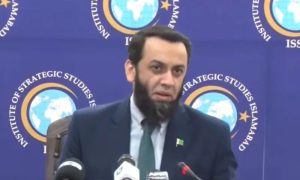
Pakistan’s Information Minister Attaullah Tarar on Tuesday said the Taliban regime in Afghanistan needs to move from a “terrorist mindset” to a mindset of a statesman to achieve lasting peace and stability in the region.
Information Minister Tarar warned that any attempt from Afghanistan to disrupt peace in Pakistan has been and will continue to be met with a response. “The terrorist mindset needs to be changed,” Tarar said while addressing a seminar titled “Afghan Predicament and the Trajectory to Peace” in Islamabad.
ALSO READ: Pakistan Asks Afghanistan’s Taliban Regime to Shun ‘Terrorist Mindset’
He said Pakistan believed in peace and peaceful coexistence and had held several rounds of negotiations with the Afghan Taliban regime to ensure peaceful relations between the two countries.
The Information Minister, however, regretted the lack of willingness on the Afghan side to achieve peace. Tarar said that the main obstacles to peace included militancy and the presence of terrorist safe havens in Afghanistan.
Pakistan has repeatedly criticised the Taliban regime for allowing terrorist groups to operate from Afghan territory.
Tarar said Pakistan and Afghanistan were neighbouring countries with longstanding links and that Pakistan had hosted around four million Afghan refugees over more than four decades.