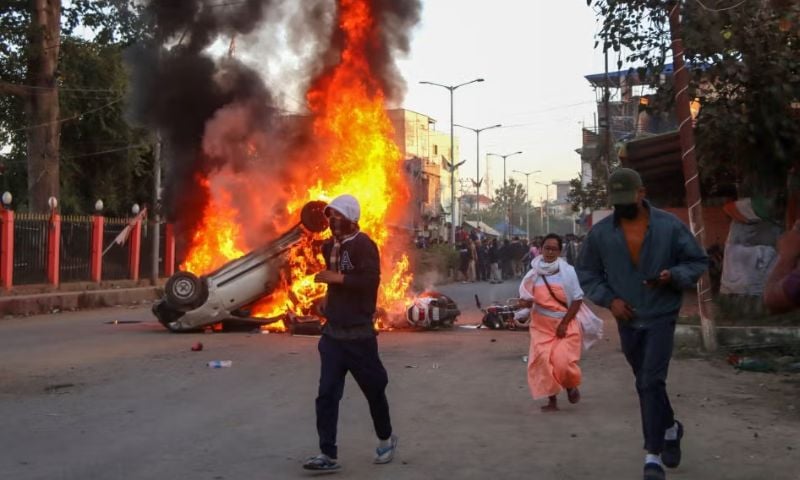
IMPHAL, India: At least four more people were killed, and another was injured in fresh violence in India’s Manipur state on Wednesday, highlighting the fragile security situation in the conflict-hit region.
The gunfight broke out at Taodaijang village in the Khoupum area of Noney district, a Naga-majority region, with Indian media reports citing officials confirming the casualties.
Police said a heavy exchange of fire erupted early in the day between armed groups. The gunfight reportedly continued for several hours, leaving four people dead, while another person sustained injuries.
At least four people were killed and several others injured in a gunfight between rival armed groups in Manipur’s Noney district on Wednesday (November 4, 2026).
https://t.co/vnEXy2doIN
— The Hindu (@the_hindu) November 4, 2026
The prolonged and heavy firing forced families to remain indoors amid fears of further violence.
Media reports said intermittent firing continued in the area even after the initial exchange, raising fears of further escalation and the further spread of violence to neighbouring villages.
The latest incident has renewed concerns over the fragile security situation in Manipur’s hill districts, where rival armed groups have clashed in the past over control and influence.
On Saturday, 5 people were killed in two separate incidents in Manipur, police said.
Three men from the Kuki tribal group were killed in an exchange of gunfire between “unidentified armed miscreants” in the state’s Noney district on Saturday, according to a police statement, cited by Indian media.
Manipur: Five Kukis Killed in 24 Hours as Naga-Kuki Tensions Escalate

The ethnic conflict between the Kukis and the Nagas began in February this year and more than 50 people have been killed so far.
https://t.co/9P3eQIiaYt— The Wire (@thewire_in) November 2, 2026
A top Kuki tribal body blamed Naga separatist outfits for the killings, describing them as a “direct unprovoked assault . . . in their homeland.”
The killings came amid mass protests attended by hundreds of thousands of people in the state capital Imphal and other areas, demanding the abrogation of a ceasefire arrangement between Kuki armed groups and the Indian state.
The predominantly Christian Kuki and Naga tribes have a long history of conflict over competing claims to ethnic homelands in the remote northeastern state. The latest fighting erupted after a Naga man was allegedly assaulted by men from the Kuki community in February this year.
The killing of three Kuki pastors in May triggered a series of retaliatory abductions and killings by both sides.
The latest Kuki-Naga clashes have added to tensions in Manipur, where the Kuki community is also embroiled in a bloody ethnic conflict with the mainly Hindu Meitei community that began in May 2023 over economic benefits and job quotas.
More than 60,000 people displaced by the conflict continue to live in temporary shelters.
Also Read: Five Killed in Fresh Ethnic Violence in India’s Manipur State
As per the local government of Manipur, at least 306 people have been killed, and 49 others reported missing in the ethnic violence that broke out in the state in May 2023.
In one of Manipur’s largest public demonstrations since ethnic violence erupted in 2023, thousands of people took to the streets of Imphal on October 31, demanding an end to the prolonged conflict, justice for victims and the safe return of thousands of families displaced from their homes.
Thousands from indigenous communities like the Meitei and Naga protested across Manipur demanding government accountability and peace. Key demands include scrapping the SoO agreement, withdrawing Assam Rifles, implementing the 1951 NRC, and safely resettling displaced families, alongside calls for Deputy CM Nemcha Kipgen’s removal amid ongoing ethnic violence.
— Nisha Yadav (@valuecraft_) November 2, 2026
Protesters accused the Centre of facilitating a “proxy war” against indigenous communities. They also demanded the withdrawal of Assam Rifles from certain areas, stronger security measures and the rehabilitation of displaced families.