
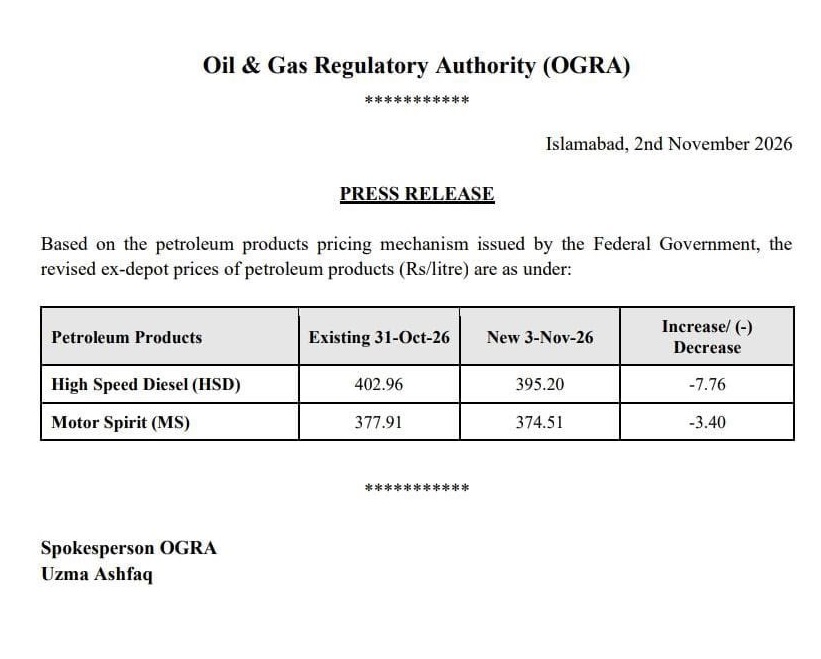
ISLAMABAD: Pakistan’s government on Monday slashed the price of petrol by Rs3.40 per litre and diesel by Rs7.76 per litre following the latest revision.
After the revision, petrol will be priced at Rs374.51 per litre, while high-speed diesel (HSD) will cost Rs395.20 per litre.
According to a press release issued by the Petroleum Division, the revised fuel prices will be applicable from November 3.
The petrol price had peaked at Rs458.41 on April 3 after beginning its upward trajectory from Rs266 in the first week of March.
Pakistan Keeps Petrol Rs 15 Per Litre Below International Rates
Earlier Petroleum Minister Ali Pervaiz Malik said that Pakistan has managed to keep petrol prices around Rs15 per litre below international market rates despite rising global fuel import costs triggered by the US-Iran conflict, crediting local refineries for absorbing part of the financial burden under a revised pricing mechanism.
The minister said regional tensions had driven up the cost of importing petroleum products, with petrol premiums rising sharply alongside freight, insurance and other logistical expenses.
Speaking about the government’s revised fuel pricing mechanism, Malik said the premium on petrol had increased from approximately $5 per barrel before the conflict to around $20 per barrel afterward.
He added that subsequent Pakistan State Oil (PSO) tenders showed premiums climbing further to between $25 and $30 per barrel, and even higher as regional conditions deteriorated.
The petroleum minister said the government had engaged local refineries to minimise the impact of rising international prices on consumers while ensuring that imported fuel remained commercially viable and domestic supplies were not disrupted.
According to Malik, approximately 70% of Pakistan’s petrol requirements are met through imports, while local refineries supply the remaining 30%.
Pakistan’s daily fuel price mechanism
On July 17, Petroleum Minister Ali Pervaiz Malik announced that fuel prices would now be fixed on a daily basis due to fluctuations in international market prices following renewed hostilities between Iran and the US.
Prior to this, the government of Pakistan had been announcing weekly revisions to fuel prices since early March, alongside measures for the conservation of fuel amid possible oil supply disruptions due to the ongoing conflict in the Middle East.
The Pakistan government in April also announced targeted relief measures to provide subsidised fuel.
Petrol is mainly used in private transport, small vehicles, rickshaws, and two-wheelers, and changes in its price affect the middle and lower-middle classes.
Similarly, changes in diesel prices also impact the public at large, as it is mainly used in the heavy transport sector, power plants, and large generators.
Oil prices fall in Asian trade
Physical crude oil prices fell sharply in Asian trading on Monday as diplomatic efforts to end the US-Israeli war on Iran raised hopes of easing tensions and restoring normal energy shipments.
ALSO READ: Oil Prices Fall in Asian Trade on Iran Peace Hopes
Dubai crude, the principal pricing reference for Middle Eastern oil supplied to Asian refiners, was indicated at $95.71 a barrel, down $12.12, or 11.24 per cent, from its Friday reference of $107.82, according to Prism’s cash-market pricing service.
Abu Dhabi’s Murban crude, another key physical grade for Asian buyers, fell to $106.73 a barrel, $12.09, or 10.18 per cent, from its Friday reference of $118.82.