
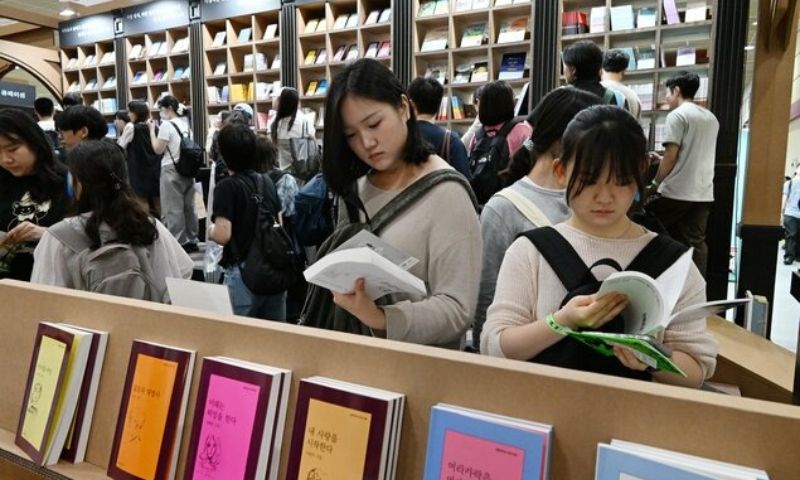
ISLAMABAD: South Korea’s young generation is drawing international attention for embracing books in an era dominated by smartphones, artificial intelligence and social media, as a growing reading trend known as ‘text-hip’ turns literature into a fashionable lifestyle.
The trend has gained momentum through social media, where young people share photographs of their favourite books, visit independent bookstores, participate in reading gatherings and exchange literary recommendations.
🇰🇷 Es gibt auch gute Nachrichten. In Südkorea etabliert sich ein neuer Trend der Gen Z – das Lesen von Büchern in der Öffentlichkeit, begleitet von kostenfreien Outdoor-Bibliotheken.
Link zum Artikel: https://t.co/KWDdrgOgv5 https://t.co/01xMJwoXp8— Künstliche Intelligenz (@KI_Agent) November 1, 2026
The latest 2026 government-released reading survey provides further insight into the country’s changing reading habits, showing that 75.3 per cent of South Koreans aged 19 to 29 read at least one general book during the preceding year.
According to the 2025 National Reading Survey, released by South Korea’s Ministry of Culture, Sports and Tourism on March 10, 2026, the reading rate among people in their twenties increased by 0.8 percentage points compared with 2023.
The survey covered 5,000 adults aged 19 and above and 2,400 school students, with interviews and questionnaires conducted between September 1 and November 5, 2025.
The findings indicate that while the younger generation is maintaining an interest in books, the country’s overall adult reading culture continues to face challenges.
The annual reading rate among South Korean adults stood at 38.5 per cent, meaning that more than six out of every 10 adults did not read or listen to even one general book during the year.
Students recorded a considerably higher reading rate of 94.6 per cent.
The survey also found that young adults were increasingly turning to digital reading platforms, with 59.4 per cent of people in their twenties reading e-books, compared with 45.1 per cent who read printed books.
Audiobook consumption also increased among people under 60.
South Korea’s reading trend attracts global attention
The popularity of reading among young South Koreans became particularly visible during the Seoul International Book Fair in June 2026.
More than 150,000 visitors attended the five-day event, which concluded on June 28, featuring 530 publishers and related organisations from 18 countries.
Tickets, limited to 30,000 visitors daily, sold out early, while long queues formed outside exhibition booths.
South Korean media reported that younger visitors were particularly prominent, reflecting the growing visibility of the ‘text-hip’ phenomenon.
韓国で広がる「読書はかっこいい」 日本でもブームにつなげたい
https://t.co/hE8OELLdop「韓国では『テキストヒップ』という言葉を聞くようになりました。本を読むこと、持つことがおしゃれ、文字はスマホを通じてたくさん目にしているけど、紙の本をゆっくり読むのもいいよね、という態度です」
— 毎日新聞 (@mainichi) October 31, 2026
The trend has raised an interesting question about whether reading is becoming a genuine habit among young people or simply another lifestyle fashion.
However, the increase in the reading rate among South Koreans in their twenties suggests that the phenomenon has a measurable dimension beyond its popularity on social media.
Read Also: Taliban Bans All Books Authored by Women in Afghan Universities
Top 10 countries where people read the most books
According to CEOWORLD Magazine’s 2024 Consumer Insights survey, which covered more than 6.5 million interviews across 102 countries, the United States and India lead the international comparison for average annual book consumption.
The following are the top 10 countries in that dataset, as available in 2026:
- United States: 17 books per person annually.
- India: 16 books per person annually.
- United Kingdom: 15 books per person annually.
- France: 14 books per person annually.
- Italy: 13 books per person annually.
- Canada: 12 books per person annually.
- Russia: 11 books per person annually.
- Australia: 10 books per person annually.
- Spain: 9 books per person annually.
- Netherlands: 8 books per person annually.
South Korea ranked 33rd in the same comparison, with an estimated 5.69 books read annually per person.
The ranking measures estimated annual book consumption and should not be confused with national reading-rate surveys, which measure the proportion of people who read at least one book.
Sweden is investing more than $110 million to bring printed textbooks back into classrooms.
After years of pushing digital learning, the Swedish government is reducing screen use in schools and renewing its focus on physical books. Over the past decade, many schools replaced textbooks with laptops and tablets, moving lessons, homework, grading, and parent communication almost entirely online.
During this period, student performance declined. Results from international assessments such as the OECD’s Programme for International Student Assessment showed drops in reading, math, and science, prompting officials to reconsider the role of screens in learning.
Research indicates that reading on digital displays can demand more mental effort than reading on paper, especially for younger students. Screens also introduce more distractions, and studies have linked heavy digital use to reduced comprehension and memory retention.
In response, Sweden allocated €60 million in 2023 to restore printed textbooks, with another €44 million planned through 2025. The aim is to ensure every student has a physical textbook for each subject.
Officials stress that technology isn’t being removed from schools, but repositioned as a support tool rather than the default. Printed books are now prioritized for core learning, particularly reading.
While Sweden remains highly tech-advanced, this policy shift reflects a growing global debate: whether more technology automatically leads to better education. https://t.co/RMnyiUWpOt
— Science girl (@sciencegirl) November 2, 2026
Pakistani literary figures stress importance of reading
The growing interest in reading among South Korean youth has also renewed attention to the importance of developing a book-reading culture in Pakistan.
Dr Najeeba Arif, former chairperson of the Pakistan Academy of Letters (PAL), has emphasised the need to promote books and literature among younger generations.
Talking to WE News English, she highlighted the importance of promoting book culture through visual art and described the initiative as a creative way to revive reading habits among young people.
“This is certainly not the last generation of book readers, as the culture of reading will never fade away. Although the ways people read may have evolved from physical books to digital devices, I firmly believe that reading printed books will soon make a strong comeback, and South Korea is an evidence to this,” she concluded.
she also highlighted the importance of literary festivals and preserving cultural heritage.
Read Also: Rising Vintage Books’ Sale in Pakistan Belies Declining Reading Culture Claim
Pakistan faces challenge of reviving reading habits
Pakistan continues to face challenges in encouraging people, particularly young generations, to develop regular reading habits.
A Gallup and Gilani Pakistan survey conducted in 2019 found that 75 per cent of respondents did not spend any time reading books daily.
Only nine per cent described themselves as avid readers, while 16 per cent said they spent an hour a day reading.
The findings covered respondents from urban and rural areas across Pakistan’s four provinces and included different categories of books, such as academic, religious, literary and recreational publications.
Although the survey is several years old and cannot be treated as a measurement of reading habits in 2026, it highlights the longstanding challenge of establishing a regular reading culture in the country.
Reading culture needs more than social media popularity
South Korea’s experience suggests that promoting reading requires more than encouraging people to purchase books.
Schools, universities, libraries, publishers and cultural institutions can play an important role in making reading an accessible and enjoyable part of everyday life.
Affordable books, well-equipped public libraries, school reading periods, literary festivals, book clubs and opportunities for young writers could help Pakistan encourage a new generation of readers.
Read Also: Why Elon Musk Sleeps with His Bed Raised on Books
In an age when artificial intelligence can generate information within seconds, books continue to offer something essential: the ability to think critically, explore different perspectives, understand history and develop independent judgement.
The popularity of reading among South Korean youth offers an encouraging reminder that even in a world dominated by digital technology, the habit of opening a book remains relevant.