
Key Points
- Asian markets opened in November with mixed performances after AI shares led Wall Street’s steepest decline since June
- Heavy spending on artificial intelligence infrastructure is raising questions about profitability
- Investors are watching upcoming corporate earnings, US elections and developments in the Middle East
ISLAMABAD: Asian stock markets were mixed on Monday as technology shares struggled to recover from last week’s selloff, with concerns over the profitability of massive artificial intelligence investments continuing to unsettle investors.
The uneven trading followed a sharp decline on Wall Street on Friday, when technology and AI-related stocks came under renewed selling pressure. US bourse went bearish after major AI companies reported earnings and outlined plans for further heavy investment in data centres and semiconductor infrastructure.
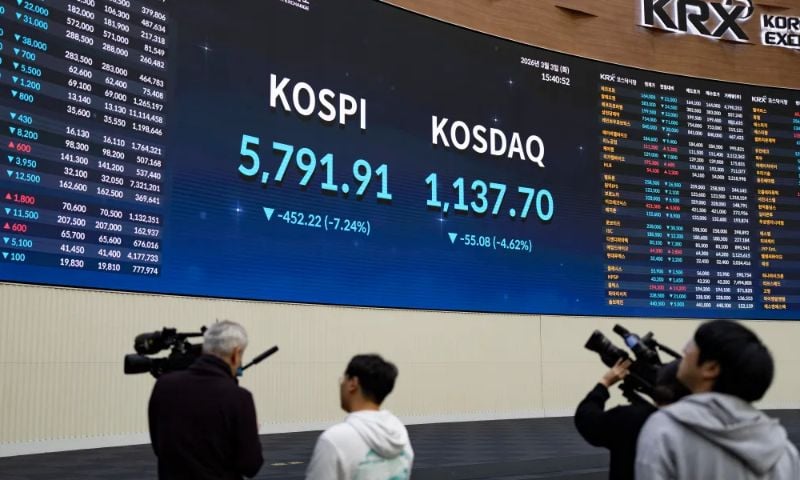
Japan’s Nikkei 225 slipped 0.3 per cent, while South Korea’s Kospi advanced 2.2 per cent. Taiwan’s Taiex declined 0.7 per cent. Hong Kong, Shanghai and Indian markets rose, while Australia’s benchmark fell.
Tech shares’ volatility
Technology shares remained particularly volatile. Japanese memory-chip maker Kioxia plunged 15.8 per cent after issuing a disappointing earnings outlook, reflecting investor concerns about the semiconductor industry.
In South Korea, Samsung Electronics gained ground, and rival SK Hynix also advanced, helping the Kospi recover some of its recent losses. Taiwan’s leading chipmaker TSMC, however, faced renewed pressure.
The technology sector’s difficulties followed Friday’s losses in New York, where the S&P 500 fell 1.8 per cent and the technology-heavy Nasdaq Composite dropped 2.9 per cent. The Dow Jones Industrial Average declined 1.1 per cent.
The selloff reflected growing doubts about whether the enormous sums being committed to artificial intelligence will generate sufficient returns.
READ ALSO: Global Stocks Slide as AI Fears Drive Bond Rally
Amazon, Alphabet, Microsoft and Meta are collectively expected to spend more than $700 billion on capital investment this year, much of it directed towards AI infrastructure. Investors are increasingly questioning whether the anticipated profits will justify such expenditure.
Corporate earnings in focus
Investors are now looking to another important week for corporate earnings, with Apple, chipmaker Advanced Micro Devices (AMD) and software company Palantir Technologies scheduled to report results.
Apple’s results are particularly important as investors assess consumer demand, the company’s AI strategy and its ability to translate investment in new technology into stronger earnings.
Recent results from Alphabet and Amazon have already intensified scrutiny of the technology industry’s spending plans, even as several companies continue to report solid profits.
The uncertainty has also raised questions about whether the AI investment boom can sustain the valuations of technology companies that have driven much of the stock market’s gains this year.
Oil and geopolitical developments
Oil prices fell more than 2 per cent on Monday, providing some support to equity markets, as reports of renewed diplomatic efforts involving Iran raised hopes of avoiding a resumption of military hostilities.
Iranian officials have discussed proposals for reopening the Strait of Hormuz, a strategically important shipping route through which a substantial share of the world’s oil supplies normally passes.
However, uncertainty over negotiations and the possibility of renewed military action continued to leave investors cautious.
US elections add to uncertainty
Financial markets are also preparing for Tuesday’s US midterm elections, which could change the balance of power in Congress and influence President Donald Trump’s domestic economic and investment policies.
Investors are particularly interested in the potential implications for technology companies, including political scrutiny of data centres, artificial intelligence infrastructure and their growing electricity requirements.
The tricky combination of technology-sector uncertainty, geopolitical risks and political developments is likely to keep global markets sensitive to corporate earnings and economic data in the coming days.