
Key Points
- China’s AI robot companies raised $13 billion in the first half of 2026, five times the year-earlier amount
- China is drawing on its manufacturing strength to compete with the US
- Access to advanced chips and reliable training data remains a challenge
ISLAMABAD: China’s robot makers are turning to a bigger challenge: making machines intelligent enough to think, learn, make decisions and perform useful jobs with limited human assistance.
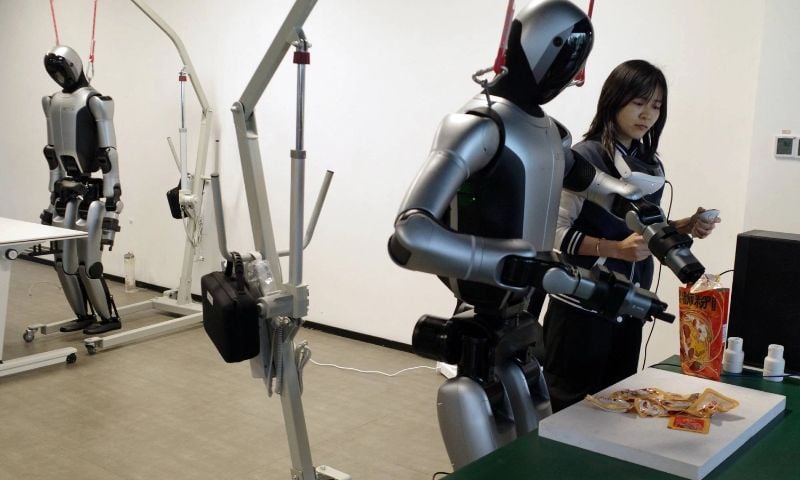
The shift following the development of humanoid robots capable of running, dancing and performing acrobatics is attracting billions of dollars in investment.
Intelligent machine manufacturers plan to move beyond impressive demonstrations to robots that can work in factories, warehouses, shops and other workplaces.
Chinese companies developing artificial intelligence (AI) for robots raised 93.5 billion yuan ($13 billion) through 322 investment deals in the first half of 2026, five times the amount recorded in the same period last year, according to research firm ITjuzi.
As the cost of manufacturing robots falls, companies increasingly see the software controlling their machines as a key to gaining a competitive advantage.
The objective is to develop robots that can understand their surroundings, follow instructions, learn unfamiliar tasks and adapt to changing situations without being programmed separately for every job.
China’s competition for smarter robots
The race involves companies in both China and the United States. American startups, including Physical Intelligence, Skild AI and Generalist, are developing software for robots to learn different skills without extensive retraining.
Generalist says its latest system can complete nearly 60 per cent of simple tasks after watching a demonstration lasting between three and 12 seconds.
China’s X Square has also demonstrated how robots can learn to handle objects by watching a single human demonstration video.
Chinese startups X Square, Galaxea and Spirit AI have each reached valuations of around $3 billion, according to company disclosures.
READ ALSO: China Unveils 13-Foot Humanoid Robot Capable of Lifting 500kg
Established manufacturers are also investing heavily in AI development. Chinese robot maker UBTech advertised a chief scientist position with compensation of up to 124 million yuan ($18 million), including shares and benefits.
Unitree, another major Chinese manufacturer, has around 30 researchers working on AI that can predict how objects behave, according to a person familiar with the company’s activities.
China teaching robots to learn
Unlike chatbots, which learn from enormous collections of online text, robots need examples of physical activities.
They must learn how to grip objects, handle flexible materials, recognise obstacles and respond when something does not go as expected.
Companies are collecting this information by recording people performing tasks, using sensors to capture movements and creating computer simulations.
Spirit AI has hired around 1,000 people to record everyday and industrial activities. ACE Robotics uses wearable sensors to capture workers’ movements and the force they apply when handling objects.
Ant Group’s robotics unit, Robbyant, says it trained an AI system using 160,000 hours of material, including 50,000 hours of human-guided robot movements.
It tested the system across 20 robot designs from 17 manufacturers, aiming to make the same software work on different machines.
Other companies are using computer-generated environments to train robots before deploying them in real workplaces.
However, simulations cannot fully reproduce the complexity of everyday life. The quality of training information remains a major challenge, particularly when robots encounter objects or situations they have never experienced before.
Chips and commercial challenges
China’s robotics ambitions also face limitations in access to advanced computer chips. US restrictions on exports of sophisticated Nvidia chips have complicated efforts to develop increasingly powerful AI systems.
Chinese companies are exploring domestic alternatives and more efficient software to reduce their dependence on advanced foreign technology.
Some applications are already moving beyond demonstrations. Spirit AI robots are being tested for connecting flexible wires during battery-pack production at CATL.
Robbyant says its machines are handling orders at two pharmacies in Shanghai. Human staff still check medicines before dispatch.
The bigger challenge is making robots dependable enough to perform unfamiliar tasks without constant human supervision.
Robotics consultant Georg Stieler cautions that successful demonstrations do not mean machines are ready for widespread commercial use.
Unitree founder Wang Xingxing has described the prospect of a breakthrough in robotics similar to the arrival of ChatGPT in artificial intelligence.