
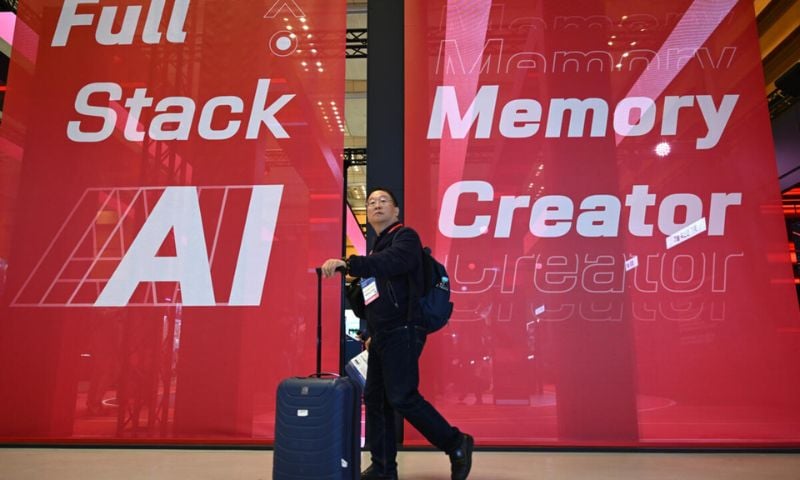
SEOUL: South Korea will nearly double its spending on artificial intelligence (AI) and semiconductors in 2027, allocating a record 21.3 trillion won ($16 billion) to strengthen its technology sector and drive future economic growth, President Lee Jae Myung has announced.
Addressing parliament during his annual budget speech on Monday, Lee said the proposed investment would cover a wide range of sectors, including semiconductor manufacturing, AI development, data centres and robotics.
“We will make bold investments in AI and future growth engines to boost our economy’s growth potential,” Lee said, describing the allocation as nearly twice the amount earmarked for the current year.
The announcement underscores Seoul’s ambition to strengthen its position in the global technology industry, particularly as demand for advanced semiconductors and AI infrastructure continues to surge worldwide.
Lee also outlined plans to modernise the country’s armed forces through advanced technologies, including artificial intelligence, robotics and drones.
The government has proposed increasing defence spending by around eight per cent from this year’s level to 73.3 trillion won in 2027, with plans to acquire nuclear-powered submarines and KF-21 fighter jets.
“We aim to rapidly transform our military into a smart, elite force by establishing integrated manned and unmanned systems based on AI, robots and drones,” Lee said.
The military modernisation plans come amid heightened security tensions on the Korean Peninsula, with North Korea recently testing several weapons systems, including a precision-guided torpedo system and an intermediate-range hypersonic missile, both of which Pyongyang said incorporated AI technology.
South Korea and the United States also reached an agreement last year on building nuclear-powered submarines, a plan strongly criticised by North Korea, which described the programme as a dangerous attempt at confrontation.
The overall 2027 budget proposal stands at 821 trillion won, representing a 12.8 per cent increase from the previous year and the largest budget in the country’s history. The proposal requires parliamentary approval, which is expected given the governing party’s majority.
Technology investment drive
South Korea, a global technology powerhouse, is home to Samsung Electronics and SK hynix, two of the world’s leading memory chip manufacturers. Both companies are benefiting from soaring demand for semiconductor components used in AI systems and data centres.
Lee said the government would allocate 4.7 trillion won to support advanced AI development projects, aiming to produce a domestically developed AI model capable of competing at the highest international level.
READ ALSO: South Korea to Invest Nearly $1.2 Trillion in Chips and AI Data Centres
The initiative builds on a public-private partnership announced in June, centred on three major projects: expanding semiconductor manufacturing hubs across the country, establishing robotics research and development centres, and developing gigawatt-scale AI data centres.
The government had previously outlined investment plans worth nearly $1.2 trillion under the broader initiative.
Samsung Electronics and SK hynix also announced plans in June for combined investments of more than 4,755 trillion won ($3.5 trillion) in South Korea, marking a record level of corporate investment.
The global AI boom has significantly boosted the profitability and share prices of South Korean chipmakers, while tightening supplies of memory chips and intensifying competition for skilled semiconductor engineers.
In September, Seoul also unveiled a 162.3 trillion won Future Fund for 2027, designed to channel increased tax revenues from the semiconductor boom into long-term economic growth.
Lee said the government would additionally invest 2.1 trillion won in electricity, water supply and industrial infrastructure to support the semiconductor industry.
He stressed that chip manufacturing facilities require reliable electricity supplies around the clock throughout the year, making infrastructure development essential to sustaining the country’s technological ambitions.