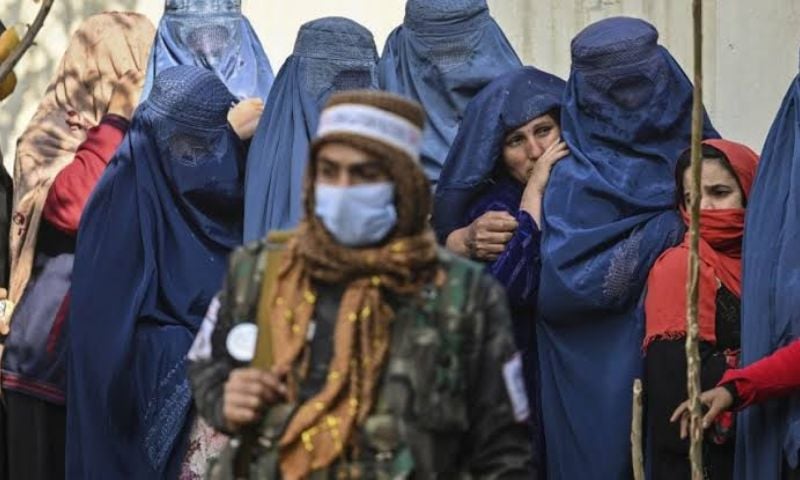
KABUL: Women heading households in Afghanistan are facing worsening poverty, social discrimination and forced marriages under the Taliban regime, with widows struggling to provide for their children amid severe economic hardship and restrictions on women’s employment, according to accounts of affected women.
Several widows have described how the absence of adequate livelihood opportunities, mounting household expenses and social pressure have pushed them into desperate circumstances, forcing some to undertake domestic work in private homes merely to keep their families afloat.
Their accounts paint a grim picture of the challenges confronting women who have lost their husbands and are now solely responsible for raising children, paying rent and meeting basic household needs in a country where women’s economic and social opportunities remain severely restricted.
Under Taliban rule reports of girls being forced into early marriages and families selling daughters amid extreme poverty raise grave human rights concerns. No child should be treated as a commodity or forced into a marriage before she can freely make such a decision. https://t.co/aBnLQcnVDQ
— شیر دل (@Shairdilkhaan) October 27, 2026
Shireen Gul, whose name has been changed to protect her identity, said she was struggling to raise her four children and meet their basic needs through domestic work. Despite facing financial difficulties, she also had to endure gossip and humiliating remarks from people because of her age and the nature of her employment.
“My children are young, and I am illiterate myself. My problems are endless. Because I am young, people talk about me when I go to their homes for work. If I don’t work, my problems only increase,” she said.
She said balancing employment with childcare and her children’s education had become almost impossible. Her son is studying in the 11th grade, and she does not want him to work because she hopes he will have a better future.
Gul said she paid 2,700 Afghanis in monthly rent and struggled to meet electricity and water bills. She added that whenever she left home for work, her children were deprived of proper care, while staying at home meant the family had to endure hunger and financial hardship.
Another widow, Tamanna, said her husband had been killed five years ago, leaving her with five children, including twin daughters who were only three months old at the time.
Although she subsequently secured a job at a bank, her low salary was insufficient to cover household expenses, rent and her children’s educational costs. Three of her children attend a private school, while financial constraints have prevented her from fulfilling their wishes.
Describing her exhausting daily routine, Tamanna said she worked during the day and spent much of the night washing clothes, preparing meals and helping her children with their studies. “My husband was the person I leaned on in every difficulty, but now I carry even the responsibilities that were his,” she said.
She also faces social discrimination and pressure from her late husband’s family. According to Tamanna, relatives make derogatory remarks about her whenever she dresses well and suspect her of having relationships with other men. Her brothers-in-law have also threatened to take her children away if she remarries.
In another disturbing account, a widow identified as Sharara said she was forced to marry her brother-in-law just three days after her husband’s death, without being consulted or given an opportunity to consent.
She said her husband had died of cancer, leaving her with a one-year-old son. While she was still grieving, her family arranged her marriage to her brother-in-law, who already had another wife and four children.
Sharara said her new husband’s wife subjected her to constant humiliation and controlled almost every aspect of her life, including her clothing and movements.
“I wish they had given me the chance to first mourn the loss of my husband and go through my period of grief, and then decide about my future and my life myself,” she said.
READ ALSO: Taliban’s Systematic Violations of Afghan Women’s Rights Constitute Crimes Against Humanity: EU
The accounts highlight the vulnerability of Afghan widows under the Taliban administration, where restrictions on women’s participation in public and economic life have further narrowed opportunities for those struggling to support their families.
The United Nations Entity for Gender Equality and the Empowerment of Women (UN Women) has previously warned that Afghan women and girls face multiple and overlapping risks, with women heading households particularly exposed to hunger and economic insecurity.
The UN agency has also highlighted that women with limited family support and fewer protective resources are more vulnerable to insecurity, exploitation and different forms of social pressure.
The worsening circumstances of these women underscore the wider humanitarian and human rights crisis in Afghanistan, where Taliban-imposed restrictions on women’s education, employment and public participation have compounded the difficulties faced by already vulnerable families.