URDA, Spain: A rail collision in Spain that claimed at least 64 lives on Wednesday came after a train was ordered to go in “error” despite a technical failure that halted all services, the transport minister said.
The first findings about the accident in the central region of Castilla-La Mancha are likely to revive questions about rail safety in Spain after another high-speed collision in January killed 46 people.
Transport Minister Oscar Puente said 69 kilometres (43 miles) of track were affected by an outage of the automatic control system, which “caused all the trains that were running at that time to stop automatically”.
“The decision to resume traffic, while that system had not been restored, belongs to the control centre, and the control centre… took the decision to resume traffic in circumstances that, from our point of view, are inexplicable,” Puente said.
A esta hora comparece ante los medios de comunicación Óscar Puente, ministro de Transportes: “Voy a explicarles la información que tenemos en estos momentos (…) Un accidente por alcance en la red ferroviaria española es un accidente verdaderamente inverosímil”. https://t.co/la7NGC5OSZ
— RTVE Noticias (@rtvenoticias) October 28, 2026
A train operated by state company Renfe restarted and travelled 25 kilometres until it collided with a stationary train belonging to private Spanish company Iryo, at a speed that could have reached “up to 200 kilometres per hour”, Puente added.
“It is clear that, in the control centre, the decision was taken to restart, and then they had more than enough time to verify the error, and they did not fix it,” Puente said.
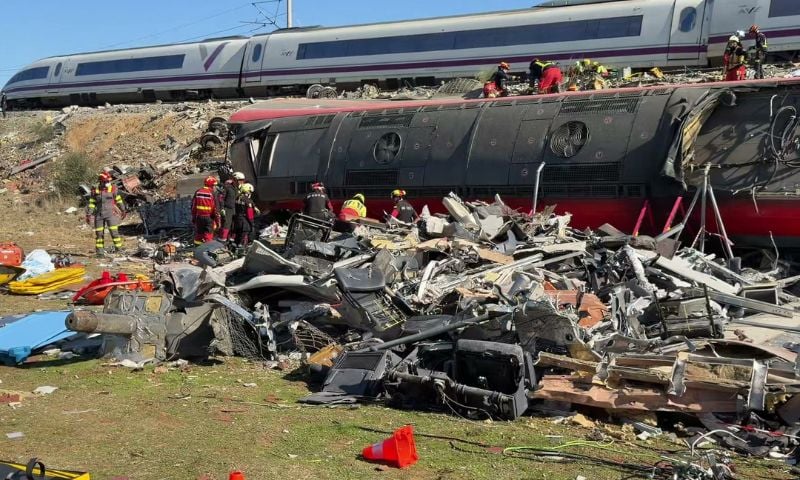
The accident occurred on the Madrid-Andalusia high-speed rail line near Urda, where a Renfe AVE train and an Iryo train collided, prompting a major emergency response involving local, regional and national authorities.
Footage from regional Castilla-La Mancha Television showed a derailed train with at least one carriage remaining on an elevated section of track while twisted metal, broken panels and wreckage could be seen strewn across an embankment beneath the line.
Miguel, a passenger travelling with several colleagues in the rear car of one of the trains, described to Cope Radio the moment of the accident.
“We heard a massive roar, a truly enormous thud that went on for 10 seconds, as if the train were about to derail. Through the right-hand window, we could see a wrecked train — I imagine it must have been the other one,” he said.
Death Toll Likely to Rise
Castilla-La Mancha region spokesperson Esther Padilla said the number of casualties was likely to rise.
She said 147 people had been travelling on the Iryo train and 397 on the Renfe train.
The collision comes nine months after an accident between high-speed trains belonging to the same operators on the same line that killed 46 people.
That crash in January, which occurred after a train derailed and smashed into an oncoming train near Adamuz, in Cordoba province, triggered a debate about the level of investment in railway maintenance in recent years.
Prime Minister Pedro Sanchez’s agenda, published on the Spanish government’s website, had been cleared for the day.
The opposition People’s Party also cancelled all campaign events ahead of a snap election on November 29, a spokesperson said.
Consternado ante el grave accidente de trenes en Toledo. Permanezco en constante contacto con el ministro de Transportes, @oscar_puente_, y con el presidente de Castilla-La Mancha, @garciapage. Los servicios de emergencia están trabajando sobre el terreno para atender a las personas afectadas y garantizar su seguridad, en coordinación con todas las administraciones implicadas. Mi cariño, solidaridad y apoyo a todas las víctimas y sus familias.
— Pedro Sánchez (@sanchezcastejon) October 28, 2026
“Shocked by the serious train accident in Toledo. My affection, solidarity, and support to all the victims and their families,” Sanchez said on X.
The Renfe and Iryo trains crashed just after 9 am (local time), causing two Iryo wagons to derail, a spokesperson for the Castilla La Mancha region said, adding that the cause was not yet clear.
El Gobierno regional activa el PLATECAM, en Fase de Emergencia, Situación Operativa 1, para la provincia de Toledo, por la colisión de dos trenes de alta velocidad en la estación de Urda. ℹ️ https://t.co/MSimexXUfl
— Gobierno de Castilla-La Mancha (@gobjccm) October 28, 2026
Rail operator Adif said the incident occurred on the line from Madrid to Seville.
Manuel Galan, the mayor of the nearby town of Urda, told Cadena SER that emergency services had asked the town council to prepare emergency facilities, including a sports hall, to accommodate passengers and the injured.