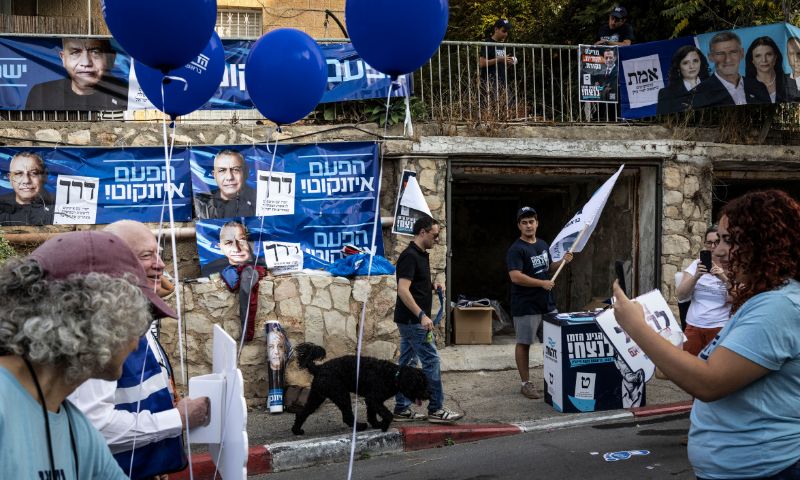
JERUSALEM: A deeply divided Israel headed to the polls on Tuesday for the first time since Hamas’s October 7, 2023 attack, with voters delivering their verdict on veteran Prime Minister Benjamin Netanyahu and the country’s rightward drift.
The elections are widely seen as a referendum on Prime Minister Benjamin Netanyahu, whose leadership has faced intense scrutiny since the Hamas-led attack of 7 October 2023.
About seven million Israelis are eligible to vote. A total of 38 parties and electoral lists initially registered for the election, although two subsequently withdrew.
With no single party expected to secure an outright majority, the outcome will depend not only on the number of seats each party wins but also on its ability to negotiate alliances and assemble a governing coalition.
Here are the principal parties and political alliances contesting the election.
Likud: The Right
Leader: Benjamin Netanyahu
Current seats: 32
Netanyahu’s Likud party has dominated Israeli politics for much of the past two decades. The prime minister, who first took office in 1996, is known for his political manoeuvring and ability to build coalitions.
However, his leadership has come under heavy criticism over the security failures that preceded the 7 October 2023 Hamas attack, the deadliest in Israel’s history.
Netanyahu has since pursued extensive military operations against Israel’s adversaries across the region, including a joint campaign with the United States against Iran, according to the supplied account.
Despite his long political career, Likud has been trailing opposition rivals in recent polls.
Yashar: The Centre
Leader: Gadi Eisenkot
Current seats: None
Former military chief Gadi Eisenkot founded Yashar in 2025, presenting it as an effort to unite Israelis after years of political division.
Eisenkot served in a national unity government with Netanyahu following the October 7 attack but has since emerged as one of the prime minister’s principal challengers.
His campaign has drawn support from established political figures on the right and, to a lesser extent, the left. He has also pledged to end exemptions from military service for ultra-Orthodox Jewish men, an issue that has become increasingly contentious among secular Israelis.
Beyahad: Centre-Right
Leaders: Naftali Bennett and Yair Lapid
Current seats: No seats under the Beyahad name
Beyahad brings together former prime minister Naftali Bennett and Yair Lapid, a former journalist who previously served as prime minister.
The pair joined forces to form a government in 2021, united largely by their opposition to Netanyahu. That coalition collapsed in 2022.
Bennett, a businessman and religious Jew who previously had ties to the West Bank settler movement, has sought to position himself as a centrist in the current campaign.
The alliance’s ability to cooperate with other opposition parties could be decisive in determining whether Netanyahu can be replaced.
HaDemokratim: The Left
Leader: Yair Golan
Current seats: Four
Led by former deputy military chief of staff Yair Golan, HaDemokratim brings together remnants of the Labour movement and the left-wing Meretz party.
Labour dominated Israeli politics for decades after the country’s establishment, while Meretz has long represented the secular left.
The Democrats support a two-state solution to the Israeli-Palestinian conflict, placing them among the relatively few Jewish-led political parties advocating that approach.
Shas: Ultra-Orthodox
Leader: Aryeh Deri
Current seats: 11
Founded in 1984, Shas represents predominantly Sephardic and Mizrahi ultra-Orthodox Jewish communities with roots in the Middle East and North Africa.
The party has been a longstanding ally of Netanyahu and presents itself as a champion of lower-income Israelis.
It strongly opposes compulsory military service for ultra-Orthodox religious students, placing it at the centre of one of the election’s most divisive debates.
Otzma Yehudit: Far-Right
Leader: Itamar Ben Gvir
Current seats: Six
Led by National Security Minister Itamar Ben Gvir, Otzma Yehudit has become an influential force on Israel’s far right.
Netanyahu brought the party into his governing coalition despite its earlier political isolation.
Ben Gvir has repeatedly drawn international condemnation for inflammatory statements and hardline positions towards Palestinians.
The party’s influence could be significant if Netanyahu needs support from far-right allies to secure a parliamentary majority.
Religious Zionism: Far-Right
Leader: Bezalel Smotrich
Current seats: Seven
Finance Minister Bezalel Smotrich leads Religious Zionism, another far-right party in Netanyahu’s governing coalition.
The party advocates annexing the occupied West Bank. Smotrich has used his ministerial position to advance settlement expansion and withhold tax revenues from the Palestinian Authority.
Its position on the occupied territory and Palestinian statehood places it firmly against the two-state solution.
United Torah Judaism: Ultra-Orthodox
Leader: Yaakov Asher
Current seats: Seven
United Torah Judaism represents predominantly Ashkenazi ultra-Orthodox Jews, whose communities trace their origins to Europe.
The party has traditionally supported Netanyahu-led governments and prioritises religious education, community funding and exemptions from compulsory military service for religious students.
Its position on conscription could become a key issue in post-election coalition negotiations.
Yisrael Beiteinu: Secular Right
Leader: Avigdor Lieberman
Current seats: Six
Former defence, foreign and finance minister Avigdor Lieberman leads Yisrael Beiteinu, a secular nationalist party that draws substantial support from Israelis who immigrated from the former Soviet Union.
Although Lieberman takes a hard line on the Palestinians, he has also clashed with ultra-Orthodox political parties over religion and state.
His opposition to Netanyahu could make his party an important player in negotiations over an alternative government.
Ra’am: Arab Islamist
Leader: Mansour Abbas
Current seats: Five
The United Arab List, known as Ra’am, became the first independent Arab party to join an Israeli governing coalition when it entered the government formed in 2021.
Led by Mansour Abbas, the party focuses on equal rights and improved living conditions for Israel’s Arab minority, which accounts for about one-fifth of the population.
Ra’am could again become a pivotal player if neither major political bloc secures a clear majority. Its willingness to cooperate with Jewish-led parties distinguishes it from other Arab political groups.
Joint List: Arab-Jewish Left
Leader: Yousef Jabareen
Current seats: Five
It supports a two-state solution and advocates political equality for Arab citizens of Israel.
Its electoral performance will depend partly on Arab voter turnout, which could influence the balance between Netanyahu’s allies and the opposition.
Amcha Israel: Far-Right
Leader: Ofer Winter
Current seats: None
Amcha Israel is a new far-right party founded by former military commander Ofer Winter.
Unlike some other far-right groups, it supports compulsory military service for all Israelis, including ultra-Orthodox men.
The party’s performance will depend on whether it can attract enough votes to cross Israel’s electoral threshold and enter the Knesset.
The Battle for 61 Seats
Israel’s parliament has 120 seats, meaning a governing coalition needs the support of at least 61 lawmakers to command a majority.
That requirement makes smaller parties and political alliances particularly important. Under Israel’s electoral system, parties must win at least 3.25% of the vote to enter parliament. Those that fall short receive no seats, potentially affecting the balance between rival political blocs.
For Netanyahu, the central challenge is to retain enough support to form a government. For his opponents, it is to turn their combined strength into a workable parliamentary majority.