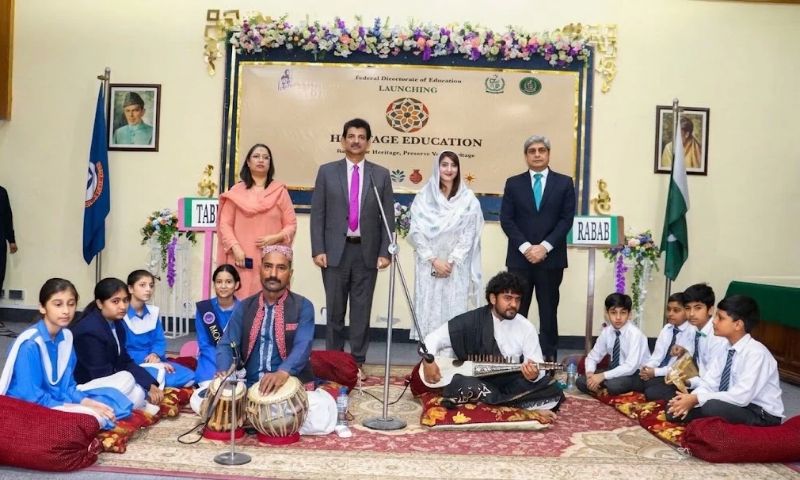
ISLAMABAD: Pakistan’s capital Islamabad has launched a Heritage Education Initiative in public schools to connect students with the country’s rich cultural traditions, preserve traditional craftsmanship and promote creative learning beyond conventional classroom teaching.
The Ministry of Federal Education and Professional Training (MoFEPT), in collaboration with the National Heritage and Culture Division, will implement the six-month pilot programme in 10 institutions under the Federal Directorate of Education (FDE), targeting students in Classes VI to VIII.
Heritage clubs to promote cultural learning
Under the initiative, each participating school will establish a Heritage Club comprising 20 to 30 students, providing them with opportunities to explore Pakistan’s cultural diversity through practical activities, research, observation and creative expression.
The programme will complement the existing curriculum without introducing additional subjects, examinations or graded assignments. Instead, students will engage directly with traditional crafts and artistic practices to develop a deeper understanding of the cultural influences that have shaped Pakistan’s identity.
The six focus areas are truck art, patchwork, jewellery making, clay pottery, rabab and digital art. These activities will expose students to both traditional craftsmanship and contemporary forms of artistic expression.
Read Also: Pakistan’s Heritage And Diplomacy Intersect On World Heritage Day
Six-month pilot to conclude with student exhibition
The pilot programme will follow four stages: discovery, experience, creation and showcase. It will conclude with an exhibition curated by students, allowing participants to display their work, demonstrate their learning and share their understanding of Pakistan’s heritage with the wider community.
The initiative will be rolled out through three phases. The first will test the programme’s feasibility and establish proof of concept, while the second will focus on consolidating the model and expanding its reach. The third phase will aim to institutionalise heritage education and ensure its long-term sustainability within the federal education system.
Read Also: SCO Coordinators Explore Pakistan’s Cultural Heritage Ahead of 2027 Chairmanship
The ministry said the initiative reflects its commitment to holistic education that extends beyond conventional classroom instruction. By encouraging students to observe, question, investigate and reinterpret cultural traditions rather than simply memorise historical facts, the programme aims to foster creativity, critical thinking and cultural appreciation.
Through Heritage Clubs, students will also learn about the value of traditional knowledge, craftsmanship and the cultural practices of local communities. The programme is expected to strengthen intergenerational connections by introducing young learners to artistic skills and knowledge passed down through generations.
The collaboration between MoFEPT and the National Heritage and Culture Division highlights the role of education in preserving cultural heritage while supporting the development of future generations.
The ministry expects the pilot to provide insights into implementation, student participation and learning outcomes, helping shape future expansion across federal educational institutions.
By integrating hands-on heritage learning into school life, the initiative aims to nurture students who appreciate Pakistan’s cultural diversity, understand their roots and recognise their role in safeguarding the country’s heritage for future generations.