
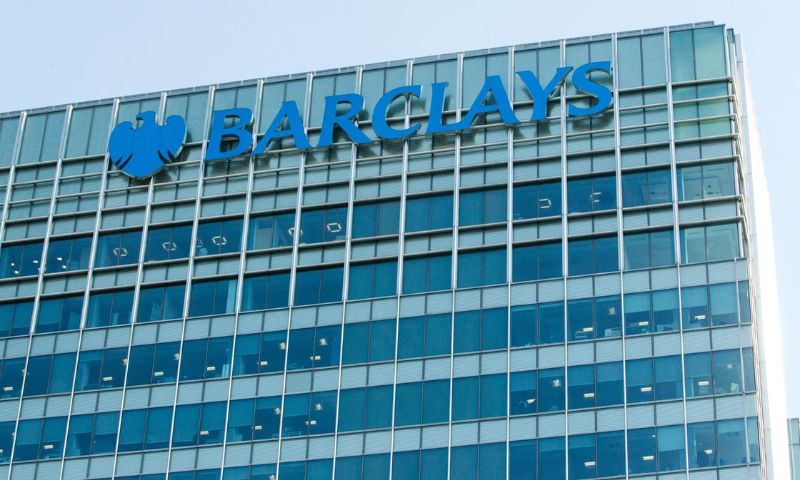
LONDON: British banking giant Barclays announced on Thursday plans to cut around 5,000 jobs, equivalent to roughly five per cent of its global workforce, by the end of 2026 as part of an artificial intelligence (AI)-driven efficiency drive.
The announcement came alongside the bank’s third-quarter earnings update, which showed that its profit after tax rose 13 per cent year-on-year to £1.65 billion ($2.2 billion), up from £1.46 billion a year earlier.
In an earnings presentation, Barclays said the planned job cuts were part of efforts to achieve “organisational simplification and technology change efficiency driven by AI”.
Around 60 per cent of the job losses would affect support functions, including a reduction in developer positions as AI enables employees to become more productive, the bank said.
Barclays chief executive C. S. Venkatakrishnan highlighted continued progress in the bank’s operational and financial performance, noting that its investment banking division had delivered strong results in equities.
Barclays is cutting 5,000 jobs to save money. Then it’s spending £500 million buying back its own stock.
Both in the same press release this morning:
→ 5,000 jobs gone, about 5% of the bank, “driven by AI”
→ Q3 pre-tax profit £2.3B, up 12%
→ a new £500M buyback1,000 of those roles are already gone. CFO Anna Cross says the other 4,000 go by the end of Q4, so in roughly ten weeks. The cuts land mostly in support functions, and developers are on the list.
Five weeks ago the CEO told Bloomberg AI would change “the size and the shape of our workforce.” In this clip from the same interview he calls AI “the icing on the cake, not the cake.” Today we found out what the cake was.
The part that bothers me is the math. Barclays booked £201M of restructuring costs this quarter and plans about £300M more next quarter. That’s a one-time bill for a payroll that stays lower every year after. The buyback shows where those savings end up: with shareholders, not with the people who did the jobs.
Every bank board in London and New York has this release open today. Which one announces next?
— Vig (@vig_says) October 22, 2026
Revenue from equities surged 47 per cent year-on-year, while the bank’s total group income increased three per cent to £7.37 billion during the quarter.
Barclays’ share price edged higher following the earnings announcement, although investors remained concerned about aspects of its financial performance and the wider business outlook.
Russ Mould, investment director at AJ Bell, said the announcement came as Barclays had failed to meet expectations for its third-quarter performance. He added that the bank’s share buyback announcement had not fully eased investor disappointment.
Mould also highlighted rising costs and two significant challenges facing the bank: an expected increase in taxes on the banking sector in next week’s UK budget and a reported investigation into the possible misrepresentation of risks in its private credit portfolio.
The planned redundancies underscore how major financial institutions are increasingly turning to AI and technological changes to improve productivity and streamline operations, while raising questions about the technology’s impact on employment in the banking sector.