
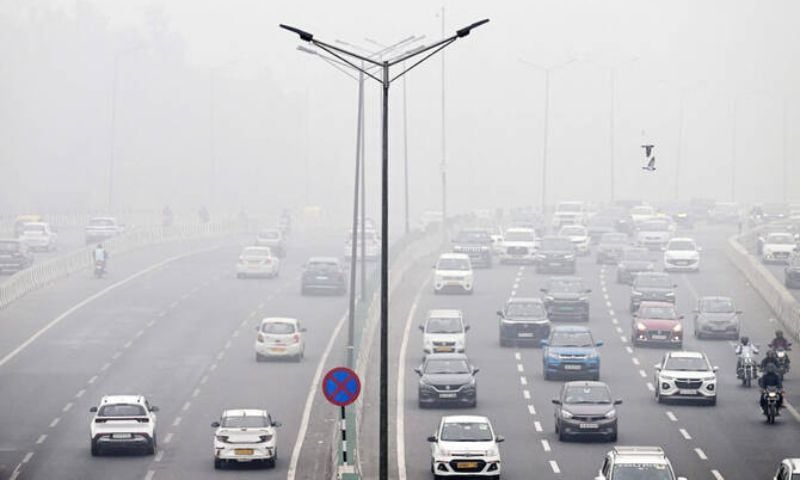
NEW DELHI: Another winter of toxic smog is looming over New Delhi, one of the world’s most polluted major cities, as India reintroduces emergency pollution-control measures while fine particulate pollution reaches around 15 times the World Health Organisation’s recommended daily limit.
The latest figures underscore a persistent public health crisis in a capital of around 30 million people, where dangerous air pollution returns each winter despite years of restrictions on traffic, construction and other sources of emissions.
The capital regularly ranks among the world’s most polluted cities, with air quality deteriorating sharply during winter as cooler air traps pollutants close to the ground.
PM2.5 levels hit 15 times WHO limit
Authorities recorded fine particulate matter (PM2.5) concentrations of 233 micrograms per cubic metre early on Thursday, approximately 15 times the World Health Organisation’s recommended daily maximum.
The government’s Commission for Air Quality Management has forecast that air quality will remain ‘poor’ in the coming days, signalling another difficult period for residents as winter approaches.
The Delhi government announced a ban on open rubbish burning on Wednesday and ordered food stalls to stop using coal and firewood. However, similar measures in previous years have failed to prevent pollution from reaching dangerous levels, particularly between November and January.
Recurring crisis raises questions
The recurring crisis has raised questions about the effectiveness of the authorities’ long-term strategy, as traffic emissions, coal-fired power plants, construction activity and the burning of agricultural stubble in neighbouring areas continue to contribute to the city’s pollution burden.
Further restrictions are scheduled to take effect on November 1, including doubled parking fees and work-from-home arrangements for government employees, in an effort to reduce traffic emissions.
Tighter construction rules will also be introduced, followed by a complete ban on construction and demolition activities from December 10 to January 20 under the winter action plan. Authorities also plan to restrict vehicular traffic and encourage greater use of public transport.
READ ALSO: Why Climate Change Poses Grave Danger to Indian Economy?
Despite recurring seasonal restrictions, the scale of the pollution problem remains alarming. Last year, PM2.5 concentrations reportedly peaked at 846 micrograms per cubic metre, around 56 times the WHO’s recommended daily maximum.
Pollution linked to 3.8 million deaths in India
The health consequences extend beyond temporary discomfort. A 2024 study published in The Lancet Planetary Health estimated that 3.8 million deaths in India between 2009 and 2019 were associated with exposure to pollution exceeding the country’s own air quality guidelines.
The United Nations Children’s Fund has also warned that polluted air increases children’s vulnerability to acute respiratory infections. The latest measures once again place the effectiveness of India’s pollution-control policies under scrutiny.
While seasonal restrictions may offer temporary relief, the repeated return of severe smog highlights the challenge of tackling the underlying sources of pollution through sustained enforcement and long-term environmental policies.