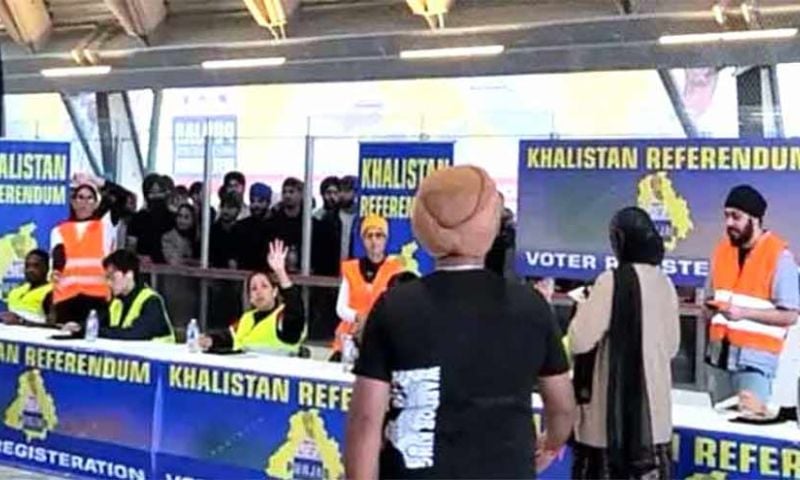
EDMONTON: Thousands of Sikhs gathered in Edmonton, Canada, on Sunday for a Khalistan referendum organised by Sikhs for Justice (SFJ), intensifying scrutiny of Indian Prime Minister Narendra Modi’s government over allegations of transnational repression and threats against Sikh separatist activists based abroad.
The voting event was held on the grounds outside Alberta’s Legislative Assembly, where participants were asked whether India’s Punjab region should become an independent state called Khalistan.
Participants arrived from Canada and the United States, with long queues forming at the polling centre. No verified final vote count is available yet; however, organisers estimated that more than 23,000 votes were cast in Edmonton’s Khalistan referendum.
Referendum timing has added to tensions surrounding the Indian government led by Prime Minister Narendra Modi, particularly over allegations of transnational repression targeting Sikh separatists in North America.
Alberta Referendum: Khalistan Vote Held at the Legislature
Sikhs for Justice held a non-binding protest “referendum” on the Alberta Legislature grounds in Edmonton today to “liberate Punjab” from Indian “occupation,” just a day before Albertans vote in a binding independence referendum.
Sikhs for Justice’s Ottawa organizer, Santokh Singh Khela, appeared on stage at the legislature grounds wearing a purple turban, this time without the metal axe he usually carries. A self-admitted member of the Canadian Sikh terrorist organization Babbar Khalsa, Khela was once sentenced to life imprisonment for a bomb plot, hatched in Montreal, targeting an Air India flight departing from JFK Airport in New York.
Meanwhile, another Sikhs for Justice organizer who took the stage in Edmonton today, “Dr.” Bakhshish Singh Sandhu, was found to have obtained his medical diploma from a fraudulent Dominican medical school that operated for only four years before U.S. authorities shut it down for massive diploma fraud.
“Kill Modi Politics” and “Long Live Khalistan” slogans echoed across the grounds, and a minute of silence was held for the Wainwright tragedy.
Follow and support @MediaBezirgan for more on-the-ground journalism.
— Mocha Bezirgan 🇨🇦 (@BezirganMocha) October 19, 2026
The referendum also came amid renewed efforts by India and Canada to rebuild relations through cooperation on trade, security, energy and technology, despite unresolved concerns over the safety of Sikh activists on Canadian soil.
FBI warning raises fresh concerns
The event was preceded by a reported warning from the US Federal Bureau of Investigation (FBI) to Gurpatwant Singh Pannun, SFJ’s general counsel and a prominent advocate of Khalistan.
According to reports, Pannun said FBI agents visited his New York residence on October 15 to warn him of an imminent threat to his life. He said the warning was connected to his planned travel to Canada for the referendum.
The FBI was reportedly investigating leads, but the identity of any person responsible for the threat had not been established publicly. The warning has renewed scrutiny of the risks faced by Sikh separatist activists overseas, particularly following a foiled assassination plot against Pannun in the United States in 2023.
READ ALSO: Thousands of Sikhs Participate in Khalistan Referendum in Canada
US prosecutors have linked that plot to former Indian intelligence official Vikash Yadav. Indian national Nikhil Gupta pleaded guilty in February 2026 to charges connected with the scheme.
These developments have intensified questions about attempts to target critics of the Modi government beyond India’s borders. However, the latest threat against Pannun has not been publicly attributed to a confirmed perpetrator.
Nijjar killing continues to cast a shadow
The killing of Sikh activist Hardeep Singh Nijjar in Surrey, British Columbia, in June 2023 remains a major source of tension between India and Canada.
The murder prompted a diplomatic crisis after the Canadian government raised allegations of a possible link between Indian agents and the killing.
The case, together with the US prosecution arising from the alleged plot against Pannun, has placed India’s conduct towards overseas critics under sustained international scrutiny.
For critics of Modi’s government, the controversy raises serious questions about the protection of political dissent and the safety of members of the Sikh diaspora.
India–Canada rapprochement faces a test
The Edmonton vote comes as New Delhi and Ottawa seek to restore cooperation after years of diplomatic strain. The competing pressures of economic engagement and security concerns present a challenge for Canadian Prime Minister Mark Carney’s government.
The latest referendum provides a platform for supporters of Khalistan to draw attention to their demand for self-determination and their allegations of persecution.
The Modi government faces continued criticism from Sikh separatist activists over its opposition to the movement. New Delhi regards Khalistan separatism as a threat to India’s sovereignty and has opposed overseas campaigns supporting the creation of a separate Sikh state.
The central issue for Canadian authorities remains ensuring public safety and investigating credible threats, regardless of the political views of those targeted.
The Edmonton referendum underscores the continuing dispute over Sikh separatism, allegations of transnational repression and the challenges facing efforts to improve India–Canada relations amid unresolved security concerns.