ISLAMABAD: Pakistan’s Deputy Prime Minister and Foreign Minister Ishaq Dar on Monday warned that the Afghan Taliban regime would eventually face consequences if it failed to take action against terrorists operating from Afghan territory.
“If the Afghan government does not take action against terrorists, one day it will have to face the consequences itself,” Dar said while addressing the International Conference on “Pakistan’s evolving terrorism landscape” in Islamabad.
Pakistan has witnessed a sharp increase in cross-border terrorist incidents, particularly in Khyber Pakhtunkhwa (KP) and Balochistan, since the Afghan Taliban returned to power in 2021.
The country recorded its highest monthly number of terrorist attacks in 12 years in September 2026, according to data compiled by the Pakistan Institute for Conflict and Security Studies (PICSS), an Islamabad-based independent think tank that monitors terrorist violence in the region.
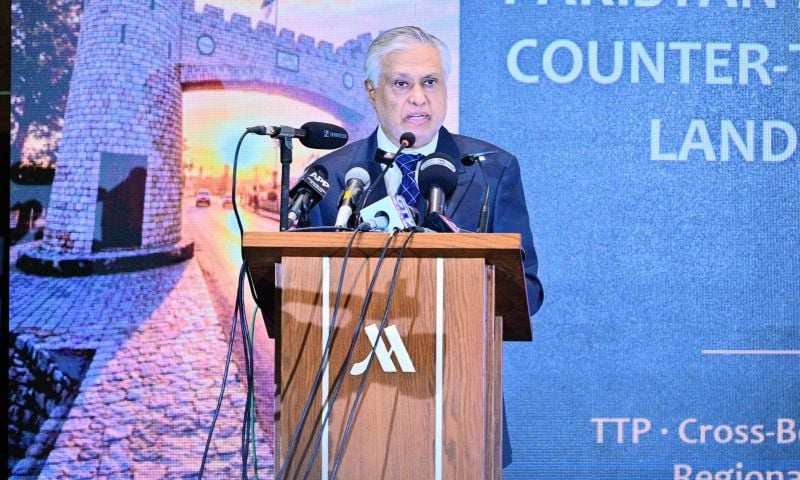
Deputy Prime Minister/Foreign Minister Senator Mohammad Ishaq Dar @MIshaqDar50 addressed the ISSI International Conference on “Pakistan’s Evolving Counterterrorism Landscape: TTP, Cross-Border Threats and Regional Security” in Islamabad today.
The DPM/FM reaffirmed Pakistan’s resolve to combat terrorism in all its forms and manifestations. He recalled Pakistan’s immense sacrifices and called for stronger international cooperation against this menace.
He called on the Afghan authorities to take concrete, verifiable and irreversible action against the TTP and other terrorist groups and ensure that Afghan soil is not used for terrorism against Pakistan or any other country.
The DPM/FM highlighted Indian sponsorship of terrorist groups operating against Pakistan, including from Afghan soil. He stressed that such support poses a serious threat to regional peace, stability and security.
He noted Pakistan’s efforts to combat terrorism through implementation of the National Action Plan, Azm-e-Istehkam and improved intelligence coordination. He also outlined Pakistan’s diplomatic efforts to advance bilateral and multilateral counterterrorism cooperation.
He lauded Prime Minister Muhammad Shehbaz Sharif’s leadership in this fight and paid tribute to the armed forces under Field Marshal Syed Asim Munir and law enforcement agencies for their courage and sacrifices.
— Ministry of Foreign Affairs – Pakistan (@ForeignOfficePk) October 12, 2026
The data showed 225 terrorist attacks nationwide in September, up from 199 in August, a 13 per cent increase. The number of attacks rose for the third consecutive month.
Addressing the conference, Ishaq Dar described terrorism as the greatest challenge facing the region and the wider world, stressing that Pakistan had made enormous sacrifices in its fight against terrorism.
Pakistan sacrificed more than 90,000 lives
“Pakistan has sacrificed more than 90,000 lives in the war against terrorism,” Dar said, urging the international community to recognise the country’s losses.
He also referred to the Jaffar Express incident and the abduction and killing of workers in Balochistan, citing them as examples of the security challenges confronting Pakistan.
Dar said counterterrorism operations were being conducted daily on the instructions of the Chief of Defence Forces and Chief of Army Staff, Field Marshal Syed Asim Munir.
He said Pakistan had repeatedly urged the Afghan authorities to prevent their territory from being used for terrorist activities against neighbouring countries.
“Pakistan has only one demand from Afghanistan: that it should not allow its territory to be used for terrorism,” he said.
According to Dar, Pakistan had held several rounds of talks with Afghan officials and sent delegations to Afghanistan to discuss counterterrorism cooperation. He also referred to a trilateral meeting involving Pakistan, China and Afghanistan held in Kabul in August last year.
However, he maintained that the Afghan Taliban regime had failed to honour its commitments to prevent terrorist groups from operating from Afghan territory.
Dar warned that the presence of the banned Tehreek-e-Taliban Pakistan (TTP) and other terrorist organisations in Afghanistan posed a serious threat to regional peace and stability. He urged the Afghan Taliban authorities to immediately stop providing terrorists with weapons and other forms of support.
Indian involvement in terrorism
Dar also accused India of supporting terrorism in Pakistan, referring to Indian national Kulbhushan Jadhav, whom Islamabad identifies as a serving Indian naval officer allegedly involved in espionage, sabotage and terrorist activities.
He said Pakistan’s security forces and law enforcement agencies had confronted terrorism with determination, but the persistent threat had adversely affected the country’s image and international standing.
ALSO READ: Afghan Taliban Harbouring Terrorists: Pakistan Reaffirms Commitment to Crush Terrorism
The deputy prime minister called for greater international cooperation to strengthen the capabilities of Pakistan’s law enforcement agencies, emphasising that acknowledging the country’s sacrifices was not enough and that practical support was also required.
Dar said terrorists crossed into Pakistan through mountainous routes to carry out attacks before returning to their safe havens across the border. He added that a significant escalation in terrorist attacks had contributed to the closure of the Pakistan-Afghanistan border.
He further stated that Pakistan subsequently allowed 1,000 containers to cross into Afghanistan following contact from the United Nations.
Describing the banned TTP as a serious threat to Pakistan’s national security, Dar said terrorist groups were receiving external support.
He cautioned that safe havens used by the terrorist organisations to launch attacks against Pakistan could eventually threaten the security of other countries in the region and beyond.