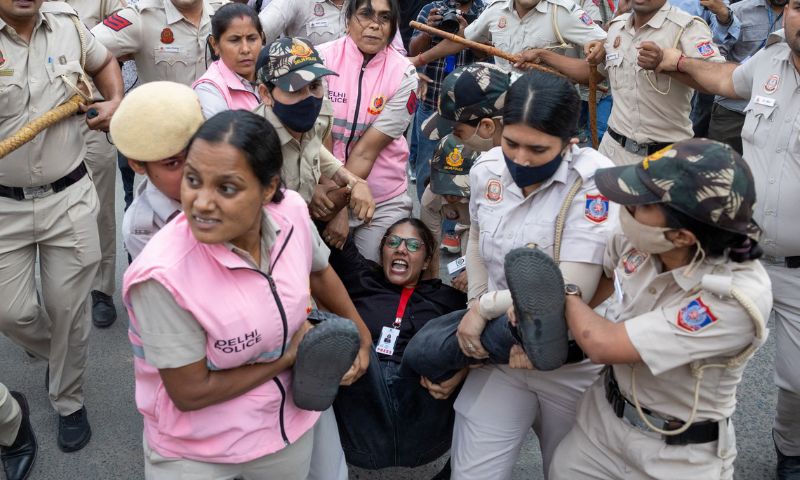
NEW DELHI: Leaders of India’s youth-led Cockroach movement accused Prime Minister Narendra Modi’s government of waging a “war with its own citizens” on Sunday and vowed to continue protesting after their release from police detention, as countrywide unrest over electoral roll revision entered a second day.
The three leaders of the Cockroach Janta Party (CJP) — Abhijit Dipke, Saurav Das and Ashutosh Ranka — were detained on Saturday during a sweeping crackdown to prevent demonstrations in the capital.
A magistrate ordered their release by Sunday morning on the condition that they would not “breach peace” for a year.
Dipke, the party’s founder, renewed his criticism of Modi in a social media post after his release.
“Modi, as PM, is an embarrassment to India. Never has this country seen a bigger coward and bully,” he wrote.
Modi, as PM, is an embarrassment to India. Never has this country seen a bigger coward and bully.
— Abhijeet Dipke (@abhijeet_dipke) October 11, 2026
The protests were organised by the CJP, student groups and civil society leaders to demand the resignation of Election Commissioner Gyanesh Kumar.
Demonstrators accuse the election chief of overseeing a revision of India’s electoral rolls that has undermined democracy and excluded millions of voters.
The dispute has intensified political tensions over an exercise that has removed 130 million names from the electoral roll.
The protesters allege the revision is intended to strengthen Modi’s ruling Bharatiya Janata Party (BJP) and disenfranchise minority groups, including Muslims, who are not traditionally part of the party’s voter base.
🔴A peaceful protest in New Delhi, India, has suddenly erupted into violent clashes between protesters and security forces. Tensions are escalating as the situation takes a dramatic turn. 🇮🇳 https://t.co/2XYf0XATUn
— International Relations (@Intl_Relations0) October 10, 2026
Heavy Security Presence as Protests Continue
Saturday’s demonstrations prompted a major security crackdown across Delhi. More than 300,000 police personnel were deployed, roads were barricaded, and internet services and public transport were shut down.
More than 7,000 people were taken into police custody, many before they reached the protest site in central Delhi.
Several senior opposition leaders were among those detained.
Protesters are being detained in Connaught Place while peacefully participating in the Tiranga Yatra alongside other women.
Its time for the trio Gyanu, Modi and Amit Shah to pack their bags https://t.co/1bvqWLcjJz
— Dr. SP (@sphavisha) October 11, 2026
Despite the restrictions, the protests marked a significant display of dissent against Modi’s government, which has been accused of suppressing political opposition and criticism during its 12 years in power.
By Sunday, central Delhi remained heavily fortified, with barricades blocking roads and large numbers of police and paramilitary personnel deployed.
Cjp protest Shivaji park politie station.
Protest Spread ho chuka hain https://t.co/1JNzOIEZ2w— CJP Gems 💎 (@GameonNewbie) October 11, 2026
Supreme Court judges had ruled that the authorities must restore internet services and reopen metro stations in the capital.
Small groups of students and CJP supporters, including people recently released from detention, again attempted to demonstrate on Sunday. Police detained several protesters.
Among them was student leader Neha Bora, who was taken into custody for a second time. Her repeated attempts to protest despite the security crackdown have made her a prominent figure in the movement.
In a video posted on social media after her detention, Bora showed a police bus fitted with metal grilles over its windows and divided into four small compartments secured with latches.
#Watch | The Office of the United Nations Human Rights Commissioner (OHCHR) on Saturday (October 10, 2026) said it was “concerned” by reports of “mass detentions” at the Delhi protests against the Chief Election Commissioner Gyanesh Kumar, a statement that the government rejected.
The UN body said that Indian authorities should ensure that the right to peaceful protest is respected and that all those detained “arbitrarily” must be immediately and unconditionally released. The government responded sharply, calling the concerns “misplaced” and calling the OHCHR’s statement “unwarranted interference in the internal affairs of India”.
Visuals: PTI, ANI
— The Hindu (@the_hindu) October 11, 2026
She said six to eight protesters had been crammed into each compartment, leaving little room to breathe. She also alleged that male protesters had faced verbal abuse and physical violence.
“So many troops, so much police presence, so much violence, abuses targeting mothers and sisters, caste-based slurs – why?” Bora said in the video. “Simply because you want to protect a thief, Gyanesh Kumar.”
Students Vow to Defy Crackdown
Surbi Yadav, a 20-year-old undergraduate student at Delhi University, said police detained her on Saturday morning and dragged her, injuring her arm and leg.
“They treated us like animals. They pushed us into a bus and took us to a sports facility that had been turned into a detention centre,” Yadav said, showing scars on her arms.
She alleged that police personnel had mistreated protesters during the journey and warned them against participating in demonstrations.
Yadav was released on Saturday evening but returned to the streets by Sunday afternoon, joining other students and holding a placard. She vowed to continue protesting until the demonstrators’ demands were met.
“We are not afraid any more. The government and the police will have to understand that,” she said.
“They can use as much force as they want to silence us, but it will be futile. In fact, it will only backfire. Every day, more people are turning against this government because of the way it is treating protesters.”
At a news conference on Sunday afternoon, CJP leaders Das and Ranka condemned the government’s handling of the demonstrations, describing the situation in Delhi as “war-like”.
They said the movement was no longer focused solely on Kumar but was also challenging Modi and Home Minister Amit Shah.
“The state is at war with its own citizens,” Das said. “An atmosphere of fear has been created in country, it’s clearly being done to save one person. We want to ask Modi and Shah, why are you trying to save Gyanesh Kumar?”